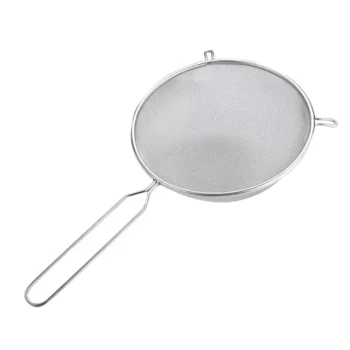
In the Internal Strain wax recovery technology, the 0.2 cm aperture metal mesh functions as a critical physical separator. It operates by pressing fragmented honeycomb against the bottom of the heating container, ensuring raw materials remain submerged while leveraging natural density differences to isolate the wax.
By keeping raw honeycomb submerged, the mesh utilizes the principle that wax is lighter than water. It allows pure molten wax to float to the surface while trapping heavier impurities below, significantly simplifying the filtration process.
The Physics of the Separation Process
Submersion and Heating
The primary mechanical function of the mesh is to actively press the fragmented honeycomb down to the bottom of the container.
This ensures the raw material is fully immersed in the water and evenly exposed to heat, preventing the honeycomb from floating prematurely before the wax has fully melted.
Exploiting Density Gradients
The system relies on the specific gravity differences between wax, water, and waste.
Because beeswax is less dense than water, the molten wax naturally seeks to rise. The mesh allows this buoyant force to work effectively by providing a permeable barrier that only passes fluids and the lightest materials.
Achieving Purity Through Physical Constraints
The Function of the 0.2 cm Aperture
The 0.2 cm openings are calibrated to act as a selective gate.
They are large enough to allow the viscous molten wax to pass through freely without creating backpressure. Simultaneously, they are small enough to block the passage of solid waste materials.
Trapping Specific Contaminants
Heavier impurities commonly found in the honeycomb are mechanically blocked by the mesh.
The mesh successfully traps waste such as propolis, larval skins, and silk cocoons beneath it. By keeping these contaminants at the bottom, the system produces a wax block at the surface with significantly higher purity.
Understanding the Trade-offs
Maintenance and Clogging
While the 0.2 cm aperture is efficient, rigid metal meshes act as a catch-all for sticky substances.
Over time, materials like propolis can adhere to the metal lattice. This requires a robust cleaning protocol between batches to ensure the apertures remain open and flow rates stay consistent.
Filtration Limits
The mesh is designed as a primary filtration step, not a sterilization filter.
While effective against bulk debris like cocoons and skins, particles smaller than 0.2 cm may still pass through with the wax. For applications requiring pharmaceutical-grade purity, a secondary, finer filtration method may still be necessary.
Optimizing Your Wax Recovery Strategy
The 0.2 cm mesh is a tool for efficiency, balancing flow rate with debris removal. Here is how to view its role based on your objectives:
- If your primary focus is Process Efficiency: Rely on the mesh to handle the bulk of separation, as it drastically simplifies the primary filtration step and reduces manual skimming.
- If your primary focus is Optical Clarity: Treat the mesh as a "roughing filter" and plan for a secondary polishing step to remove particulates smaller than 0.2 cm.
The 0.2 cm mesh transforms a complex extraction task into a streamlined, gravity-fed purification system.
Summary Table:
| Feature | Function & Impact |
|---|---|
| Aperture Size | 0.2 cm: Optimized to allow molten wax passage while blocking bulk debris |
| Mechanical Role | Submerges honeycomb to ensure even heating and prevent premature floating |
| Separation Principle | Uses density gradients; wax floats while heavier waste (propolis, cocoons) is trapped |
| Efficiency Gain | Drastically simplifies primary filtration and reduces the need for manual skimming |
| Maintenance | Requires regular cleaning of the metal lattice to prevent propolis build-up |
Scale Your Honey Processing with HONESTBEE Professional Equipment
Maximize your yields and streamline your operations with industry-leading technology. HONESTBEE provides commercial apiaries and distributors with a comprehensive range of wholesale beekeeping tools, specialized machinery, and essential consumables. From high-precision wax recovery systems to advanced honey-filling machines and hive-making hardware, our portfolio is designed to enhance your production efficiency and product purity.
Ready to elevate your beekeeping business? Contact us today to discuss our wholesale offerings and discover how our expertise can benefit your apiary or distribution network.
References
- Gleydson Luiz de Oliveira Neto, Rodrigo Diniz Silveira. Alternative wax recovery from Apis mellifera: Different combs size effect. DOI: 10.33448/rsd-v10i8.17313
This article is also based on technical information from HonestBee Knowledge Base .
Related Products
- Heavy-Duty Ergonomic Grip Galvanized Pollen Shovel
- HONESTBEE AC Powered Wire Embedder with Alligator Clips
- Nylon Honey Strainer Square Filter Cloth for Honey Filters
- Professional Beekeeper Suit with Square Folding Cotton Veil
- Conical Nylon Honey Strainer Filter Bag for Beekeeping and Honey Filtration
People Also Ask
- For what reasons do beekeepers collect bee pollen? Boost Hive Health and Unlock New Revenue Streams
- Why should commercial apiaries focus on the collection of diversified bee products? Maximize Your Hive’s Profit Potential
- How do bee pollen collection tools affect the quality of bee pollen used in functional dairy ice cream production?
- How does a specialized pollen collector facilitate the harvesting of diverse bee products? Automate High-Value Yields
- What is the impact of pollen collectors and associated equipment on the cost structure of pollen production? Maximize ROI