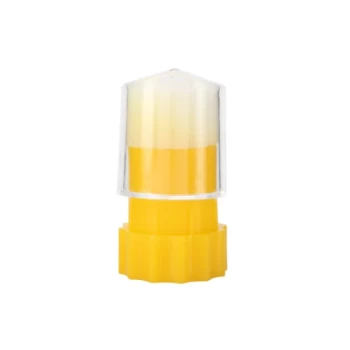
Plastic identification tags and permanent markers function as the essential logistical backbone for maintaining data integrity in large-scale honey bee hygienic behavior experiments. Plastic tags serve to assign unique numerical IDs to entire beehives, while permanent markers are utilized to label the specific wooden frames of experimental honeycombs. Together, they allow researchers to precisely track and retrieve specific biological samples across multiple colonies and sites.
In complex field experiments, the success of the study relies on absolute traceability. These tools bridge the gap between large-scale colony management and granular data collection, ensuring no confusion occurs during the critical 24-hour observation windows.
The Hierarchy of Identification
To manage the chaos of thousands of bees and multiple apiary sites, researchers must establish a two-tiered system of identification.
Tracking at the Colony Level
Plastic identification tags are used to label the exterior of the beehive boxes.
By assigning a unique number to every hive, researchers can manage experiments across widespread geographic locations. This ensures that data collected from one site is never mistakenly attributed to a colony at a different location.
Tracking at the Unit Level
Permanent markers provide the necessary granularity inside the hive.
Researchers write directly on the wooden frames of the honeycombs. This designates exactly which frame contains the experimental data, distinguishing it from the unrelated resource frames surrounding it.
Ensuring Data Integrity
The primary goal of using these physical identifiers is to eliminate ambiguity during the data collection process.
Preventing Cross-Contamination of Data
In a large-scale screening, researchers may be monitoring dozens of colonies simultaneously.
Without distinct physical labels on both the hive and the frame, it becomes nearly impossible to associate a specific behavioral result with the correct colony history. The tags and marker labels create a verifiable chain of custody for every data point.
Facilitating Rapid Retrieval
Hygienic behavior screenings typically involve a specific 24-hour observation period.
Researchers must return to the exact same frame one day after the initial setup to measure results. The visual cues provided by the marker labels ensure the correct frame is located immediately, minimizing disturbance to the colony.
Understanding the Trade-offs
While these low-tech solutions are effective, they are not without limitations that researchers must manage.
Durability vs. Environment
The primary reference highlights the use of these tools for a 24-hour window, but environmental factors can degrade markings over longer periods.
Permanent marker ink on wood can fade due to hive humidity or propolis accumulation by the bees. Similarly, plastic tags can become brittle or detach if not secured properly, potentially severing the link between the physical hive and its data log.
Scope of Tracking
It is important to note the distinction in what is being tracked.
Plastic tags and markers track the infrastructure (hives and frames), not the biological agents (the bees themselves). While they secure the "where" of the experiment, they do not track the "who"—that requires different methods, such as individual bee tagging, which is distinct from the frame and hive labeling described here.
Making the Right Choice for Your Goal
To apply this to your own experimental design, consider which level of tracking is most critical for your current phase.
- If your primary focus is Site Management: Prioritize high-contrast plastic identification tags to differentiate colonies across multiple locations instantly.
- If your primary focus is Data Accuracy: Ensure you use high-quality permanent markers on frames to guarantee the experimental unit is retrievable after the 24-hour cycle.
Success in hygienic screening is less about the complexity of the tools and more about the rigor of their application.
Summary Table:
| Identification Tool | Primary Target | Main Function | Key Benefit |
|---|---|---|---|
| Plastic ID Tags | Beehive Exterior (Colony) | Unique colony numbering | Prevents cross-site data confusion |
| Permanent Markers | Wooden Frames (Unit) | Precise sample labeling | Facilitates rapid retrieval in 24h windows |
Scale Your Apiary Operations with HONESTBEE
Maintaining precision in large-scale beekeeping requires more than just markers and tags—it requires professional-grade infrastructure. HONESTBEE specializes in supporting commercial apiaries and distributors with a comprehensive wholesale selection of beekeeping tools, hive-making machinery, and essential consumables.
Whether you need specialized honey-filling equipment or reliable hive hardware to streamline your research and production, we provide the industrial-strength solutions your business demands.
Ready to elevate your apiary efficiency?
Contact HONESTBEE Today to discuss our wholesale offerings and how we can support your growth.
References
- Tapia-González José, T.D.K.H. Geydan Rivera. Influencias climáticas, regionales y cantidad de cría en el comportamiento higiénico de Apis mellifera. DOI: 10.21929/abavet2021.20
This article is also based on technical information from HonestBee Knowledge Base .
Related Products
- Durable Plastic Hive Number Set for Beekeeping
- Queen Bee Catcher Plastic Bee Marker Bottle with Piston Marking Tube
- Plastic Long Marker Device for Catching and Marking Bees Queen Bee Marking Tube and Cage
- Professional Engraved Round Hive Number Tags for Beekeeping
- Queen Bee Marking Tube Cage Bottle Catcher Holder with Clear Plastic Plunger Marker
People Also Ask
- How do plastic hives offer protection against wax moths? Secure Your Apiary with Durable Pest Resistance
- Why might bees reject a plastic hive? Key Factors in Colony Acceptance and Material Management
- What are the advantages of numbered plastic tags? Achieve Precise Individual Honeybee Identification
- What is the role of record-keeping tools like manuals and hive markers in professional queen bee breeding? Master Data.
- What is a major durability advantage of plastic hives? Immune to Rot for 10+ Year Lifespan