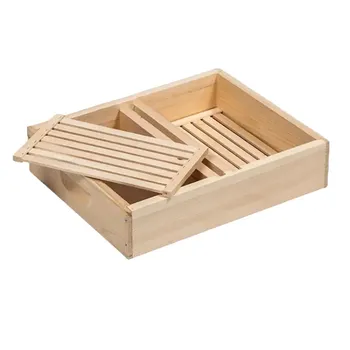
Delaying the transition from nurse bees to foraging bees can increase royal jelly output because it keeps more worker bees in the physiological state best suited to feeding larvae and secreting royal jelly. High nutrient storage, supported by proteins such as hex71 (hex70a), helps maintain this nursing role during the early adult stage, while hive feeding equipment provides continuous access to the nutrition required for sustained gland activity.
The core benefit is workforce allocation: keeping more well-nourished, physiologically active nurse bees in the colony increases the labor available for royal jelly secretion. Properly installed feeders and feeding management equipment help prevent nutritional interruptions when natural nectar or pollen supplies are inadequate.
Why Nurse Bees Matter for Royal Jelly Production
Nurse Bees Perform the Specialized Work
Young worker bees are responsible for producing and distributing royal jelly to developing larvae and queen cells. Their hypopharyngeal glands are the primary organs involved in royal jelly secretion.
These glands are especially active when nurse bees are approximately 6 to 12 days old. A colony with a strong population in this age range has more workers available for sustained royal jelly production.
Foraging Represents a Physiological Shift
As worker bees mature, they generally transition from nursing duties to outside foraging. This changes how the colony's labor is distributed and reduces the number of workers directly engaged in larval feeding and royal jelly secretion.
Delaying this transition preserves a larger pool of nurse bees inside the hive. For commercial producers, that can improve the colony's capacity to support grafted larvae and fill queen cells consistently.
Nutrient Storage Helps Maintain the Nursing Phase
Storage proteins such as hex71 (hex70a) support nutrient uptake and metabolic storage in adult worker bees during roughly the first 15 days of life. Maintaining adequate nutrient reserves helps workers remain functionally suited to nursing activity for longer.
This is not simply a matter of feeding more bees. The objective is to maintain the nutritional conditions that support hypopharyngeal gland activity and a stable nurse-bee population.
How Hive Feeding Equipment Supports the Process
It Provides Continuous Access to Feed
Colony feeders and other in-hive feeding equipment can supply artificial syrup, water, or protein feed when natural sources are limited. This reduces the risk that nurse bees experience a nutritional interruption during a critical production cycle.
Consistent access is particularly important for colonies supporting grafted larvae, where a shortage of food can reduce secretion activity or lead to larval abandonment.
It Helps Stabilize Production During Nectar Gaps
Weather, seasonal changes, and local forage conditions can create periods when nectar or other nutrients are scarce. Supplementary feeding equipment gives beekeepers a controllable way to support colonies during these gaps.
The result is greater operational consistency for apiaries seeking stable royal jelly production beyond a narrow natural forage window.
It Supports Efficient Hive Management
Feeding equipment installed inside the hive can be integrated with broader production practices, including queen-rearing frames, grafting tools, and harvest scheduling. This creates a more coordinated system for maintaining the nurse-bee population and supporting queen-cell production.
For distributors and commercial beekeepers, a complete equipment portfolio is valuable because feeding, grafting, colony management, and harvesting must work together rather than as isolated purchases.
Aligning Feeding With the Production Window
Maintain the 6- to 12-Day Nurse-Bee Population
The most productive approach is to maintain a strong population of nurse bees within the age range associated with peak hypopharyngeal gland activity. Feeding is one part of this process, alongside colony strength, brood management, and appropriate queen-rearing equipment.
Monitoring colony condition helps determine when additional feed is needed and whether the hive can support another grafting or harvest cycle.
Coordinate Grafting and Harvesting
Grafting and harvesting schedules should be aligned with the period when nurse bees are most capable of royal jelly secretion. A well-timed production cycle allows the colony to direct available nursing labor toward the intended queen cells.
Feeding equipment helps preserve this schedule when natural food availability would otherwise create an interruption.
Use Equipment That Matches Commercial Workflows
For B2B buyers, the useful question is not only whether a feeder functions, but whether it fits the apiary's operating model. Capacity, ease of installation, refill efficiency, compatibility with hive formats, and delivery reliability all affect the equipment's practical value.
A supplier offering feeders alongside frames, grafting tools, and related hive equipment can simplify procurement and reduce delays during time-sensitive production cycles.
Understanding the Trade-offs
Feeding Does Not Replace Colony Management
Supplementary feed supports nutrition, but it cannot compensate for weak colonies, poor brood conditions, inadequate nurse-bee populations, or poorly timed grafting. Royal jelly production depends on coordinated biological and operational conditions.
Feeding should therefore be treated as a management tool within a broader production program.
Feed Must Match the Colony's Needs
Artificial syrup, water, and protein feed serve different purposes and should be selected according to colony conditions and the production objective. Excessive or poorly managed feeding can create handling, storage, or hive-management problems.
Beekeepers should use equipment that allows controlled delivery and regular inspection rather than relying on an unmonitored supply.
Equipment Reliability Affects Production Continuity
A feeder that leaks, is difficult to refill, or cannot be installed securely may introduce more operational problems than it solves. Equipment failures are especially costly when they occur during a grafting or harvest window.
For wholesalers and resellers, product quality, technical support, replacement availability, and rapid fulfillment are therefore part of the production value, not secondary purchasing details.
Making the Right Choice for Your Goal
Select feeding and hive-management equipment according to the production constraint you need to address.
- If your primary focus is maximizing royal jelly output: Prioritize equipment and management practices that maintain a strong, well-nourished population of 6- to 12-day-old nurse bees.
- If your primary focus is year-round production: Use controllable supplementary feeding equipment to bridge periods of scarce natural nectar and reduce interruptions to nurse-bee gland activity.
- If your primary focus is efficient commercial operations: Source feeders, queen-rearing frames, grafting tools, and related hive equipment through a supplier that can provide one-stop purchasing, responsive service, and fast order fulfillment.
- If your primary focus is dependable resale supply: Evaluate feeder durability, hive compatibility, technical expertise, replacement support, and delivery speed alongside the initial product price.
By maintaining nutrition and coordinating equipment with the nurse-bee production window, beekeepers can keep more colony labor directed toward royal jelly secretion when it matters most.
Summary Table:
| Key Factor | Benefit for Royal Jelly Production | How Feeding Equipment Helps |
|---|---|---|
| Nurse bee age (6-12 days) | Peak hypopharyngeal gland activity | Ensures continuous nutrition to sustain gland function |
| Nutrient storage (hex71) | Maintains nursing physiology | Provides supplemental feed to support nutrient reserves |
| Workforce allocation | More nurses for larval feeding | Prevents interruptions during nectar gaps |
| Production window alignment | Better grafting and harvest timing | Enables consistent production scheduling |
Looking to optimize royal jelly production with reliable feeding solutions? HONESTBEE offers a full range of beekeeping equipment, from feeders to queen-rearing tools, designed for commercial apiaries and distributors. Benefit from our rapid response, dedicated service, and ultra-fast delivery. Contact us today to discuss your needs and boost your apiary's efficiency!
Related Products
- HONESTBEE Professional Hive Top Bee Feeder Feeding Solution
- Professional Hive Top Bee Feeder for Beekeeping
- Premium Wood Hive Top Feeder with Floating Rafts for Langstroth Hives
- HONESTBEE Entrance Bee Feeder Efficient Hive Front Liquid Feeding Solution for Beekeeping
- Professional Hive Front Entrance Bee Feeder
People Also Ask
- How does a bee hive top feeder work? A Guide to Efficient, Protected Feeding
- Do I need an inner cover with a hive top feeder? Optimize Your Hive Setup for Healthy Bees
- What is a hive top feeder? A Guide to Efficient, Low-Stress Beekeeping
- What is a hive top feeder, and how does it work? A Complete Guide to Efficient In-Hive Feeding
- What are the characteristics, advantages, and disadvantages of hive top feeders? Optimize Your High-Volume Feeding