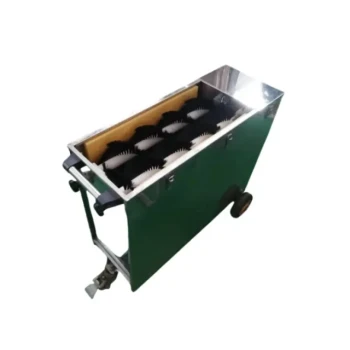
Resistive radiation heating is the preferred choice for industrial-scale bee pollen vacuum drying because it offers superior technical maturity, lower capital investment, and easier scalability compared to microwave systems. In high-vacuum environments where air is too thin for convection, resistive elements provide a stable, cost-effective radiation source that ensures uniform drying for bulk quantities without the complexity of microwave field interference.
While microwave heating works for small-scale or continuous niche operations, resistive radiation is the definitive standard for industrial expansion. It combines economic efficiency with technical stability, allowing processors to scale capacity while maintaining the delicate nutritional integrity of bee pollen.
The Physics of Heat Transfer in a Vacuum
Overcoming the Convection Barrier
In a high-vacuum environment, the air is extremely thin, making traditional convection heat transfer almost entirely ineffective. This necessitates a shift toward thermal radiation to move energy into the product.
The Efficiency of Resistance-Heated Trays
Utilizing resistance-heated trays to transfer energy directly to the bee pollen via thermal radiation is the most efficient solution for deep heat penetration. This method ensures that the core of the pollen reaches the necessary temperature for moisture release without relying on air as a medium.
Lowering the Boiling Point
Vacuum drying operates in a low-pressure environment, which reduces the partial pressure of water vapor on the surface of the material. This allows for rapid evaporation at significantly lower temperatures, preventing the thermal degradation of the pollen.
Economic and Operational Scalability
Technical Maturity and Cost-Competitiveness
Resistive heating technology is highly mature and significantly more cost-competitive than high-frequency or microwave alternatives. For B2B resellers and distributors, this translates to lower equipment overhead and more competitive final product pricing.
Ease of Implementation for Bulk Loads
Scaling to industrial-level capacity is simpler with resistive systems because the technology is easier to implement for large-capacity production. Microwave systems often face "hot spot" issues and shielding complexities as the chamber size increases.
Stability and Reliability
Resistive radiation provides a stable and predictable heat source required for drying bulk quantities. This reliability is essential for maintaining efficient order fulfillment and ensuring a consistent supply for global distributors.
Preserving the Commercial Value of Bee Pollen
Protection of Sensitive Nutrients
Vacuum drying effectively limits the destruction of nutrients by ultraviolet rays and prevents the oxidation of active compounds. This process is critical for maintaining high levels of Vitamin C and preserving the natural color and flavor profile.
Retention of Biological Activity
The low-temperature vacuum environment allows for moisture removal through sublimation or low-temp evaporation, protecting heat-sensitive lipids, phenolic compounds, and proteins. This ensures the pollen retains its status as a premium, biologically active nutritional supplement.
Maintaining Structural Uniformity
By avoiding the intense, sometimes uneven bursts of energy associated with microwaves, resistive radiation promotes structural uniformity in the finished product. This consistency is a key quality indicator for high-end wholesale markets.
Understanding the Trade-offs
Microwave Limitations at Scale
While microwave heating offers rapid energy transfer, it often requires complex maintenance and specialized engineering to ensure uniform heating in large batches. These technical hurdles can lead to increased downtime and inconsistent product quality at the industrial level.
The Speed-Complexity Balance
Microwaves may be faster for small batches, but the economic trade-off becomes unfavorable as volume increases. The maturity of resistive heating reduces the risk of equipment failure, ensuring that large-scale operations meet their rapid response and delivery targets.
Making the Right Choice for Your Goal
- If your primary focus is industrial-scale volume: Resistive radiation heating is the industry standard for its reliability, ease of scaling, and proven cost-efficiency.
- If your primary focus is preserving premium biological activity: Vacuum-based resistive heating ensures the lowest possible thermal stress, protecting the proteins and antioxidants that drive market value.
- If your primary focus is minimizing capital risk: Resistive technology offers the most mature and economically stable path to high-volume production with lower maintenance overhead.
By leveraging expert-level resistive heating technology within a vacuum framework, processors can deliver a high-quality, nutritionally dense product that meets the rigorous demands of the global B2B market.
Summary Table:
| Feature | Resistive Radiation Heating | Microwave Heating |
|---|---|---|
| Capital Investment | Lower; highly cost-competitive | Higher; complex engineering required |
| Scalability | Easy for large-capacity industrial use | Difficult due to field interference & shielding |
| Technical Maturity | High; industry standard for vacuum drying | Moderate; better for small-scale niche use |
| Heating Uniformity | Stable & predictable for bulk loads | Risk of "hot spots" in large batches |
| Nutrient Preservation | Excellent; low-temp vacuum protection | High; but requires precise, complex control |
| Maintenance | Simple; lower operational overhead | Specialized & complex maintenance needed |
Scale Your Production with HONESTBEE’s Industrial Solutions
Maximize your profit margins and operational reliability with HONESTBEE, your premium one-stop sourcing partner for professional beekeeping. We understand the needs of distributors and wholesalers, providing a full-spectrum portfolio from high-efficiency pollen processing machinery to hive-making equipment and essential consumables.
Why Partner with Us?
- Expert Sourcing: Access premium industrial hardware and honey-themed cultural merchandise.
- Reliable Fulfillment: Benefit from ultra-fast delivery and rapid response times.
- Industry Expertise: Our deep technical knowledge ensures you get equipment optimized for nutrient preservation and scalability.
Ready to upgrade your wholesale offering? Contact us today to explore our full catalog and OEM/ODM support!
References
- Bui Quoc Khoa, Patricia Tam. Simulation Optimization of Vacuum Drying Process for Bee Pollen Using R Software. DOI: 10.54660/.ijmrge.2024.5.6.978-1013
This article is also based on technical information from HonestBee Knowledge Base .
Related Products
- Portable Electric Bee Vacuum with Lithium Battery and 20L Collection Bucket
- Removable Plastic Pollen Trap With Ventilated Tray for Bees Pollen Collector
- Plastic Bee Pollen Trap Strips Comb Catcher Collector
- High Performance Cordless Electric Bee Shaker for Beekeeping
- 30 cm Plastic Entrance Hole Bee Pollen Trap and Collector
People Also Ask
- What are the advantages of using portable bee vacuums for sampling honey bees? Optimize Nosema Detection Efficiency
- Who is qualified to use a bee vacuum? Essential Safety and Experience Requirements for Effective Bee Relocation
- What potential problems can occur when using a bee vacuum? Prevent Colony Mortality and Ensure Safe Bee Removal
- What are the benefits of using a bee vacuum? Safely Remove & Preserve Honey Bee Colonies
- Why do people use bee vacuums? A Humane Solution for Live Bee Removal