The Architect and the Alchemist
Producing extracted honey is an act of harvesting. The beekeeper collects a raw material—nectar concentrated by bees—and processes it.
Producing comb honey is an act of architecture. The beekeeper creates a system that guides the bees to build the final, perfect, consumer-ready product themselves.
This is a fundamental psychological shift. You are no longer just a harvester; you are the manager of a microscopic construction crew, and your goal is an untouched, pristine artifact. Success is not measured in volume alone, but in perfection.
Engineering the Ideal Conditions
Bees don't build beautiful, complete honeycomb on demand. They do it when specific environmental and internal hive conditions align perfectly. The commercial beekeeper’s job is to engineer this alignment.
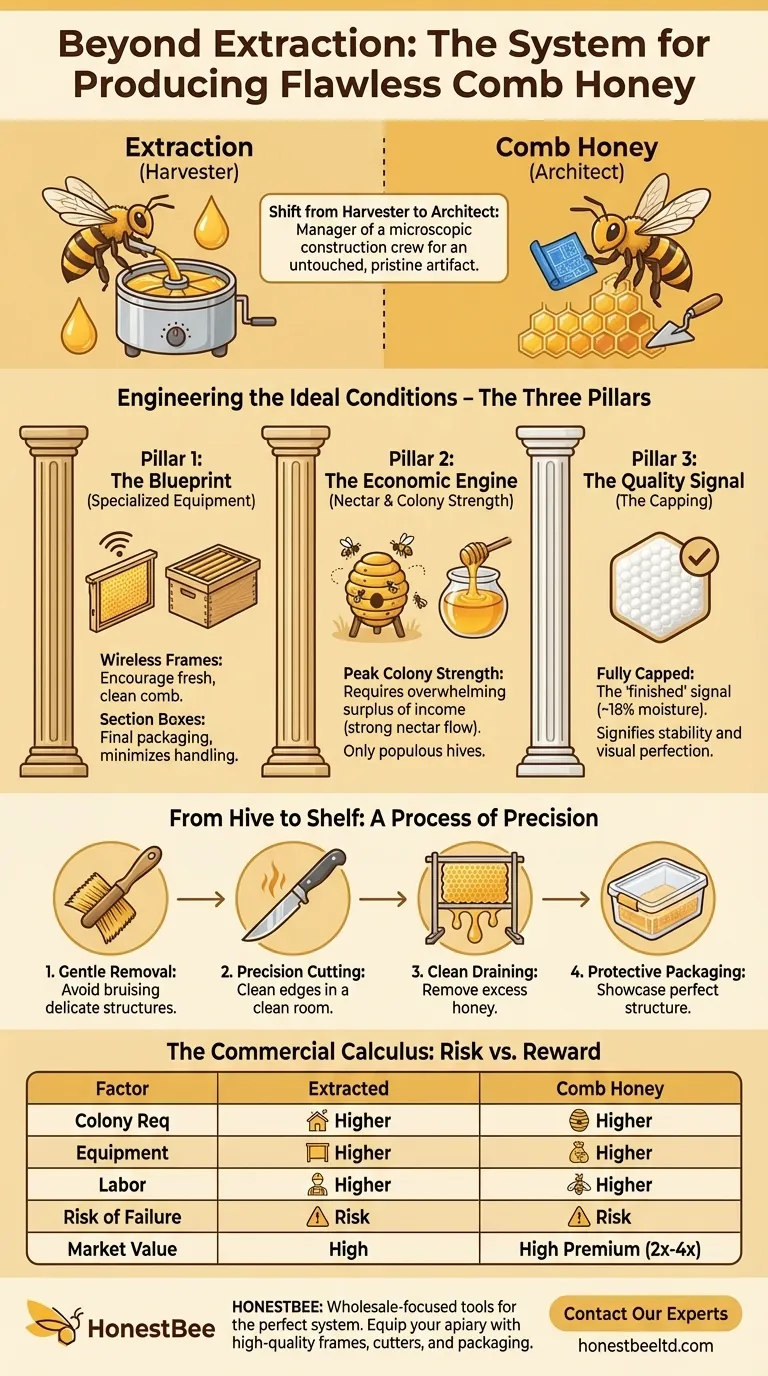
This system rests on three pillars.
Pillar 1: The Blueprint (Specialized Equipment)
Bees will not build a marketable product without the right framework. Standard frames with support wires are an immediate obstacle, as they make the final comb impossible to cut cleanly.
The entire process must be built on a foundation designed for the end result.
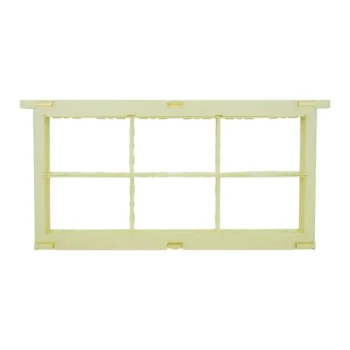
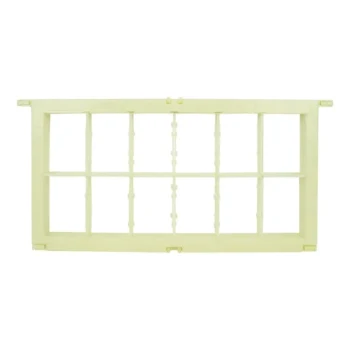
- Wireless Frames: These use a thin wax starter strip or no foundation at all, encouraging bees to draw fresh, clean comb without embedded wires.
- Section Boxes: These are small wooden or plastic cassettes that bees fill directly. The box itself becomes part of the final packaging, minimizing post-harvest handling.
The quality of your blueprint dictates the quality of the final structure. For commercial apiaries, sourcing reliable, uniform equipment like foundationless frames and perfectly sized packaging is the first, non-negotiable step.
Pillar 2: The Economic Engine (Nectar & Colony Strength)
A bee colony operates on a ruthless economic logic. It will not invest the immense energy required to produce new beeswax unless it is experiencing an overwhelming surplus of income—a strong nectar flow.
Weak or average-sized colonies will not build comb honey. They are focused on survival, not expansion.
Only the most populous, booming hives—ones literally running out of space—have the workforce and the resource incentive to draw out and fill new comb with speed and precision. Your role is to ensure your strongest colonies are given the comb honey supers at the precise peak of a nectar flow. It's a calculated bet on their strength and nature's abundance.
Pillar 3: The Quality Signal (The Capping)
The single most critical moment in comb honey production is knowing when the work is done. The bees provide a clear, unmistakable signal.
Once honey in a cell is cured to the correct moisture content (~18%), bees seal it with a fresh, white layer of beeswax. This is the capping.
A "finished" frame for comb honey must be fully capped. This is the bees' quality assurance stamp. It signifies two things:
- The honey is stable and will not ferment.
- The product is visually perfect and complete.
Harvesting too early results in an weeping, unstable product. Waiting too long allows the pristine white cappings to become travel-stained and darkened. The window is precise.
From Hive to Shelf: A Process of Precision
Harvesting comb honey is less like farming and more like moving a finished sculpture from the studio to the gallery. Every step is fraught with the risk of damaging a delicate, high-value product.
- Removal: The frames must be cleared of bees gently, using a bee brush or a low-pressure blower. Every bump or jolt risks bruising the delicate wax structure.
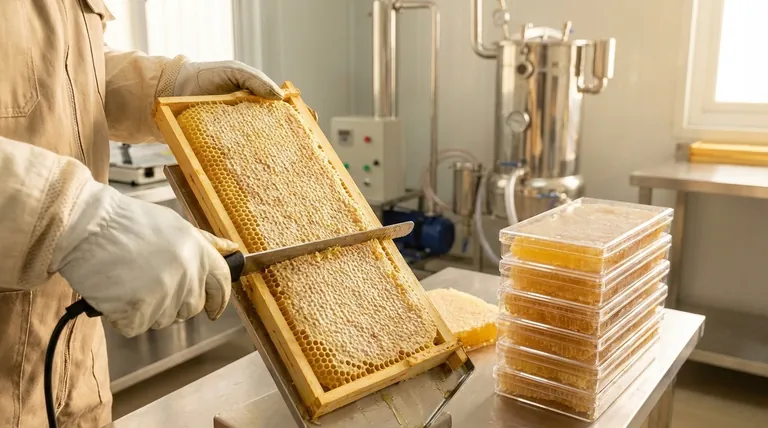
- Cutting: In a clean room, the entire sheet of comb is sliced from the frame. It is then cut into uniform, marketable squares with a specialized heated knife or comb cutter for clean edges.
- Draining: The cut sections are placed on a rack to allow excess honey from the opened cells to drain away. This is crucial for clean packaging.
- Packaging: Each section is carefully placed into a clear, rigid container that showcases its perfect hexagonal structure while protecting it from damage.
The Commercial Calculus: Risk vs. Reward
Why undertake such a demanding process? Because comb honey commands a significant market premium. But this reward comes with calculated risks that every commercial operator must weigh.
| Factor | Extracted Honey Production | Comb Honey Production |
|---|---|---|
| Colony Requirement | Viable with moderately strong hives | Requires exceptionally strong, healthy hives |
| Equipment | Reusable, durable wired frames | Specialized, often single-use or delicate frames/sections |
| Labor Intensity | Lower; focused on bulk extraction | Higher; requires delicate, precise handling |
| Risk of Failure | Low; imperfect frames can be extracted | High; partially filled or uneven combs are unsalable as premium |
| Market Value | Commodity Price | High Premium (2x-4x) |
The success of a comb honey operation hinges on managing these risks through meticulous planning, precise timing, and—above all—the right equipment.
Building a system capable of producing flawless comb honey is the art of presenting honey exactly as the bees made it. It's a testament to the beekeeper's skill as both a biologist and an engineer. At HONESTBEE, we provide the wholesale-focused tools and supplies that form the foundation of that system.
To equip your commercial apiary or distribution business with the high-quality frames, cutters, and packaging needed to succeed, Contact Our Experts.
Visual Guide
Related Products
- Professional 500g Sectional Comb Honey Frame System for Beekeeping
- Professional Sectional Comb Honey Frame with 250g Cassette System for Beekeeping
- Electric Honey Press Machine for Squeezing Honey Comb Press Equipment
- Heart-Shaped Comb Honey Frame and Honeycomb Cassette
- Stainless Steel Honey Bee Smoker Hive and Honeycomb Smoker for Beekeeping
Related Articles
- The Architect's Dilemma: Choosing a Beekeeping Frame System for Longevity and Yield
- How Stored Honey Frames Accelerate Colony Recovery: A Beekeeper’s Guide
- How Honey Frames Naturally Manage Queen Bees Without Compromising Colony Health
- Why Your Cut Comb Honey Quality Is Inconsistent—And the Simple Fix You're Overlooking
- How to Expand Your Beehives in Spring Without Triggering Swarms