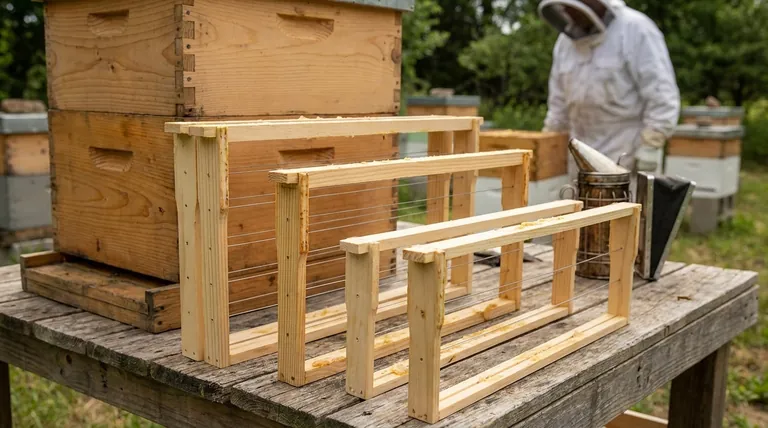
The Decision Before the Hive
Every beekeeper, whether managing a dozen hives or a thousand, eventually stands before their apiary and faces a decision that has little to do with bees and everything to do with physics, philosophy, and finance.
The question is simple: which size frame should I use?
The answer, however, defines the physical reality of their work for years to come. A beehive frame is not just a piece of wood and wire; it is the fundamental interface between the colony and its keeper. It dictates how the bees organize their society and how the beekeeper manages their own body and business.
Three Philosophies of Hive Management
The choice between deep, medium, and shallow frames is less about the equipment itself and more about the management philosophy you adopt. Each size represents a different set of priorities and a different bet on what matters most.
The Purist's Approach: Maximizing the Brood Nest
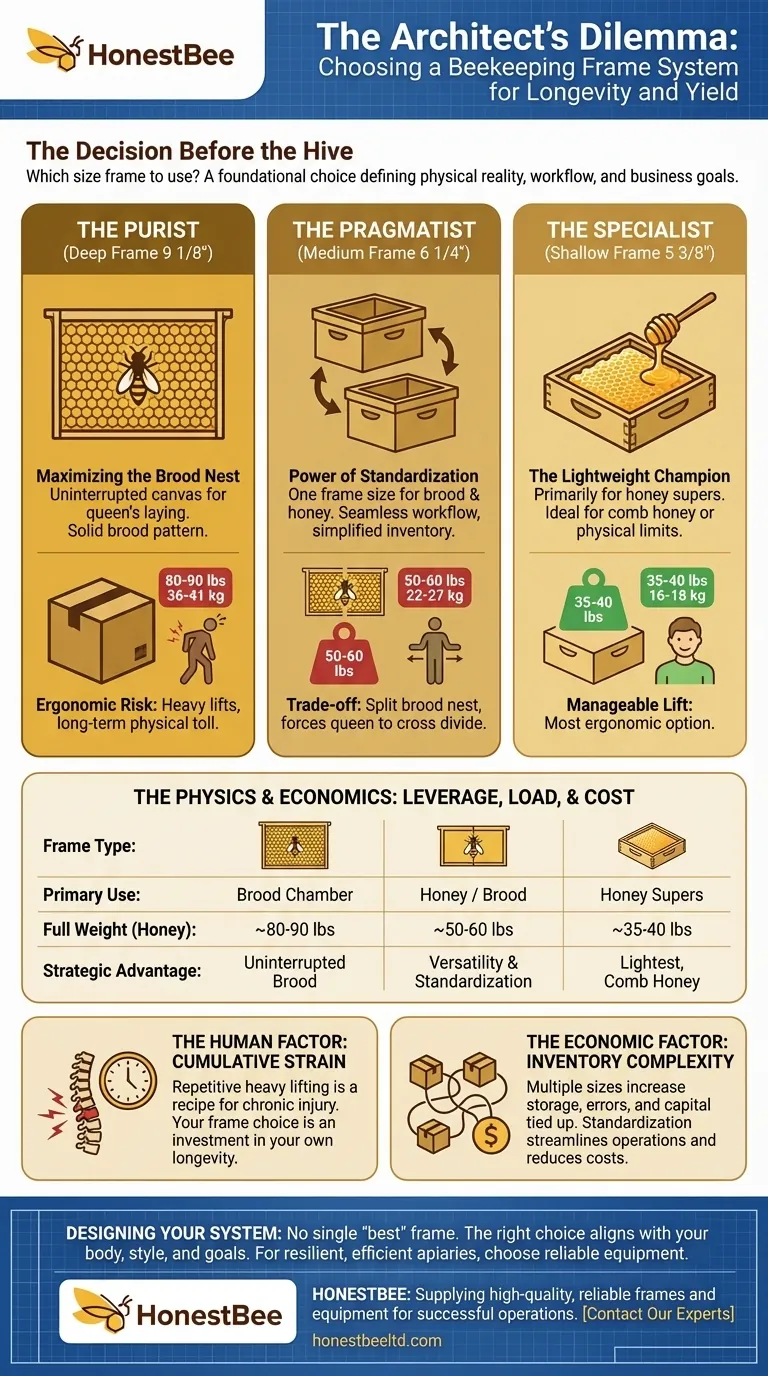
The deep frame (9 1/8") is the traditionalist's choice for the brood chamber. The logic is compelling: it offers the queen a vast, uninterrupted canvas to lay her eggs. A solid, contiguous brood pattern is the engine of a powerful colony.
This approach prioritizes what seems most natural for the bees.
The cost, however, is paid by the beekeeper. A deep box, when filled with honey instead of brood, can weigh over 80 pounds (36 kg). For a commercial operator, lifting hundreds of these is not just a hard day's work; it's a long-term ergonomic risk.
The Pragmatist's System: The Power of Standardization
Enter the medium frame (6 1/4"). Some of the most efficient commercial apiaries are built on a radical idea: one frame size to rule them all.
Using medium frames for both brood and honey supers creates a perfectly interchangeable system. Any box fits anywhere. There's no thinking, no sorting, just seamless workflow. It simplifies inventory, assembly, and on-the-fly hive manipulations.
The trade-off is a split brood nest, requiring two medium boxes to approximate the space of one deep. While many thriving operations prove this is not a biological handicap, it forces the queen to cross a wooden divide in her laying pattern. It is a bet on human efficiency over perceived colony perfection.
The Specialist's Edge: The Lightweight Champion
The shallow frame (5 3/8") is the specialist's tool. It is used almost exclusively for honey supers, with one goal in mind: weight reduction.
A shallow super full of honey is the most manageable lift. This makes it the only viable option for beekeepers with physical limitations. It's also the preferred frame for producing comb honey, where the entire pristine comb is the product. This choice is driven by a specific physical constraint or a high-value market opportunity.
The Physics of the Choice: A Matter of Leverage and Load
Your decision is ultimately governed by the unyielding laws of physics and economics. It’s a calculation of weight, repetition, and cost.
| Frame Type | Primary Use | Full Weight (Honey) | Strategic Advantage |
|---|---|---|---|
| Deep | Brood Chamber | ~80-90 lbs / 36-41 kg | Uninterrupted brood nest for the queen. |
| Medium | Honey / Brood | ~50-60 lbs / 22-27 kg | The ultimate in versatility and equipment standardization. |
| Shallow | Honey Supers | ~35-40 lbs / 16-18 kg | The lightest option; ideal for comb honey or lift limits. |
The Human Factor: Cumulative Strain
A single 80-pound lift is manageable. Lifting that same weight 200 times in an afternoon, week after week, season after season, is a recipe for chronic injury. The true cost of a heavy system isn't measured in dollars, but in the physical toll on the beekeeper. Your chosen frame size becomes a direct investment—or liability—in your own longevity in the business.
The Economic Factor: Interchangeability and Inventory
For a commercial apiary, complexity is expensive. Managing inventory for three different box sizes and three different frame sizes means more storage space, more potential for error, and more capital tied up in woodware. A standardized system, like an all-medium operation, streamlines purchasing and operations, reducing cognitive load and hidden costs. This is where the quality and consistency of your supplier become paramount.
Designing Your System, Not Just Choosing a Box
There is no single "best" frame. The right choice is the one that creates a coherent system aligned with your body, your management style, and your business goals.
For large-scale commercial apiaries and distributors, this decision multiplies across thousands of hives. The need for durable, precisely manufactured frames—whether deep, medium, or shallow—is non-negotiable. Building a resilient and efficient apiary starts with a solid foundation, and choosing the right equipment partner is as crucial as choosing the right frame.
At HONESTBEE, we supply the high-quality, reliable frames and equipment that successful beekeeping operations are built upon, allowing you to execute your chosen strategy with confidence. Contact Our Experts
Visual Guide
Related Products
- Professional 500g Sectional Comb Honey Frame System for Beekeeping
- Professional Sectional Comb Honey Frame with 250g Cassette System for Beekeeping
- Professional Wooden Requeening Frame for Beekeeping
- JZBZ Langstroth Queen Rearing Frame for Beekeeping
- Wooden Bee Hive Frames for Beekeeping and Wholesale
Related Articles
- How Stored Honey Frames Accelerate Colony Recovery: A Beekeeper’s Guide
- How Honey Frames Naturally Manage Queen Bees Without Compromising Colony Health
- Why Your Cut Comb Honey Quality Is Inconsistent—And the Simple Fix You're Overlooking
- Beyond Extraction: The System for Producing Flawless Comb Honey
- How to Expand Your Beehives in Spring Without Triggering Swarms