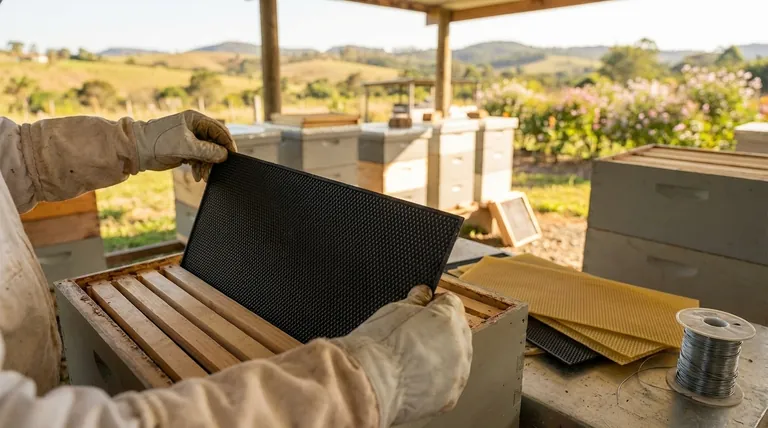
Have you ever invested in a pallet of "high-efficiency" plastic foundation, only to find your bees giving it the cold shoulder? You assemble hundreds of new frames, expecting a booming season, but weeks later, the foundation remains untouched—a pristine, plastic monument to your frustration. Or worse, you discover warped, collapsed frames because you handled them the way you've handled frames for years. For a commercial operation, this isn't just an annoyance; it's a direct hit to your bottom line.
The Vicious Cycle of Wasted Effort
When faced with poor bee acceptance or installation failures, the reaction is predictable. We fall back on what we know from a lifetime of working with traditional wax foundation.
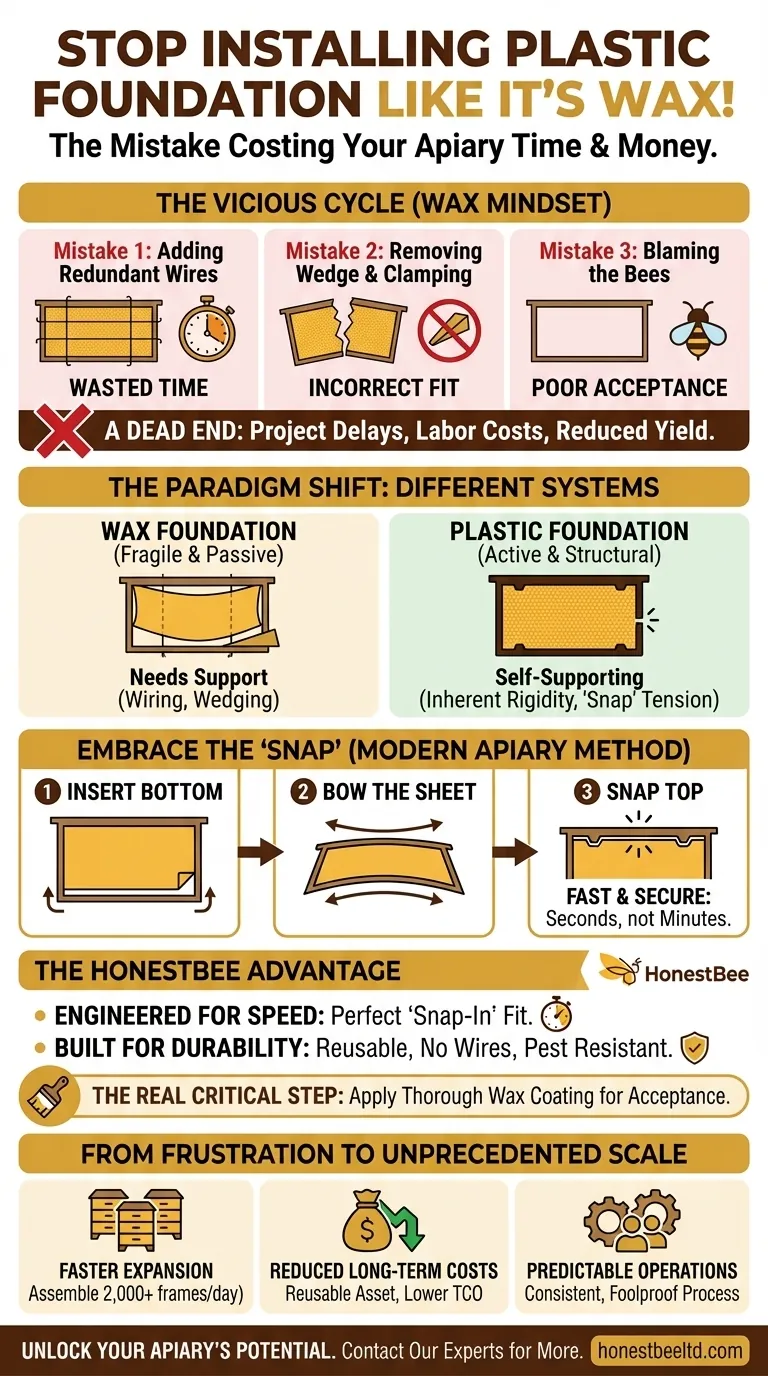
The common "solutions" usually look like this:
- "Maybe it needs more support." You painstakingly add horizontal wires, treating the rigid plastic sheet like a fragile sheet of wax.
- "Let's clamp it in." You remove the wedge from the top bar, trying to secure the plastic foundation the old-fashioned way, only to find it doesn't fit properly.
- "The bees just don't like it." You blame the material, writing off your investment and reverting to slower, more fragile methods.
These attempts feel productive, but they're a dead end. Every hour your team spends wiring frames that don't need it, or re-assembling frames that were installed incorrectly, is an hour stolen from hive inspections, honey harvesting, or expansion. The real business consequences are stark: project delays, reduced honey yield from unproductive hives, and a significant increase in labor costs—all because a "time-saving" product is doing the opposite.
The Real Culprit: You're Fighting the Frame's Design, Not a Flaw
Here is the turning point: the problem isn't the plastic foundation. The problem is that we're treating it like a stronger version of wax. It’s not. It’s a completely different system built on a different physical principle.
From Fragile Sheets to Structural Components
Wax foundation is delicate and passive. It has no structural integrity on its own. It must be carefully clamped by a wedge and supported by an intricate web of wires to prevent it from sagging or collapsing under its own weight, especially in the heat. All the traditional installation steps—wedging, wiring, embedding—are designed to compensate for the inherent fragility of wax.
Plastic foundation is the exact opposite. It is an active, structural component. It is designed with inherent rigidity and a calculated amount of flex. That slight bow you create during installation isn't a workaround; it's the core of the design. It's what provides the tension to "snap" the sheet securely into the top and bottom grooves.
This is why the old methods fail:
- Removing the wedge destroys the precise groove the foundation is designed to snap into.
- Adding wires is completely redundant. It’s like putting a seatbelt on a statue. You're wasting time and materials to "solve" a problem that doesn't exist.
You've been given a key, but you're still trying to pick the lock. The real challenge isn't the frame's integrity, but ensuring the bees see it as a home.
Embracing the 'Snap': The Right Tool for a Modern Apiary
To truly unlock the efficiency of plastic foundation, you need to stop fighting its design and start embracing it. This means abandoning the wax-centric mindset and adopting a method built for speed and strength. The process requires a foundation that is engineered for this exact purpose.
This is where HONESTBEE's wholesale plastic foundation excels. It is not just a sheet of plastic; it's a component designed from the ground up to solve the core challenges of commercial apiaries.
- Engineered for Speed: Our foundation's dimensions are precisely controlled to ensure a perfect "snap-in" fit every time. The installation process is reduced to a single, swift motion: insert the bottom, bow the sheet, and snap the top into place. What used to take minutes per frame now takes seconds.
- Built for Durability: Made from high-grade, resilient polymer, our foundation is self-supporting and eliminates the need for any wires or extra support. It withstands rough handling, aggressive honey extraction, and is impervious to wax moth damage, allowing for season after season of reuse.
By designing a product that perfectly embodies the "snap-in" principle, we turn frame assembly from your biggest bottleneck into your fastest task. The critical step that remains—applying a thorough coating of beeswax to encourage acceptance—can now get the focus it deserves.
From Frustration to Unprecedented Scale
Once you stop battling your equipment and start leveraging its intended design, your operational potential transforms. The time and capital once lost to inefficient processes are now freed up, enabling you to do what was previously out of reach.
Imagine this:
- Exponentially Faster Expansion: Instead of your team spending a week wiring 500 frames, they can assemble 2,000 in a single day. This allows you to rapidly expand your apiary to meet growing demand or seize new pollination contracts.
- Reduced Long-Term Costs: Your foundation is now a reusable asset, not a fragile consumable. The near-elimination of replacement costs due to sagging, pest damage, or extraction breakage dramatically lowers your total cost of ownership.
- Predictable, Scalable Operations: You now have a simple, foolproof assembly process that any crew member can master in minutes. This creates consistency and reliability across your entire operation, from a few hundred hives to a few thousand.
By solving the foundational problem of the frame itself, you unlock a more resilient, profitable, and scalable future for your beekeeping business.
If you're ready to move beyond the old methods and build a more efficient and robust operation, our team of experts is here to help. We understand the unique pressures of commercial beekeeping and can help you equip your apiary for a new level of productivity. Let's discuss how the right equipment can solve your biggest operational challenges. Contact Our Experts.
Visual Guide
Related Products
- Food Grade Plastic bee Foundation for Bee Frames
- Assembled Wooden Bee Frames with Plastic Foundation for Durability and Convenience by HONESTBEE
- Plastic Bee Frame Beekeeping Hive Frames for Wholesale
- Notebook Style Beeswax Foundation Mould Wax Foundation Mold
- Colorful Silicone Beeswax Foundation Mold Mould for Beekeeping
Related Articles
- The Real Reason Your Bees Ignore Plastic Frames—And How to Fix It for Good
- The Beekeeper's Paradox: Why Durable Foundation Fails and How to Fix It
- How Commercial Beekeepers Balance Durability and Bee Behavior with Plastic Foundations
- The Architect's Dilemma: Why Bees Ignore Your Plastic Foundation
- Is Your Plastic Foundation Costing You Honey? Why "Pre-Waxed" Might Not Be Enough






