The Unspoken Contract with Bees
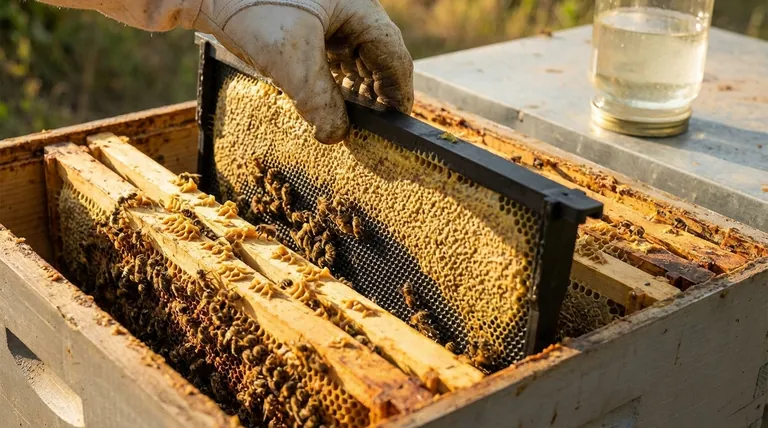
A beekeeper installs a fresh box of pristine plastic foundation into a bustling hive. Weeks later, they return to find it utterly untouched. The bees have built burr comb in every available crevice, but the expensive, perfectly milled sheets remain barren.
This isn't an act of defiance. It's a calculated business decision.
The bee colony is a superorganism governed by a ruthless internal economy. Every action is weighed against its energy cost and potential return. Drawing wax comb is one of the most resource-intensive tasks a colony undertakes. To them, a sheet of bare plastic isn't a helpful shortcut; it's a foreign, low-return investment they are wisely choosing to ignore.
Your job is not to force them, but to change the terms of the deal.
The Economy of Wax
To understand the bees' hesitation, you must first appreciate the cost of wax. It is biological capital, synthesized from pure energy. Young worker bees must consume vast quantities of nectar or honey, burning precious calories to activate the eight small wax glands on their abdomens.
This is a luxury good, produced only in times of overwhelming abundance.
The Signal of Abundance
A strong nectar flow is the market signal that green-lights large-scale construction. It floods the hive with raw materials, telling the colony's collective intelligence that resources are plentiful enough to justify major capital expenditures like building new comb.
Without this signal, the colony remains in a state of conservation.
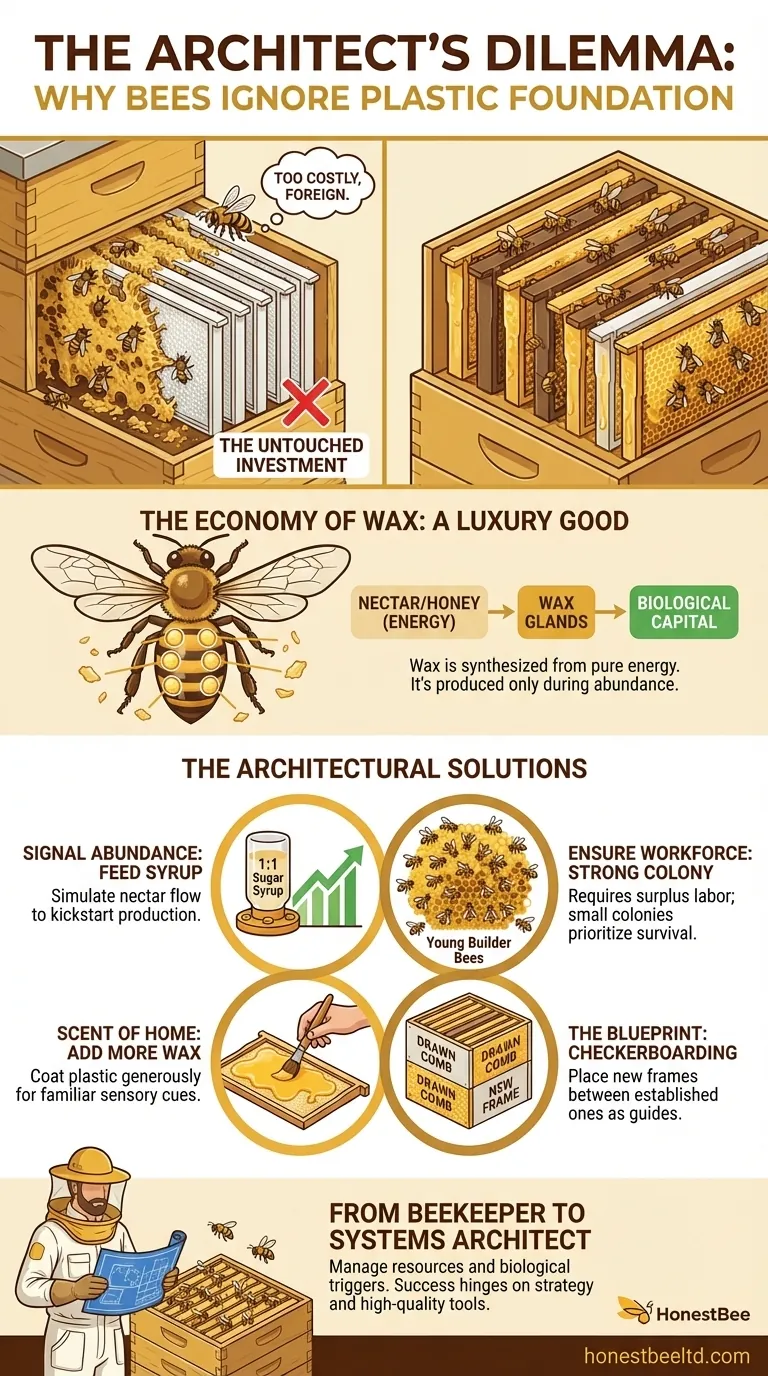
If the natural flow is weak, you must become the market maker. Feeding a 1:1 sugar-to-water syrup simulates a nectar flow, providing the cheap, abundant energy source required to fuel the wax glands and kickstart production.
The Labor Force Requirement
Resources alone are not enough. A construction project needs a dedicated labor force.
Only a strong, populous colony has the surplus of young bees—the specialized construction workers of the hive—to spare for building. A small or struggling colony will allocate every available bee to essential services: nursing brood, regulating temperature, and foraging. They are in survival mode, not expansion mode.
You cannot build a city with a skeleton crew, no matter how much material you provide.
Bridging the Natural and the Artificial
Plastic foundation is an elegant human invention designed for efficiency and durability. But to a bee, it's an alien landscape. Your task is to translate this foreign object into a language they understand.
The Scent of Home: Applying More Wax
Most plastic foundation arrives with a microscopically thin factory coating of beeswax. This is often insufficient to overcome the plastic's unnatural scent and texture.
By melting down beeswax and painting a thick, generous layer onto the foundation, you are not just adding wax; you are adding an irresistible set of sensory cues. The familiar scent and texture signal "this is home, this is safe, build here." Starting with high-quality, uniformly coated foundation from a reliable supplier provides a better baseline, minimizing the friction between bee biology and beekeeper goals.
The Blueprint: Strategic Frame Placement
Never install a solid block of undrawn plastic frames. To the bees, this is a vast, undesirable void. They will often build chaotic, problematic brace comb in an attempt to navigate around it.
Instead, use a technique called checkerboarding.
Place a single new plastic frame between two fully drawn combs. The established combs act as a blueprint. They provide the structural guide and the pheromonal cues that encourage the bees to simply and efficiently fill the gap. You are giving them a clear, manageable task, not an overwhelming void.
Navigating Unintended Consequences
Intervening in the hive's economy carries risk. A successful architect must anticipate how the system will react to their inputs.
The Peril of a "Syrup-Bound" Brood Nest
While feeding syrup encourages wax production, it can have a dangerous side effect. If the colony has no other space, they will store the syrup in the brood nest.
When the queen's laying area is backfilled with sugar water, she has nowhere to lay eggs. This condition, known as being "honey-bound" or "syrup-bound," can halt brood production entirely, crippling the colony's future workforce and sending it into decline. Monitor your frames and be ready to add more space.
Heeding the Calendar and the Colony
The urge to expand is a powerful, seasonal instinct. The prime building season is spring and early summer when days are long and the colony is geared for explosive growth.
Attempting to get foundation drawn in the late fall is like trying to plant crops in the snow. You are working against the fundamental biological and environmental rhythms that govern the hive.
| Key Factor | The Underlying Principle |
|---|---|
| Strong Nectar Flow | Provides the raw energy and economic signal for wax production. |
| Colony Strength | Ensures a sufficient workforce of young bees for construction. |
| Extra Wax Coating | Translates an artificial object into a familiar, inviting surface. |
| Checkerboarding | Uses existing comb as a blueprint to guide new construction. |
| Correct Timing | Aligns the beekeeper's goals with the bees' natural growth cycle. |
From Beekeeper to Systems Architect
Successfully managing a modern apiary is less about commanding bees and more about becoming an architect of their environment. You are managing resources, incentives, and biological triggers to guide the colony toward a desired outcome.
This architectural approach requires not only an understanding of bee psychology but also a commitment to high-quality tools. The foundation you provide is, quite literally, the foundation of your success. For commercial operations where productivity and reliability are paramount, using professional-grade equipment isn't a luxury—it's a necessity.
Ultimately, your success hinges on both your strategy and the quality of the equipment you use to execute it. Contact Our Experts
Visual Guide
Related Products
- Food Grade Plastic bee Foundation for Bee Frames
- Assembled Wooden Bee Frames with Plastic Foundation for Durability and Convenience by HONESTBEE
- Plastic Bee Frame Beekeeping Hive Frames for Wholesale
- Notebook Style Beeswax Foundation Mould Wax Foundation Mold
- Colorful Silicone Beeswax Foundation Mold Mould for Beekeeping
Related Articles
- The Real Reason Your Bees Ignore Plastic Frames—And How to Fix It for Good
- The Beekeeper's Paradox: Why Durable Foundation Fails and How to Fix It
- How Commercial Beekeepers Balance Durability and Bee Behavior with Plastic Foundations
- Stop Installing Plastic Foundation Like It's Wax: The Mistake Costing Your Apiary Time and Money
- Is Your Plastic Foundation Costing You Honey? Why "Pre-Waxed" Might Not Be Enough






