The Unseen Resistance
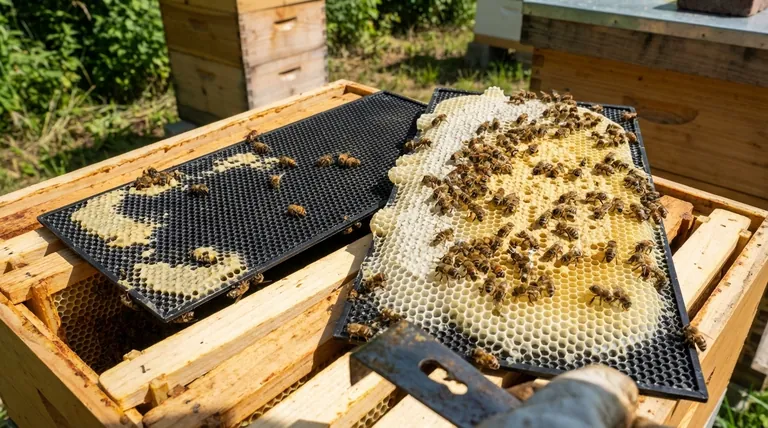
Every commercial beekeeper has felt the quiet frustration. You open a hive, expecting to see frames of new plastic foundation drawn out into perfect, pearly-white comb. Instead, you find a void. The bees have stubbornly ignored the engineered solution, building burr comb in every available crevice except the one you provided.
This isn't a product failure. It’s a biological disconnect. We introduce a tool designed for human efficiency—durability, reusability, speed—into a system that operates on an ancient, sensory logic. Understanding this paradox is the key to unlocking the true potential of modern equipment.
The Sensory Disconnect: A Bee's Perspective
To a honeybee, the world is a symphony of scent and texture. Their decision to build is not based on structural integrity but on deeply ingrained instinct.
A World Built on Wax
The hive is an organism that breathes wax. Bees produce it, sculpt it, and communicate through its subtle chemical signals. Wax is the known, trusted medium.
Bare plastic is a sensory dead zone. It lacks the familiar scent that screams "home" and the workable texture their mandibles are evolved to manipulate. It is fundamentally alien.
The Thin Veneer of Acceptance
Most commercial plastic foundations arrive "pre-waxed," but this layer is often a whisper-thin coating designed for shipping, not for bee acceptance. It’s like a poor translation of a language. It has the right words but none of the nuance.
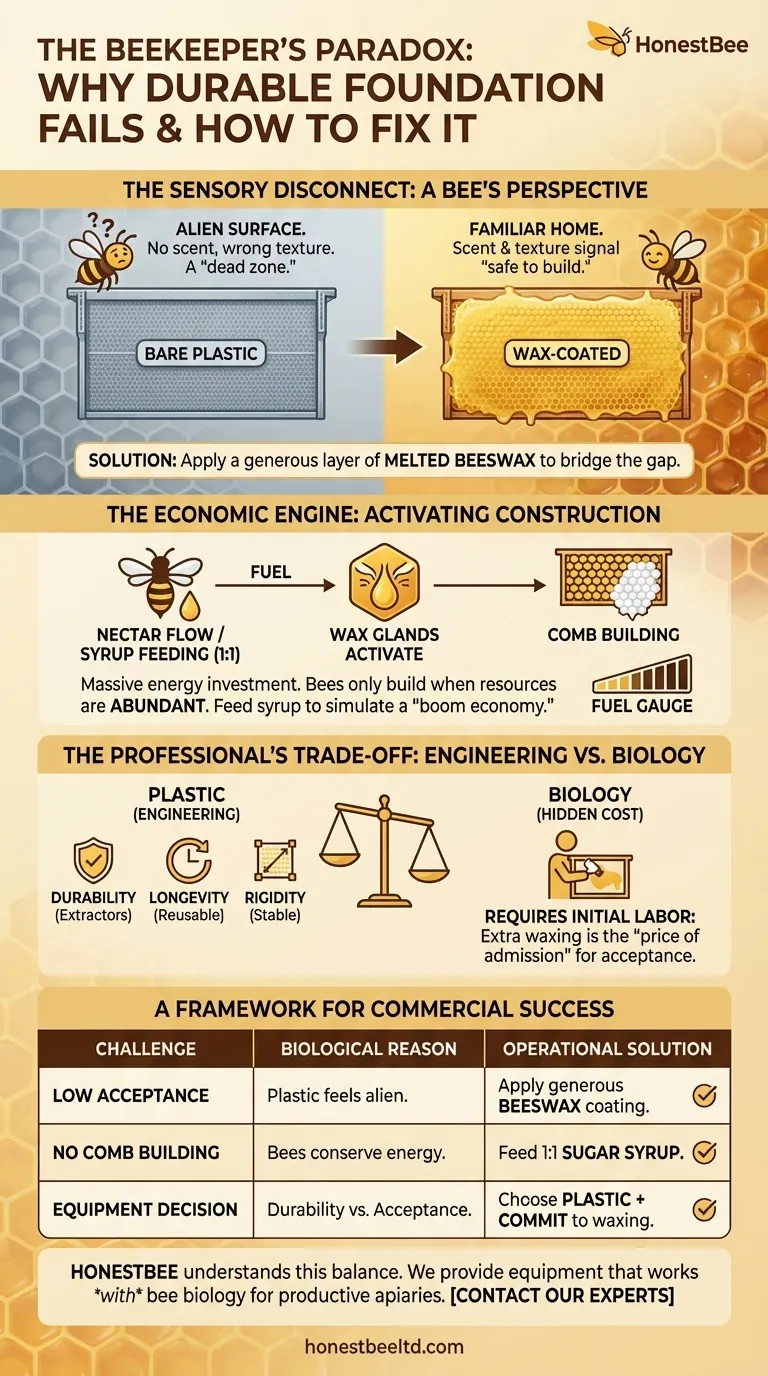
A generous, hand-applied layer of melted beeswax acts as a bridge. It’s not just a coating; it’s a clear signal to the colony, translating the foreign surface into a language they understand: "This is a safe and proper place to build."
The Economic Engine of the Hive
Even a perfectly waxed frame will sit empty if the colony's economic conditions aren't right. This is the most critical and most frequently overlooked variable.
Resource Abundance is Non-Negotiable
Drawing comb is one of the most energy-intensive tasks in the hive. Bees must consume vast quantities of nectar to activate their wax glands and produce mere flakes of wax.
It is a massive capital investment. A colony will not—and cannot—invest in new construction unless there is a powerful influx of revenue. A strong nectar flow is the biological trigger that signals a time of prosperity, making expansion a logical and necessary endeavor.
Simulating a Boom Economy
In the absence of a natural nectar flow, a beekeeper must become a central banker. Feeding a 1:1 sugar-to-water syrup simulates a period of abundance.
This artificial nectar flow provides the raw fuel for wax production and, just as importantly, convinces the colony's collective intelligence that now is the time to build infrastructure. Without this economic signal, all other preparations are meaningless.
The Professional's Trade-Off: Durability vs. Biology
For a commercial operation, plastic foundation is a logical engineering choice. Its benefits are undeniable, but they come with a responsibility to understand the biological cost.
The Logic of Plastic
- Durability: It withstands the immense centrifugal force of high-speed extractors.
- Longevity: It resists damage from wax moths and can be scraped and reused for years, reducing long-term costs.
- Rigidity: It provides a stable structure that prevents cross-combing and ensures uniform frames.
The Hidden Labor Cost
The paradox is that this time-saving, durable material requires an initial investment of labor. To achieve high acceptance rates, the "convenient" option of pre-waxed plastic must be augmented with an additional, thorough wax coating. This isn't a flaw; it's simply the price of admission for bridging the gap between our world and theirs.
A Framework for Commercial Success
Success is not about choosing plastic or wax; it's about aligning your operational strategy with the unchangeable biology of the honeybee.
| Challenge | Biological Reason | Operational Solution |
|---|---|---|
| Low Acceptance | Plastic feels alien, lacking the natural scent and texture of beeswax. | Apply a generous, even coating of melted beeswax to every new frame. |
| No Comb Building | Bees conserve energy and will not produce wax without an abundant nectar supply. | Install foundation only during a strong nectar flow or while feeding a 1:1 sugar syrup. |
| Equipment Decision | Plastic offers long-term durability while beeswax offers immediate acceptance. | Choose plastic for durability and commit to the initial waxing process for best results. |
At HONESTBEE, we understand that professional beekeeping is a balance of efficiency and biology. We supply commercial apiaries and distributors with high-quality, durable equipment designed for the realities of large-scale operations. Our focus is on providing tools that work with the bees' nature, not against it, ensuring your investment in equipment translates directly to a productive, thriving apiary.
To equip your operation for maximum acceptance and long-term durability, Contact Our Experts.
Visual Guide
Related Products
- Food Grade Plastic bee Foundation for Bee Frames
- Assembled Wooden Bee Frames with Plastic Foundation for Durability and Convenience by HONESTBEE
- Plastic Bee Frame Beekeeping Hive Frames for Wholesale
- Notebook Style Beeswax Foundation Mould Wax Foundation Mold
- Colorful Silicone Beeswax Foundation Mold Mould for Beekeeping
Related Articles
- The Real Reason Your Bees Ignore Plastic Frames—And How to Fix It for Good
- How Commercial Beekeepers Balance Durability and Bee Behavior with Plastic Foundations
- Stop Installing Plastic Foundation Like It's Wax: The Mistake Costing Your Apiary Time and Money
- The Architect's Dilemma: Why Bees Ignore Your Plastic Foundation
- Is Your Plastic Foundation Costing You Honey? Why "Pre-Waxed" Might Not Be Enough






