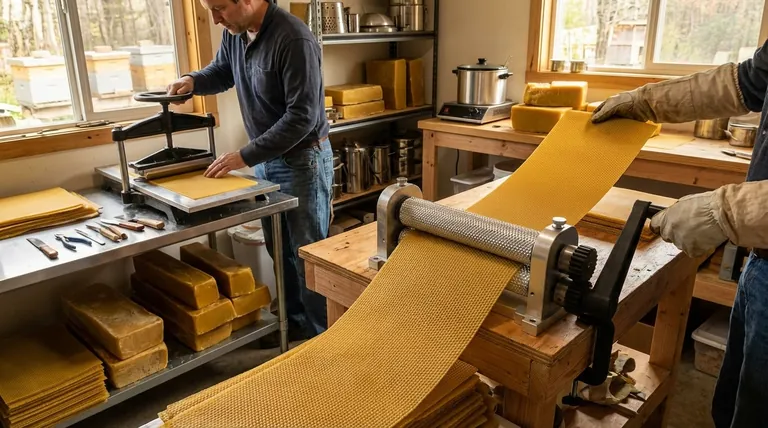
The Perfection of the Hexagon
Look closely at a honeycomb. It’s a masterpiece of natural engineering—a perfect tessellation of hexagons built with mathematical precision. For centuries, beekeepers have sought to give their colonies a head start by providing them with foundation sheets: thin sheets of beeswax imprinted with the very same hexagonal pattern.
But this raises a fundamental question of production. How do you transfer this intricate, delicate pattern onto a malleable sheet of wax, not just once, but thousands of times with perfect consistency? The answer lies not in a single tool, but in a philosophy of scale.
The Principle is Pressure, Not Removal
The creation of a foundation sheet is a process of embossing. It is not cutting, carving, or molding in the traditional sense. It is a controlled act of displacement.
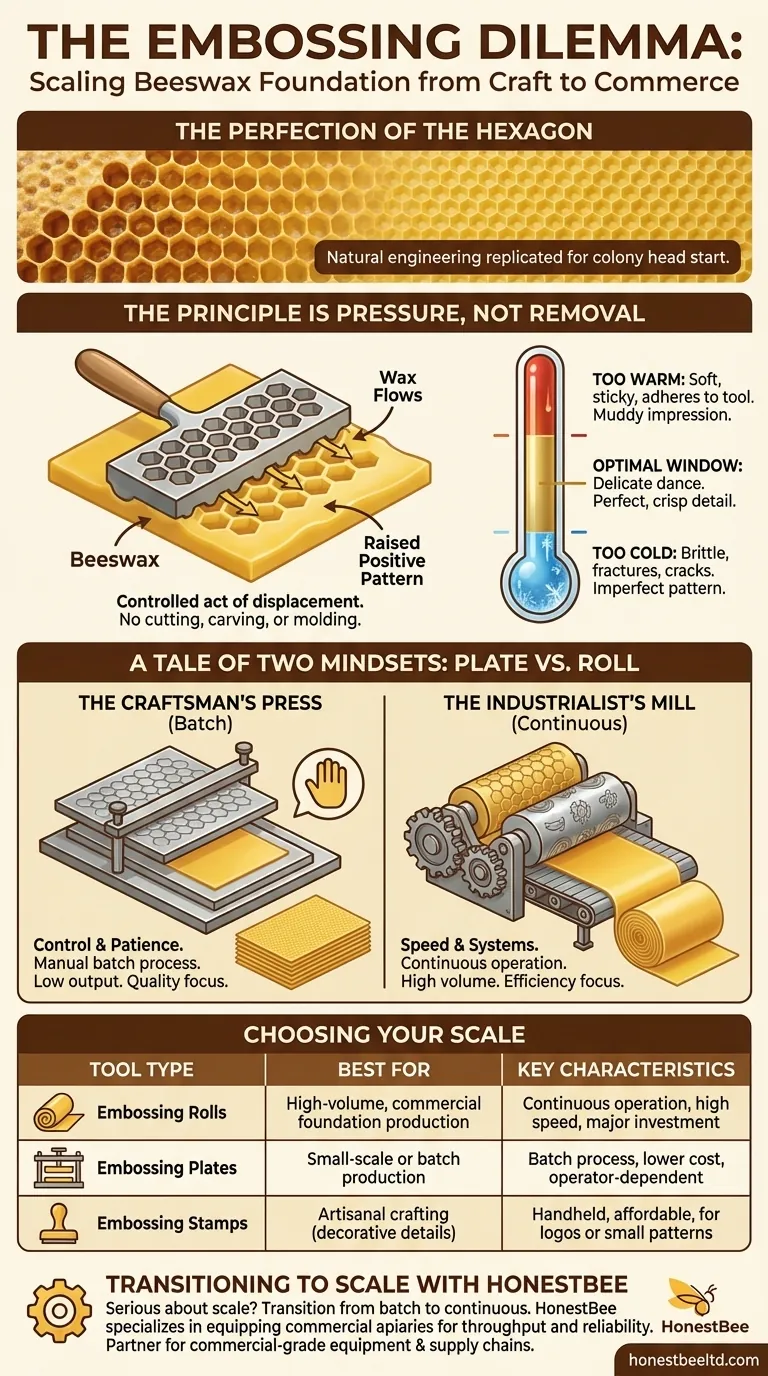
A tool bearing a negative imprint of the honeycomb base is pressed onto a smooth, flat sheet of beeswax. Under precise pressure, the wax flows, moving away from the points of high pressure and into the engraved cavities of the tool. The result is a raised, positive pattern on the wax surface, a perfect mirror of the mold.
This entire process, however, is governed by a single, unforgiving variable: temperature.
The Tyranny of Temperature
Wax is a temperamental medium. Its state dictates the outcome.
If the beeswax is too cold, it becomes brittle. The pressure that is meant to shape it will instead shatter it, creating fractures and imperfections. The delicate walls of the cell pattern will crack.
If the beeswax is too warm, it becomes soft and sticky. It will adhere to the tool, pulling away and destroying the crisp detail of the pattern. The impression will be muddy and indistinct, failing to hold its shape.
Success in embossing is a delicate dance within a narrow thermal window. It is a testament to the operator's understanding of their material—a piece of engineer's intuition.
A Tale of Two Mindsets: Plate vs. Roll
The choice of embossing tool is less about the technology itself and more about the operator’s goal. It reveals a fundamental split in operational mindset between the craftsman and the industrialist.
The Craftsman's Press: Control and Patience
Embossing plates are the domain of the dedicated hobbyist or the small-scale apiary. Two flat, patterned plates are mounted in a press. A single sheet of wax is placed between them, and pressure is applied manually or with a simple mechanical assist.
This is a batch process. It is deliberate and tactile. The operator feels the pressure and inspects each sheet. The focus is on the quality of the individual unit, not the output per hour. It’s a system built on patience and direct control.
The Industrialist's Mill: Speed and Systems
Embossing rolls, or mills, represent a leap into commercial production. Two massive, engraved cylinders rotate in opposite directions, pulling a continuous ribbon of warm wax between them. The pattern is embossed on both sides simultaneously in one fluid motion.
This is a system built for flow and efficiency. It is capable of producing hundreds or thousands of identical sheets per hour. The investment here is not just in the tool, but in the entire process: temperature control systems, wax feeders, and cutters. The operator's job shifts from making one perfect sheet to managing a system that produces countless perfect sheets.
Choosing Your Scale
There is no "better" tool, only the right tool for the job. Your choice is a direct reflection of your operational ambition. It's a trade-off between capital investment, speed, and the scale you intend to serve.
| Tool Type | Best For | Key Characteristics |
|---|---|---|
| Embossing Rolls | High-volume, commercial foundation production | Continuous operation, high speed, major investment |
| Embossing Plates | Small-scale or batch production | Batch process, lower cost, operator-dependent |
| Embossing Stamps | Artisanal crafting (decorative details) | Handheld, affordable, for logos or small patterns |
Transitioning from batch production with plates to continuous operation with a rolling mill is the moment an apiary or beekeeping supply business gets serious about scale. This step requires not just a significant capital investment in machinery but also a partner who understands the demands of commercial-grade equipment and consistent supply chains.
At HONESTBEE, we specialize in equipping commercial apiaries and distributors for precisely this level of operation. We understand that when your business depends on throughput and reliability, you need equipment that performs without compromise.
If your ambition is to scale your production and meet the demands of a larger market, you need the right tools and the right partner. Contact Our Experts
Visual Guide
Related Products
- Beeswax Machine Press Embosser Wax Foundation Mold Printer Bee Hive Equipment Making Sheet
- Economy Manual Beeswax Embossing Mill Wax Foundation Machine Roller
- Fully Automatic Beeswax Embossing Machine Foundation Mill
- Electric Flatting and Embossing Machine with Tray for Beekeeping
- Manual Beeswax Comb Foundation Machine Wax Foundation Mill Embossing Machine
Related Articles
- Why Your In-House Beeswax Foundation is Failing Your Business—And How to Fix It
- Beyond the Embosser: The Systems Thinking Behind Perfect Beeswax Foundation
- How Beeswax Foundation Machines Transform Beekeeping Efficiency
- How Beeswax Foundation Machines and Smart Equipment Transform Beekeeping Efficiency
- Why Your Beeswax Foundation Fails: The Hidden Physics Behind Embossing