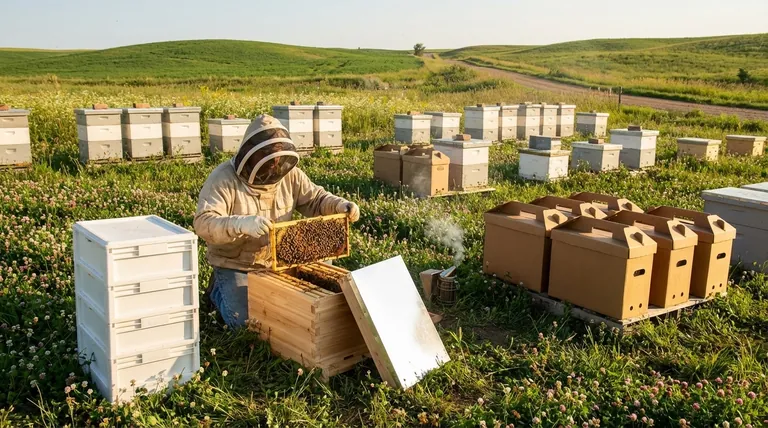
In a commercial apiary, every piece of equipment is part of a larger system. A hive is a production unit. An extractor is a processing plant. And a nucleus (nuc) box? It's often misunderstood as just a "small hive," a temporary home.
This view is incomplete.
A nuc box is a specialized tool designed to manage a colony in a state of transition. The choice of which nuc to deploy is not merely a technical decision about wood versus plastic; it's a strategic one that reflects an operator's immediate goal—be it rapid queen rearing, secure transportation, or long-term colony development.
Thinking of your nuc boxes not as a collection of containers but as a managed fleet of strategic assets is the first step toward optimizing your operation.
Sizing the Vessel: Matching Capacity to Intent
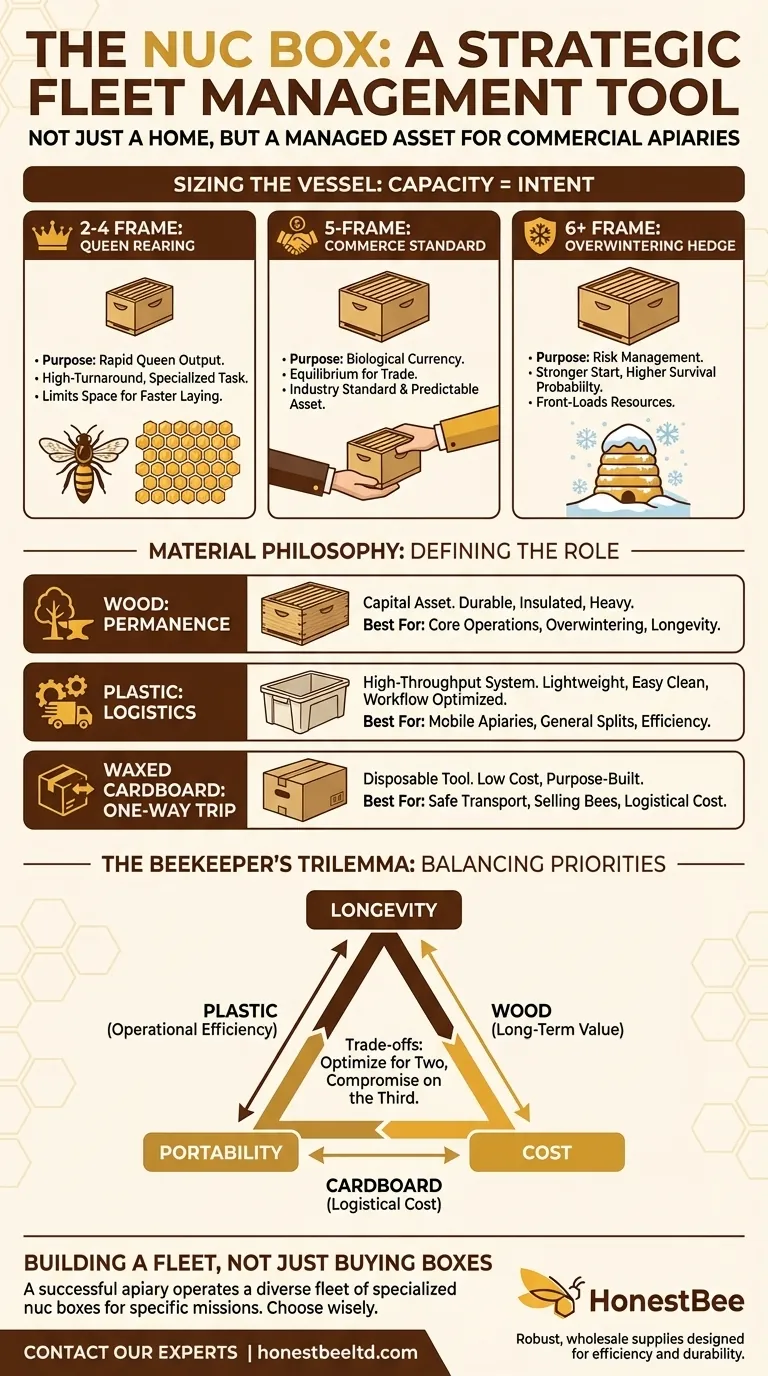
The number of frames a nuc box holds is its most fundamental constraint. This isn't just about volume; it's about controlling a biological process.
The 5-Frame: The Gold Standard of Commerce
The five-frame nuc is the industry standard for a reason. It represents a point of equilibrium—large enough for a queen to establish a viable brood pattern, yet small enough for the colony to efficiently thermoregulate and defend itself.
For commercial beekeepers, the 5-frame nuc is the fundamental unit of trade, the biological currency for selling colonies. Its standardization creates a predictable and transferable asset.
Micro-Management: The Logic of 2- to 4-Frame Mating Nucs
Smaller nucs are instruments of intense focus. Their purpose is to impose a productive constraint. By severely limiting space, you encourage a new queen to start laying almost immediately.
These are not for long-term growth; they are for the high-turnaround, specialized task of queen rearing. Using one is a deliberate choice to accelerate a specific biological outcome at the expense of colony longevity.
The Overwintering Hedge: The Case for 6+ Frames
A larger, six-or-more-frame nuc is a strategic hedge. When making a split, it allows you to transfer a greater share of resources—more brood, more bees, more food. This front-loads the new colony's chances of success.
For overwintering, it's an act of risk management. You're betting that the stronger starting population will have a higher probability of surviving the harshness of winter, making it a viable production unit in the spring.
Material Philosophy: Durability, Portability, and Disposability
The material a nuc is made from dictates its role within your operational fleet. Each represents a different philosophy of use.
The Investment in Permanence: Wood
Wooden nuc boxes are capital assets. They are heavy, durable, and offer superior insulation. A beekeeper who invests in wood is investing in permanence. These boxes are for the core of the operation: raising colonies, overwintering valuable stock, and tasks where longevity outweighs the need for lightweight portability. They are built to endure seasons, not just trips.
The Logic of Logistics: Plastic
Plastic nucs are designed for a high-throughput system. They are lightweight, durable, and exceptionally easy to clean and sanitize. Their integrated features—vents, feeders, built-in frame rests—are all about optimizing the beekeeper's workflow.
This is the choice for the mobile apiary, where units are constantly being moved, deployed, and re-tasked. Plastic embodies efficiency and scalability.
The Economics of the One-Way Trip: Waxed Cardboard
Waxed cardboard is the ultimate expression of a purpose-built tool. Its value is not in its durability, but in its low cost and disposability. It brilliantly solves a single problem: the safe, cost-effective, one-way transport of a bee colony.
Choosing cardboard is a conscious decision to invest only in the bees, not their temporary container. It is the purest logistical tool in the beekeeper's arsenal.
The Beekeeper's Trilemma: A Framework for Decision-Making
Every equipment choice is a negotiation between competing priorities. For nuc boxes, this can be understood as a balance between Longevity, Portability, and Cost. You can typically optimize for two, but the third will be a compromise.
| Strategic Priority | Ideal Nuc Box Characteristics | Best For... |
|---|---|---|
| Long-Term Value | Wood, 6+ Frames | Overwintering, building strong splits |
| Operational Efficiency | Plastic, 5-Frame, Integrated Features | General splits, mobile operations |
| Queen Rearing | Wood/Plastic, 2-4 Frames, Dividers | Maximizing queen output per box |
| Logistical Cost | Waxed Cardboard, 5-Frame | Selling and transporting bees |
Building a Fleet, Not Just Buying Boxes
A successful commercial apiary doesn't rely on a single type of nuc box. It operates a diverse fleet, with each model chosen for a specific mission. You might use cardboard for sales, plastic for internal splits, and wood for nurturing your most valuable genetic stock through the winter.
Managing this fleet requires a supplier who understands the demands of commercial-scale operations. HONESTBEE provides robust, wholesale beekeeping supplies designed for efficiency and durability, offering a range of nuc boxes to equip every part of your strategic system. We understand that you're not just buying a box; you're investing in the future of your apiary.
When you're ready to build a more resilient and efficient operation, Contact Our Experts.
Visual Guide
Related Products
- Styrofoam Mini Mating Nuc Box with Frames Feeder Styrofoam Bee Hives 3 Frame Nuc Box
- 5 Frame Wooden Nuc Box for Beekeeping
- Automatic Heat Preservation 6 Frame Pro Nuc Box for Honey Bee Queen Mating
- 5 Frame Langstroth Poly Nuc Corrugated Plastic Nuc Boxes
- 4 Frame Plastic Nuc Boxes for Beekeeping Bee Nuc Box
Related Articles
- The Thermodynamics of a New Colony: Why a Smaller Nuc Box Is a Stronger Start
- Architecting Royalty: The Nuc Box as a Queen's Crucible
- How Smaller Nuc Box Frames Improve Brood Health Through Thermal Regulation
- Designing for Instinct: Why the Nuc Box is the Perfect Swarm Trap
- The Architect's Dilemma: How a Nuc Box Solves a Honeybee Swarm's Housing Crisis


