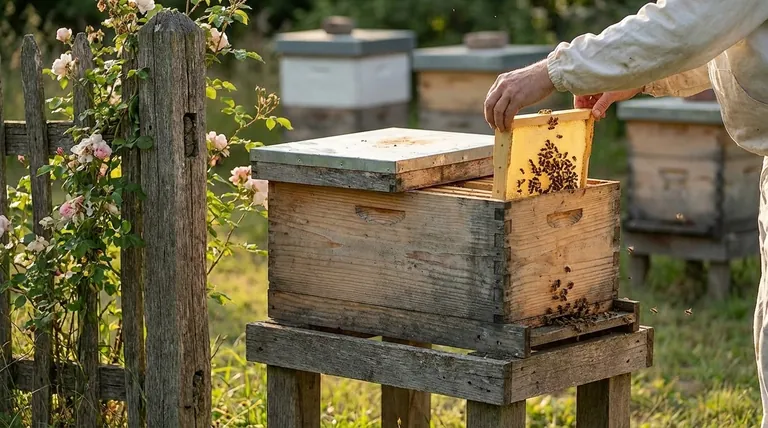
The Paradox of Royal Creation
In beekeeping, creating a new queen is the highest-stakes operation. The future of a colony—its productivity, temperament, and survival—rests on the success of a single, unproven individual.
Logically, one might think this critical task demands the full resources of a massive hive. But the opposite is true. The path to a strong queen begins not in a booming metropolis of 60,000 bees, but in a carefully constructed miniature world: the nucleus box.
This isn't just about saving resources. It's a profound strategic choice to manage chaos. By reducing the scale, we increase control, visibility, and the probability of success. The mating nuc is an engineered solution to a biological problem fraught with uncertainty.
The Strategic Power of Less
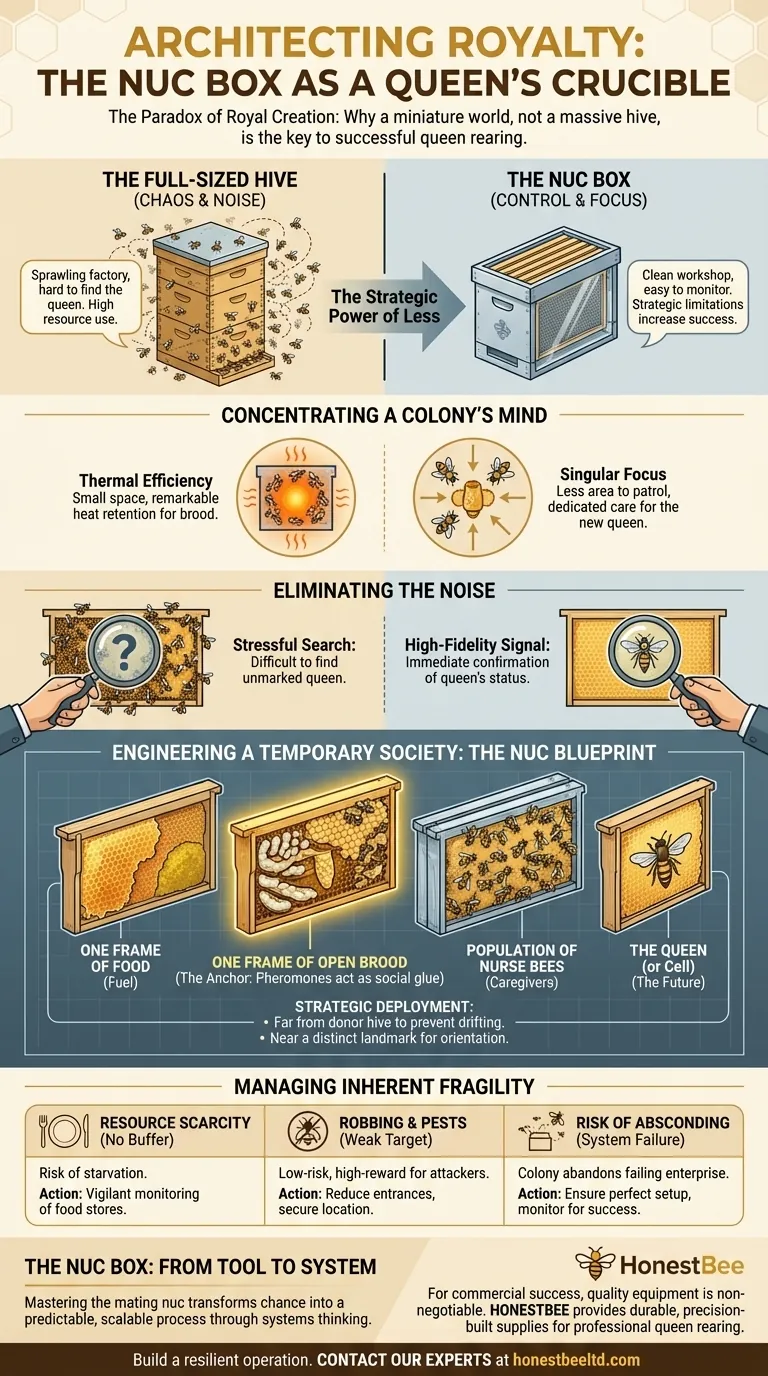
Using a full-sized hive to mate a virgin queen is like trying to find a single specific bolt in a sprawling, noisy factory. A nuc box turns the factory into a clean, well-lit workshop. Its power lies not in its size, but in its strategic limitations.
Concentrating a Colony's Mind
A small population in a confined space generates and retains heat with remarkable efficiency. This thermal stability is vital for the queen's development and her first batch of brood.
More importantly, the small colony has a singular focus. With fewer cells to patrol and fewer larvae to feed, the bees’ collective energy is dedicated to the care and protection of the new queen. It concentrates their behavior, turning thousands of individuals into a unified support system.
Eliminating the Noise
Finding an unmarked virgin queen in a 10-frame hive is a stressful, often fruitless search. In a 3, 4, or 5-frame nuc, the task takes seconds.
This isn't a matter of convenience; it's a matter of data. The beekeeper needs a clear, immediate signal: Has the queen returned from her mating flights? Is she laying? A nuc box provides a high-fidelity signal by stripping away the noise of a massive population.
Engineering a Temporary Society
A mating nuc is not just a box with bees. It's an intentionally designed, short-term social system. Its assembly follows a precise blueprint to ensure the inhabitants don't simply abandon their new post.
The Non-Negotiable Anchor
The single most critical component is a frame of open brood—eggs and young larvae—from a strong donor hive. This is non-negotiable.
The pheromones emitted by the larvae act as a powerful social glue. It tells the transplanted worker bees, "This is home. There is work to be done here. We have a future." Without this signal, their deep-seated instinct is to drift back to the familiar scent and security of their original hive.
The Blueprint for a Mating Nuc
A successful setup is a carefully balanced ecosystem.
- One Frame of Food: Honey and pollen to fuel the colony.
- One Frame of Open Brood: The social anchor and future workforce.
- A Population of Nurse Bees: Young bees are best suited for caring for the queen and brood.
- The Queen (or Queen Cell): Introduced into this stable, receptive environment.
Strategic Deployment
Placement is key to breaking the bees' old habits. The nuc should be located far from the donor hive to prevent workers from drifting back. Placing it near a distinct landmark, like a tree or fence post, gives the new queen a clear visual marker to orient herself for successful mating flights.
Managing Inherent Fragility
This engineered system, for all its advantages, is inherently fragile. Its small size is both its greatest strength and its primary weakness.
| Vulnerability | The Psychological Reason | The Beekeeper's Role |
|---|---|---|
| Resource Scarcity | The system has no buffer. A few days of bad weather can lead to starvation or halt brood rearing. | Vigilant monitoring of food stores. |
| Robbing & Pests | A small, weak colony is a low-risk, high-reward target for stronger hives and pests. It cannot defend itself effectively. | Reduce entrances; ensure a secure location. |
| Risk of Absconding | If the system fails—the queen dies, food runs out—the colony's best survival strategy is to abandon the failing enterprise. | Ensure the initial setup is perfect; monitor for success. |
The Nuc Box: From Tool to System
Mastering the mating nuc transforms queen rearing from a game of chance into a predictable, scalable process. It’s a lesson in systems thinking: by understanding the behavioral drivers of the colony, we can design a micro-environment that guides them toward a desired outcome.
This process, however, demands equipment that is as reliable as the method itself. A poorly constructed nuc box that leaks heat or allows pests easy entry undermines the entire system. For commercial apiaries and distributors, where success at scale is paramount, the quality of the foundational equipment is non-negotiable. HONESTBEE provides the durable, precision-built beekeeping supplies that enable professionals to architect success, one queen at a time.
If you're ready to build a more resilient and predictable queen rearing operation, let's talk about the right tools for the job. Contact Our Experts
Visual Guide
Related Products
- 5 Frame Wooden Nuc Box for Beekeeping
- Styrofoam Mini Mating Nuc Box with Frames Feeder Styrofoam Bee Hives 3 Frame Nuc Box
- Automatic Heat Preservation 6 Frame Pro Nuc Box for Honey Bee Queen Mating
- 5 Frame Langstroth Poly Nuc Corrugated Plastic Nuc Boxes
- 4 Frame Plastic Nuc Boxes for Beekeeping Bee Nuc Box
Related Articles
- How Smaller Nuc Box Frames Improve Brood Health Through Thermal Regulation
- The Thermodynamics of a New Colony: Why a Smaller Nuc Box Is a Stronger Start
- How to Successfully Requeen Hives Using the 5-Frame Nuc Method: A Beekeeper’s Guide
- Designing for Instinct: Why the Nuc Box is the Perfect Swarm Trap
- The Architect's Dilemma: How a Nuc Box Solves a Honeybee Swarm's Housing Crisis


