You’ve done everything by the book. You’ve treated your hives for Varroa mites, rotating miticides to prevent resistance. Yet, a few weeks later, the mite counts are creeping back up. Your colonies seem perpetually stressed, honey production is inconsistent, and you’re caught in a frustrating, expensive game of pest control whack-a-mole. For a commercial operation, this isn't just an annoyance—it's a direct threat to your bottom line.
The Costly Cycle of "Trying Harder"
This scenario is all too common in apiaries across the country. Faced with persistent pest problems, the typical response is to escalate: treat more often, use stronger chemicals, or invest in more expensive "miracle" solutions. You might blame a bad batch of queens or simply a "bad year" for mites.
But these are reactive measures, and they trap your business in a costly cycle. This isn't just a beekeeping challenge; it's a business problem with serious consequences:
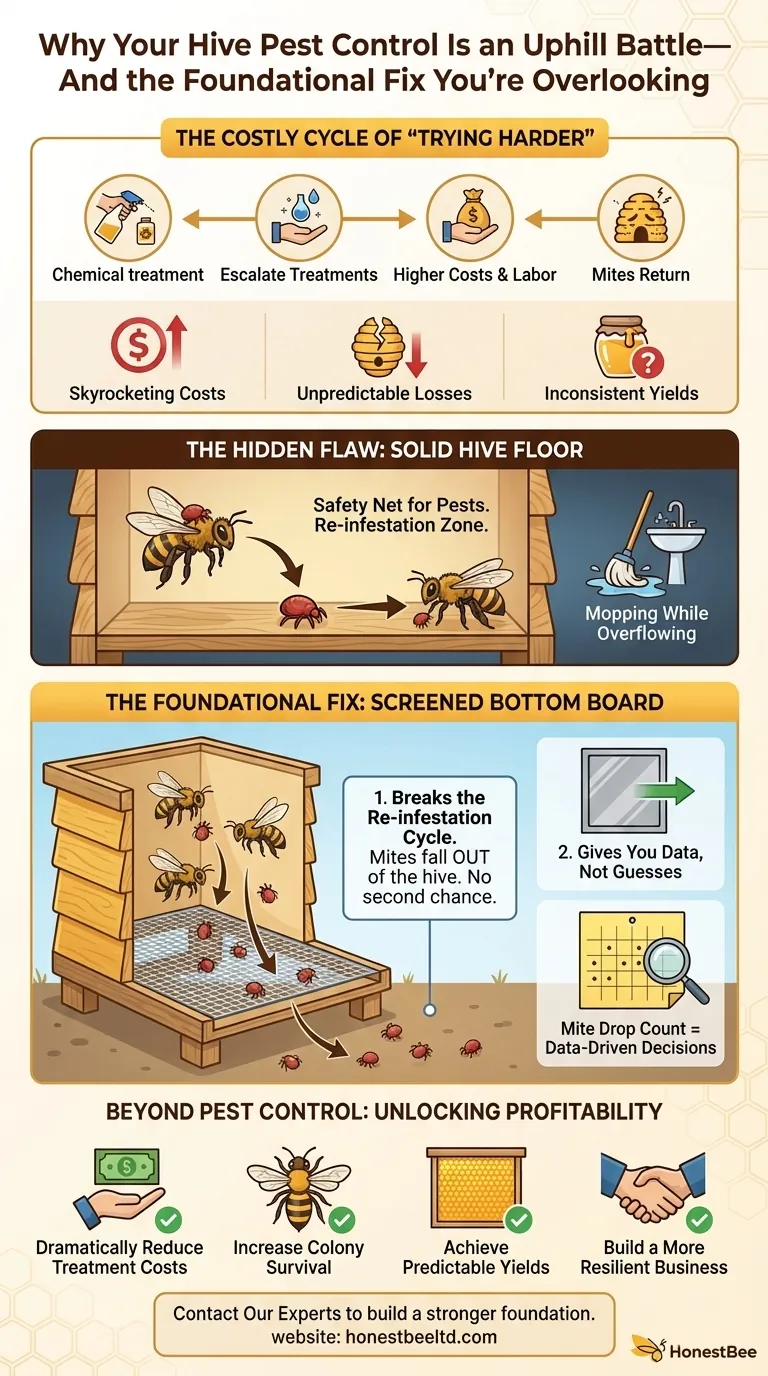
- Skyrocketing Costs: The expense of chemical treatments and the labor to apply them eats directly into your profit margins.
- Unpredictable Losses: Constant pest pressure weakens colonies, leading to higher-than-acceptable winter losses and the steep cost of replacing them.
- Inconsistent Yields: Stressed hives are under-productive hives. Unreliable honey yields and a weakened workforce for pollination contracts put your revenue at risk.
You're working harder and spending more, but you feel like you're running in place. Why? Because these efforts, while well-intentioned, only treat the symptom, not the underlying cause.
The Hidden Flaw in Your Hive: Why Pests Keep Winning
The turning point comes when we stop asking, "How can I kill more mites?" and start asking, "Why are the mites so successful in the first place?" The answer is often hiding in plain sight: the solid floor of your hive.
Your bees are naturally hygienic. They actively groom themselves and each other to dislodge pests like Varroa mites. But here's the critical moment that a solid bottom board changes:
- A bee successfully grooms a mite off its body.
- The mite falls onto the solid floor of the hive.
- It waits for the next bee to walk by, climbs back on, and the infestation continues.
Your standard hive floor is acting as a safety net for the very pests you're trying to eliminate. It creates a perfect "re-infestation zone," actively undermining the time and money you spend on treatments. It's like mopping the floor while the sink is still overflowing. This is why aggressive treatment schedules often feel like a losing battle—the hive's own structure is working against you.
Solving the Problem at its Source: The Role of the Screened Bottom Board
To truly break this cycle, you don't need a stronger chemical; you need to remove the pests' safety net. This is where a screened bottom board transforms from a simple piece of equipment into a foundational tool for Integrated Pest Management (IPM).
A screened bottom board is not a magic cure. It is a piece of engineering designed with a deep understanding of the pest's lifecycle. It works by fundamentally changing the hive environment to be hostile to pests.
At HONESTBEE, we supply durable, commercial-grade screened bottom boards designed to address this root cause in two key ways:
1. It Breaks the Re-infestation Cycle
The mesh floor is the core innovation. When a bee dislodges a mite, it doesn't just fall to the floor—it falls completely out of the hive. There is no second chance, no waiting to hitch a ride on a new host. This simple, passive action constantly reduces the mite population without any chemicals or extra labor.
2. It Gives You Data, Not Guesses
Effective management requires accurate information. Our screened bottom boards are designed to work with a removable insert or "sticky board." By sliding it in for a 24-hour period, you can perform a "mite drop count." This doesn't just tell you if you have mites; it tells you how many. You can now make data-driven decisions about when and if treatment is necessary, moving from scheduled, speculative treating to precise, need-based intervention. This saves money, reduces chemical use, and minimizes stress on your colonies.
Beyond Pest Control: Unlocking Predictability and Profitability
When you solve this foundational problem, the benefits ripple across your entire operation. This isn't just about having fewer mites; it's about shifting your business from a reactive, defensive posture to a proactive, strategic one.
With a properly managed foundation using screened bottom boards, you can:
- Dramatically Reduce Treatment Costs: By accurately monitoring mite levels, you treat only when necessary, cutting down on chemical expenses and labor.
- Increase Colony Survival: Healthier, less-stressed bees are far more likely to survive the winter, securing your most valuable asset.
- Achieve Predictable Yields: Strong colonies are productive colonies. This translates to more reliable honey production and the ability to confidently fulfill pollination contracts.
- Build a More Resilient Business: For equipment distributors, you can offer your clients a solution that genuinely solves one of their biggest and most expensive problems, building trust and loyalty.
You finally get to stop firefighting and start focusing on what truly matters: growing your operation with healthier, more productive hives.
Effective pest management is more than just applying treatments; it’s about creating an environment where your colonies can thrive. By addressing the core mechanics of pest infestation, you can build a more resilient, predictable, and profitable beekeeping operation. Whether you manage a large-scale commercial apiary or supply other beekeepers with the tools they need to succeed, our team understands the unique challenges you face. Let's discuss how to build a stronger foundation for your business. Contact Our Experts
Visual Guide
Related Products
- Langstroth Screen Bottom Board for Beekeeping Wholesale
- Australian Pine Wood Langstroth Screen Bottom Board for Wholesale
- Solid Bottom Board Australian Pine Wood Langstroth Bottom Board for Wholesale
- Langstroth Solid Bottom Board for Beekeeping
- HONESTBEE Top Bar & Bottom Bar Forming Machine | Bee Frame Machine
Related Articles
- Beyond Pest Control: Why Your Bottom Board Choice Is Directly Impacting Your Apiary's Profitability
- Beyond the Solid Floor: A Systems Approach to Hive Ventilation and Pest Control
- How Screened Bottom Boards Enhance Varroa Mite Control in Modern Beekeeping
- Your Hive's Foundation: The Hidden Key to Summer Productivity and Pest Control
- Hive Engineering: The Bottom Board as a Critical Climate and Pest Control System


