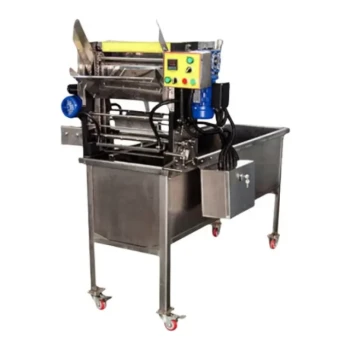
Commercial honey-filling and packaging machines turn traceability requirements into a controlled, repeatable production step. They can dose honey accurately, associate each production run with lot- or hive-level identification, and automatically print and apply barcodes, batch numbers, and origin information to the final container. This reduces manual errors while helping large apiaries meet hive-to-jar traceability, labeling, hygiene, and high-volume fulfillment requirements.
Core takeaway: Automation does not create regulatory compliance by itself; it provides the control system needed to apply accurate identifiers consistently and maintain reliable production records. The machine, labeling software, product data, and operating procedures must work together.
Why Traceability Becomes Difficult at Commercial Scale
Many hives create complex source data
Large apiaries may process honey from numerous hives, yards, harvest dates, or production lots. Without disciplined identification, it becomes difficult to prove which source corresponds to each finished jar, case, or shipment.
Unique hive barcodes and matching identification numbers provide the foundation for linking production data to the final package. The packaging line becomes the point where that information is transferred from internal records to the consumer product.
Manual labeling creates avoidable risk
Handwriting or manually applying labels can lead to incorrect batch numbers, misplaced labels, inconsistent formatting, and mismatches between the honey filled and the information printed on the package.
Automated systems reduce these risks by applying the selected label or code according to a controlled production setup. They also make it practical to repeat the same process across high-volume runs.
How Filling and Labeling Equipment Supports Compliance
Accurate filling connects physical product to production records
High-precision piston, quantitative-pump, or weight-based metering systems deliver consistent quantities into each container. This helps ensure that the packaged units correspond to the declared net quantity and the production lot recorded in the system.
Consistent dosing also makes batch control more reliable. When filling parameters, lot information, and container counts are recorded together, producers have a clearer audit trail from processed honey to finished inventory.
Integrated labeling applies origin and batch information
Automated labeling equipment can print or apply lot-specific barcodes, hive identifiers, and batch numbers during the filling and packaging sequence. This reduces the possibility that a label from one origin or lot is applied to another.
The exact information and format must be configured to the applicable destination-market rules. The machine supports the process, but the apiary remains responsible for using correct data and legally compliant label content.
Barcodes support source verification
A barcode or identification number can link a finished package to internal information such as hive identity, production lot, or harvest record. This supports faster verification by the producer, distributor, wholesaler, or other authorized party.
For export and distribution, machine-applied identification also helps preserve product information as honey moves through multiple supply-chain stages. It can reduce the risk of origin information being lost, altered, or separated from the product.
Sealing protects the integrity of the labeled product
Hygienic filling and hermetic sealing help prevent secondary contamination and moisture absorption after processing. This is important because traceability is only useful when the identified product also remains safe, stable, and consistent.
A clean, enclosed filling design reduces unnecessary human contact with the honey. That supports sanitary production while helping preserve expected sensory characteristics such as color and crystallinity.
The Production Workflow Behind Reliable Traceability
1. Identify the source material
Before filling begins, the apiary should establish the relevant hive, yard, harvest, or batch identifiers. The appropriate level of identification depends on the producer’s traceability system and the requirements of the target market.
These identifiers must be accurate before they are sent to the labeling or printing equipment. Automation cannot correct incomplete or incorrect source records.
2. Prepare and process the honey
Extraction, filtration, and processing should be managed so that each production lot remains identifiable. Mixing honey from different sources may change the traceability relationship and must therefore be reflected in the lot-control procedure.
Commercial processing equipment helps handle large harvest volumes while maintaining more consistent sanitary and production conditions than manual filling alone.
3. Configure the filling and coding run
Operators select the correct product, container, fill quantity, and identification data for the scheduled run. The system should be checked before production to confirm that the intended barcode, batch number, and origin information match the honey being packaged.
This verification step is essential when several varieties, origins, or customers are processed on the same line.
4. Fill, label, and seal each unit
The equipment meters the honey, applies the required identification, and seals the container in a controlled sequence. This reduces the number of manual handoffs where source and label information can become mismatched.
Depending on the line design, additional equipment may handle cap placement, labeling, date or batch coding, inspection, and case packing.
5. Inspect and retain records
Finished packages should be checked for readable codes, correct label placement, accurate fill quantity, and proper sealing. Production records should connect the source identification to the finished lot and shipment.
These records are particularly valuable during customer inquiries, quality investigations, recalls, or regulatory inspections.
Why Automation Matters to Distributors and Resellers
It supports dependable order fulfillment
Automated lines produce uniform, market-ready units at a speed suitable for retail distribution, bulk export, and wholesale orders. Consistent packaging makes it easier to prepare customer-specific quantities and repeat orders.
For distributors, this can improve confidence that products will arrive with consistent labels, packaging quality, and traceability information.
It makes multi-market packaging more manageable
Different customers or markets may require different language, label formats, or identification conventions. A configurable printing and labeling system can help manage these variations, provided each configuration is reviewed and approved before use.
This is more practical than relying on fully manual label preparation for every order.
It improves supplier responsiveness
Efficient filling, labeling, and packing reduce production bottlenecks during harvest peaks. That can support faster responses, shorter fulfillment cycles, and more predictable delivery performance for wholesalers and B2B buyers.
For equipment distributors, the value is therefore broader than machine speed: the line supports the apiary’s operational reliability and service capability.
Understanding the Trade-offs
Automation does not replace regulatory review
A machine can print the wrong information perfectly if the data, label template, or operator setup is incorrect. Compliance still requires human oversight, documented procedures, and verification against the rules of each destination market.
The equipment should be treated as an enforcement tool within a quality system, not as a substitute for regulatory expertise.
Greater capability requires stronger data discipline
Hive and batch identifiers must be created, maintained, and transferred consistently. Poor database control or unclear lot definitions can undermine an otherwise sophisticated packaging line.
Producers should define who creates identifiers, who approves label data, and how changes are controlled.
Integration affects total project complexity
A complete line may involve filling, capping, sealing, coding, labeling, inspection, and case packing equipment. Integrating these functions can improve control, but it also increases commissioning, training, maintenance, and validation requirements.
The correct solution depends on production volume, container formats, changeover frequency, labor availability, and the traceability depth required.
Precision equipment still needs maintenance
Pumps, metering systems, sensors, printers, and applicators require cleaning, calibration, and preventive maintenance. Neglecting these activities can cause inaccurate fills, unreadable codes, label placement errors, or avoidable downtime.
A supplier’s service capability, spare-parts availability, response time, and operator training should be evaluated alongside the machine specifications.
Making the Right Choice for Your Goal
Select equipment as part of a complete traceability and fulfillment plan, rather than as an isolated purchase.
- If your primary focus is origin traceability: Choose a filling and labeling line that can reliably associate hive or lot identifiers with each finished package and support controlled production records.
- If your primary focus is regulatory labeling: Prioritize accurate data handling, configurable printing, readable barcode application, and verification procedures for each target market.
- If your primary focus is high-volume production: Select precision metering, hygienic enclosed filling, automated sealing, and line speeds that match harvest and order volumes.
- If your primary focus is distribution efficiency: Evaluate changeover time, packaging flexibility, order fulfillment capacity, technical support, and spare-parts availability.
- If your primary focus is equipment sourcing: Work with a supplier able to provide the filling, labeling, coding, inspection, and service capabilities required for a coordinated packaging line.
With accurate data, validated procedures, and properly integrated machinery, commercial honey packaging can make traceability a dependable operational advantage rather than a manual compliance burden.
Summary Table:
| Feature | Benefit |
|---|---|
| Precision filling | Accurate quantities ensure consistency with declared net weight and lot records. |
| Automated labeling | Applies barcodes and batch info, reducing human error and ensuring correct origin labeling. |
| Hermetic sealing | Protects product integrity, essential for traceability reliability. |
| Configurable systems | Manage multi-market label formats and regulatory variations. |
| Record integration | Connects hive/lot data to finished packages for full audit trail. |
Looking to enhance your honey packaging line with reliable traceability and labeling? At HONESTBEE, we offer a complete range of commercial honey filling and packaging machines, along with integrated labeling and coding solutions. Our one-stop sourcing for beekeeping equipment ensures fast, compliant production for distributors and apiaries. With rapid response, dedicated support, and OEM/ODM customization, we help you meet strict standards and boost efficiency. Contact us today to upgrade your packaging line and secure your supply chain. Get in touch now to discuss your requirements!
Related Products
- Fully Automatic Honey Filling Packaging Machine for Processing Line
- Precision Automated Packaging Turntable Honey Spoon Filling Sealing Packing Machine
- Economy Small Honey Filling Machine Honey Bottle Filler Packaging Machine
- Small Honey Filling Machine Sachet Packing Equipment Single Nozzle
- Automatic Single-Dose Snap & Squeeze Honey Sachets Packing Machine
People Also Ask
- Why are fully automatic honey filling and packaging lines essential? Boost Your Honey's Market Value and Quality
- What is a fully-automatic honey filler? Streamline Your Production with High-Precision Automation
- How do automated honey filling and packaging machines affect profitability? Boost Margins with HONESTBEE Technology
- How do automated honey filling and packaging machines contribute to the market value of honey products? Maximize Your ROI
- How do industrial-grade automated honey filling and packaging machines mitigate the risk of physical contamination?