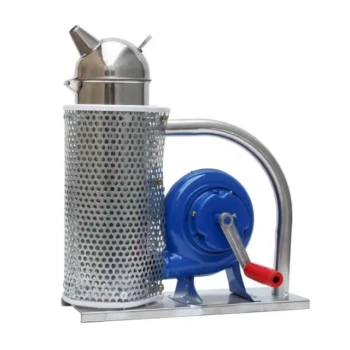
A bee smoker acts as a precision delivery system that transforms dried stinging nettle into a potent medicinal aerosol. By maintaining the controlled combustion of the plant matter, the device releases volatile acaricidal components and uses pneumatic pressure to force these active agents deep into the hive, ensuring they reach Varroa mites hiding on adult bees and within capped brood cells.
Core Insight: The smoker is not merely a burning chamber; it is a conversion tool that turns solid plant matter into a highly permeable aerosol, allowing active anti-mite compounds to penetrate the most inaccessible crevices of the hive.
The Mechanism of Effective Application
The effectiveness of stinging nettle smoke relies on how the smoker processes the raw material and delivers it. This involves three distinct physical stages.
Controlled Combustion
The smoker facilitates the burning of dried stinging nettle in a contained environment. This process is not just about creating smoke; it is about releasing volatile acaricidal components.
The device allows these active substances to be liberated from the plant fibers through heat without destroying them.
Aerosol Generation
Once the volatile components are released, the smoker converts them into tiny aerosol particles.
This change of state is critical because it turns a solid fuel into a gas-like mist capable of carrying the medicinal agents.
Pneumatic Pressure and Distribution
The bellows of the smoker generate the necessary air pressure to move the aerosol.
This pressure ensures the smoke is distributed uniformly throughout the beehive, rather than lingering only at the entrance or the top bars.
Reaching the Target
The ultimate goal of using the smoker is to contact the parasite. The device's design overcomes the physical barriers within a hive.
Penetrating Physical Barriers
The generated smoke possesses high permeability, allowing it to flow around frames and bees.
This property enables the smoke to infiltrate deep crevices where mites often hide to avoid detection.
Targeting the Brood
Crucially, the smoker drives the aerosol into capped brood cells.
Since Varroa mites parasitize both adult bees and developing larvae, this ability to reach inside sealed cells ensures the treatment targets the entire mite population.
Operational Control
While the smoker handles the physics, the beekeeper manages the input variables to ensure the process works.
Regulating Smoke Output
By pumping the bellows, you control the volume and velocity of the smoke.
This allows you to apply the smoke specifically where it is needed, rather than relying on passive drift.
Fuel Management
To maintain a steady stream of acaricidal aerosols, you must monitor the fuel level.
Refilling the chamber with dried nettle and ensuring consistent ignition prevents the treatment from becoming too thin or stopping midway.
Understanding the Trade-offs
Using a smoker for mite control requires balancing effectiveness with hive safety.
Temperature Management
While combustion is necessary to release the active components, excessive heat can be detrimental.
If the fuel burns too hot, the smoke may damage the bees' wings or sensitive tissues. The combustion must remain controlled.
Dosage Consistency
The concentration of the aerosol depends on the quality of the dried nettle and how well it is packed.
Inconsistent packing or damp fuel can lead to weak smoke that fails to deliver enough active ingredients to affect the mites.
Making the Right Choice for Your Goal
To maximize the effectiveness of stinging nettle smoke, tailor your approach to the specific needs of the colony.
- If your primary focus is deep infestation control: Pump the bellows rhythmically to generate high pressure, forcing smoke into capped brood cells and tight crevices.
- If your primary focus is treatment consistency: Ensure your dried nettle is properly prepared and dry before ignition to maintain a uniform release of volatile components.
- If your primary focus is safety: Monitor the smoker's temperature and extinguish the fuel completely after use to prevent injury to the bees or accidental fires.
Mastering the smoker transforms it from a simple calming tool into an effective device for chemical-free parasite management.
Summary Table:
| Feature | Mechanism | Benefit for Mite Control |
|---|---|---|
| Controlled Combustion | Heat-releases volatile acaricidal agents | Liberates active compounds without destroying them |
| Aerosol Generation | Converts solid fuel into a gas-like mist | Enables deep penetration into inaccessible hive crevices |
| Pneumatic Pressure | Bellows-driven air distribution | Forces medicinal smoke into capped brood cells |
| Operational Control | Volume and velocity regulation | Ensures uniform dosage across the entire mite population |
Maximize Your Apiary Productivity with HONESTBEE
Are you looking to scale your Varroa mite management or upgrade your commercial beekeeping operations? HONESTBEE is your dedicated partner, catering to commercial apiaries and distributors with a comprehensive wholesale offering.
We provide more than just tools; we provide the foundation for industrial success. Our portfolio includes:
- Specialized Hardware: Advanced hive-making and honey-filling machines.
- Essential Equipment: Professional-grade bee smokers, protective gear, and honey extractors.
- Industry Consumables: A wide array of essential supplies for high-volume operations.
- Cultural Merchandise: Honey-themed products to expand your brand's reach.
Whether you are stocking a distribution network or managing thousands of colonies, HONESTBEE delivers the quality and scale you need.
Contact us today to explore our wholesale catalog and customized solutions!
References
- Rasha Sakla, M. Hafez. Stinging nettle (Urtica dioica) as a potential control agent for Varroa mite (Varroa destructor) in honeybee colonies (Apis mellifera). DOI: 10.1186/s12870-025-06108-6
This article is also based on technical information from HonestBee Knowledge Base .
Related Products
- Professional Bee Smoker with Elongated Spout and Durable Bellows for Beekeeping
- Stainless Steel Honey Bee Smoker Hive and Honeycomb Smoker for Beekeeping
- European Stainless Steel Bee Smoker for Honey Bee Hive
- Premium Traditional Copper Bee Smoker with Bellows
- Heavy-Duty Bee Smoker with Durable Plastic Bellows for Beekeeping
People Also Ask
- What roles do bee smokers and precision tools play in honey harvesting? Master Safety and Quality Control
- Why is the use of professional bee smokers and specialized fuel essential? Protect Honey Purity & Colony Safety
- Why is a professional bee smoker considered an essential tool for hive management and safety? Master Colony Control.
- What is the mechanism by which a professional bee smoker assists in colony management? Boost Hive Safety and Efficiency
- Why is a professional bee smoker essential for hive maintenance? Master Colony Control & Safety