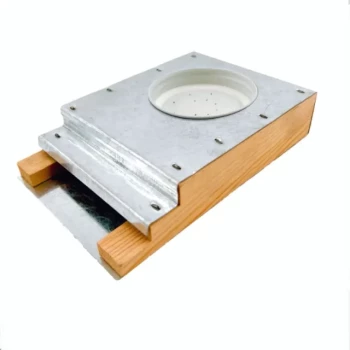
A hive top feeder typically operates by utilizing vacuum pressure to release syrup through an inverted container. Placed directly over the hole in the hive’s inner cover, the device—often a mason jar with perforated lids—allows bees to access food from below. To secure this system, the feeder is enclosed within an empty hive box, shielding it from weather and opportunistic pests.
Top feeders provide a controlled food source accessible only from inside the hive, relying on a vacuum seal or reservoir system to regulate flow. Their effectiveness depends entirely on proper enclosure within an empty hive body to prevent theft by robber bees and exposure to the elements.
The Mechanics of Delivery
The Vacuum Principle
The most common iteration of a top feeder uses an inverted container, such as a mason jar. Small holes are punched into the lid, and the container is turned upside down.
The vacuum pressure created inside the jar prevents the syrup from pouring out all at once. Instead, the liquid is available in controlled drops, which the bees consume as needed.
Positioning and Access
The feeder is placed on top of the uppermost box of the hive stack. Critical to its function is its alignment with the hole in the inner cover.
This alignment allows bees to climb up through the inner cover to access the syrup without leaving the safety of the hive.
Design Variations
While the jar method is common, some top feeders are designed as shallow boxes featuring a liquid reservoir.
These models often incorporate hardware cloth or mesh to allow bees access to the syrup while providing a foothold to prevent them from drowning. These units are sized to fit standard 8-frame or 10-frame equipment.
Protecting the Feed Source
The External Shell
Because the feeder sits on top of the inner cover, it is exposed. To solve this, an empty hive box is placed around the feeder.
This creates a protective shell, essentially extending the hive upward to enclose the feeding mechanism.
Defense Against Robbery
Sugar syrup is a high-value target for robber bees and wasps.
By enclosing the feeder within an empty box, you hide the direct access point and mask the scent of the syrup, ensuring only your colony can reach the food.
Weather Shielding
The outer box acts as a barrier against environmental stress.
It protects the feeder and the syrup from sun, wind, and rain, which could otherwise spoil the feed or alter its temperature, making it difficult for the bees to consume.
Understanding the Trade-offs
Monitoring Accessibility
The primary downside to the jar-style top feeder is the difficulty in checking food levels.
Because the unit is fully enclosed, you must physically remove the protective box to see if the jar is empty. This adds a step to your inspection process and can disturb the colony in cooler weather.
Volume Constraints
Feeders vary significantly in volume.
Jar-style feeders are limited by the size of the glass container, whereas box-style reservoir feeders can typically hold a larger quantity of syrup, reducing the frequency of refills.
Integrating Top Feeders into Your Apiary
When selecting and using a top feeder, consider your management style and local threats.
- If your primary focus is preventing robbery: Ensure the empty hive box surrounding the feeder fits tightly and has no gaps that could allow scent to escape or pests to enter.
- If your primary focus is ease of monitoring: Acknowledge that jar-style feeders require you to open the hive stack to check levels, whereas some reservoir models may offer visibility from the top.
By isolating the food source within the hive structure, you ensure your colony has safe, exclusive access to nutrition without inviting competition.
Summary Table:
| Feeder Type | Feeding Mechanism | Key Benefit | Main Drawback |
|---|---|---|---|
| Inverted Jar | Vacuum Pressure | Cost-effective and simple | Low volume; requires hive opening to check |
| Box Reservoir | Liquid Reservoir | Large capacity; fewer refills | Potential for bee drowning if mesh is absent |
| Inner Cover Hole | Direct Access | Minimizes heat loss | Requires precise alignment |
| Empty Hive Body | Protective Shell | Prevents robbery and weather damage | Adds height/weight to the hive stack |
Scale Your Apiary Operations with HONESTBEE
Are you looking to optimize your feeding strategy or expand your commercial beekeeping business? At HONESTBEE, we specialize in supporting commercial apiaries and distributors with a robust wholesale offering. From precision-engineered hive-making and honey-filling machinery to high-quality beekeeping tools and essential consumables, we provide the full spectrum of equipment needed for modern beekeeping.
Partner with us to gain access to:
- Comprehensive Wholesale Solutions: Bulk tools and hardware designed for durability.
- Advanced Machinery: Streamline your production with our honey-themed industrial equipment.
- Expert Support: We understand the needs of large-scale operations and distributors.
Ready to elevate your production? Contact us today to discuss how our specialized hardware and cultural merchandise can drive your business forward.
Related Products
- Professional Hive Top Bee Feeder for Beekeeping
- HONESTBEE Professional Hive Top Bee Feeder Feeding Solution
- HONESTBEE Square Top Hive Bee Feeder Top Bee Feeder
- HONESTBEE Round Hive Top Bee Feeder for Syrup
- Rapid Bee Feeder White Plastic 2L Round Top Feeder for 8 or 10-Frame Bee Hives
People Also Ask
- What is a hive top feeder? A Guide to Efficient, Low-Stress Beekeeping
- Do I need an inner cover with a hive top feeder? Optimize Your Hive Setup for Healthy Bees
- What is a hive top feeder, and how does it work? A Complete Guide to Efficient In-Hive Feeding
- What are the characteristics, advantages, and disadvantages of hive top feeders? Optimize Your High-Volume Feeding
- How does a bee hive top feeder work? A Guide to Efficient, Protected Feeding