Floral constancy gives commercial beekeepers a natural route to specialty honey production. Because individual worker bees generally focus on one flower species during a foraging trip, colonies can collect relatively uniform nectar and pollen during strong, localized blooms. Commercial operators use this behavior to plan apiary placement, harvest timing, pollen collection, and processing-line changeovers—but floral constancy does not guarantee pure monofloral honey without environmental control and verification.
The commercial value of floral constancy depends on controlling what happens before, during, and after the bloom. Apiaries must align colony management with the target crop, then use hygienic, adaptable extraction and filling equipment to preserve product identity and prevent cross-contamination between floral batches.
How Floral Constancy Creates Commercial Value
It concentrates nectar collection during a bloom
A worker honeybee typically visits one flower species during a foraging trip when that source is abundant. Under favorable bloom conditions, pollen loads can be strongly mono-floral, supporting the production of specialty products such as orange blossom, buckwheat, or blueberry honey.
This behavior allows beekeepers to position colonies near a dominant crop and harvest when that crop is producing significant nectar. The commercial opportunity is higher-value, differentiated honey rather than undifferentiated bulk honey.
It supports separate honey and pollen product lines
Floral constancy can benefit both honey and pollen operations. Pollen traps, used appropriately during peak single-crop blooms, can collect high-purity pollen loads while colonies continue their normal foraging activity.
However, pollen trapping must be integrated with colony nutrition and seasonal management. Excessive collection can reduce the colony’s available protein supply, so equipment selection should support controlled, adjustable harvesting rather than maximum collection at all times.
It improves pollination planning
The same fidelity that creates distinctive honey can improve crop pollination. Bees repeatedly visiting the same crop can transfer pollen efficiently across flowers, making commercial apiaries valuable not only as honey producers but also as agricultural pollination providers.
This creates a broader management requirement: equipment and hive capacity must support colony strength during the crop’s flowering period, not merely the subsequent honey harvest.
How Beekeepers Manage Colonies for Floral Separation
Apiary location is the first control point
Floral constancy is most commercially useful when a target crop dominates the forage available around the apiary. Beekeepers therefore consider crop concentration, competing blooms, bloom timing, weather, and the distance bees can travel.
If several nectar sources flower simultaneously, the resulting honey may become blended even though individual bees remain flower-constant during each trip. Floral purity is therefore influenced by the surrounding landscape, not just by bee behavior.
Harvest timing protects batch identity
Supers or frames intended for a particular floral source should be managed around the target bloom. Harvesting too early can reduce yield, while leaving supers in place through later blooms can increase the risk of mixed floral character.
Commercial operators commonly organize equipment and harvested material by floral source, location, and date. Clear traceability makes it easier to maintain product claims and plan processing-line changeovers.
Colony expansion must match the nectar flow
Honeybee colonies can expand rapidly during spring and high-flow periods, requiring modular, standardized hive bodies, frames, and supers. Precision-fit components help provide adequate storage volume and reduce structural problems under heavy honey loads.
Industrial hive-making machinery can support consistent production of these components, particularly for distributors and large apiaries supplying standardized frame-based systems.
Hive design affects downstream processing
Frame-based hives such as Langstroth systems are well suited to high-volume liquid honey production because the comb can be extracted centrifugally and returned to the colony. Top-bar and Warré systems generally require crushing the comb, which changes the equipment requirements and produces more recoverable beeswax.
The hive format should therefore be selected together with the intended product mix: liquid honey, comb honey, beeswax, or a combination of these.
Selecting Machinery for Floral-Specific Honey
Choose extraction equipment around the hive system
For standardized removable frames, centrifugal extractors provide efficient liquid-honey recovery while preserving the comb. Equipment capacity should match the number of frames harvested, expected seasonal throughput, and the scale of the operation.
For crushed-comb systems, the process requires crushing, draining, pressing, or comparable separation methods rather than a conventional centrifugal workflow. Buyers should not treat all hive formats as interchangeable when specifying extraction machinery.
Match the line to honey viscosity and throughput
Honey from different floral sources can vary in viscosity, temperature response, crystal-forming tendency, color, and particulate content. Pumps, filters, settling tanks, and filling machines must therefore handle the actual characteristics of the product rather than relying only on nominal volume ratings.
For high-volume commercial operations, automated extraction and filling machinery improves consistency and reduces labor. The correct specification still depends on batch size, container format, filling accuracy, and the required rate of order fulfillment.
Use filtration without erasing product identity
Filtration can remove wax particles and other unwanted material, improving appearance and protecting downstream filling equipment. The filtration approach should be selected according to the product specification, because excessive processing may be unsuitable for certain raw, specialty, or minimally processed honey programs.
Equipment suppliers should clarify whether the customer needs coarse straining, finer filtration, settling, or a combination. The objective is clean, stable processing while preserving the characteristics expected of the floral product.
Design for hygienic changeovers
When an operation processes several floral varieties, shared equipment can transfer residues from one batch to the next. This is especially important for premium monofloral products, where a small amount of carryover can undermine batch separation and traceability.
A practical solution is equipment designed for efficient draining, cleaning, inspection, and changeover. Dedicated contact parts or parallel processing paths may be justified for high-value products, but a dedicated machine is not automatically required in every operation.
Treat organic compliance as a system requirement
Machinery can support organic processing through cleanable construction, appropriate food-contact materials, controlled lubrication, traceable sanitation, and separation from prohibited substances. It cannot by itself make a product organic.
Organic compliance depends on the complete certified operation, including apiary management, inputs, storage, sanitation, processing procedures, records, and verification. Equipment specifications should therefore be reviewed against the applicable organic standard and certifier requirements.
Select filling equipment for the final market
Filling machinery should accommodate the product’s viscosity, package size, closure system, and required accuracy. Liquid honey, comb honey, and specialty pollen products may require different handling methods.
Comb honey deserves particular care because cutting, conveying, and filling can damage its appearance. Where the product commands a premium for its visual quality, gentle product handling may matter more than maximum line speed.
How Propolis and Beeswax Affect Equipment Decisions
Propolis demands robust hive-handling tools
Bees use propolis to seal cracks and attach or stabilize internal hive components. This natural behavior can make frames, boxes, covers, and rests difficult to separate during inspections and harvesting.
Commercial operations benefit from durable hive tools, frame scrapers, and precisely manufactured hive components. Consistent tolerances reduce unnecessary damage and help crews work efficiently during high-volume handling.
Beeswax recovery depends on the harvest method
Crushing comb generates a larger stream of wax than centrifugal extraction, creating an opportunity for additional revenue. Apiaries targeting wax production may need solar wax melters, rendering equipment, settling tanks, and purification stages.
This is an important sourcing consideration for distributors: the best equipment package is not always the one with the highest honey throughput. It should reflect whether the customer values comb preservation, wax recovery, or both.
Understanding the Trade-offs
Floral constancy is not absolute floral purity
Bees favor abundant, rewarding sources, but colonies can collect from multiple plants across a season or landscape. Honey stored in the hive may also be blended through colony activity, super management, and delayed harvesting.
Producers seeking a formal monofloral designation should use appropriate traceability and, where required, analytical verification. Marketing language should not rely on bee behavior alone.
Dedicated equipment improves separation but raises cost
Separate extractors, tanks, pumps, or filling paths can reduce cross-contamination risk and simplify scheduling. They also increase capital cost, floor space, maintenance requirements, and cleaning responsibilities.
For many operations, a well-designed shared line with validated cleaning and documented changeovers offers a more economical solution. Dedicated equipment is most compelling when product value, volume, certification requirements, or contamination risk justifies it.
Automation increases capacity but reduces flexibility
Automated extraction and filling systems are attractive for large standardized operations. They can improve throughput, repeatability, and labor efficiency.
Smaller apiaries or producers handling diverse floral batches may benefit more from modular equipment that can be reconfigured quickly. The correct balance depends on seasonal volume, product variation, and available technical support.
Species and hive type must remain part of the specification
Apis mellifera operations commonly use standardized frame hives and can justify high-volume extraction systems. Other honeybee species, such as Apis cerana, may require different hive dimensions and management approaches because of their nesting behavior and sensitivity to disturbance.
Machinery and hive components should therefore be specified around the actual bee species, hive design, and production method. A one-size-fits-all equipment package can create avoidable retention, handling, and processing problems.
How to Apply This to Your Project
The strongest equipment strategy connects floral sourcing, hive design, processing capacity, sanitation, and market claims before any machinery is purchased.
- If your primary focus is monofloral honey: Prioritize apiary placement, bloom-based harvest scheduling, batch traceability, gentle filtration, and hygienic equipment changeovers that protect floral separation.
- If your primary focus is high-volume liquid honey: Use standardized frame hives with appropriately sized centrifugal extraction, pumping, filtration, and filling equipment matched to seasonal throughput.
- If your primary focus is organic or premium-certified products: Specify cleanable food-contact equipment and documented sanitation procedures, then confirm the complete process with the relevant certifier.
- If your primary focus is beeswax recovery: Select a harvest system that supports comb handling and add suitable melting, rendering, purification, and storage equipment.
- If your primary focus is distributing equipment to varied customers: Offer a modular portfolio covering hive components, pollen traps, extractors, filters, pumps, fillers, wax-processing systems, and replacement parts, supported by fast technical response and reliable fulfillment.
- If your primary focus is comb honey: Choose precise hive-handling and comb-cutting equipment that protects appearance, structural integrity, hygiene, and filling accuracy.
Floral constancy creates the opportunity, but disciplined apiary management and correctly matched processing machinery determine whether that opportunity becomes a consistent commercial product.
Summary Table:
| Factor | Impact on Commercial Beekeeping | Equipment Consideration |
|---|---|---|
| Apiary location | Concentrate nectar collection during bloom | Plan hive placement near target crop |
| Harvest timing | Protect batch identity | Schedule harvest around bloom |
| Hive design | Affects extraction method | Choose frame-based for centrifugal extraction |
| Filtration | Preserve product identity | Select appropriate filtration level |
| Changeovers | Prevent cross-contamination | Design for efficient cleaning |
| Organic compliance | System requirement | Ensure equipment meets standards |
| Filling equipment | Match market requirements | Choose based on viscosity and packaging |
Maximize your honey's potential with HONESTBEE. Our comprehensive wholesale solutions for commercial apiaries and distributors include hive-making machinery, honey extraction and filling lines, pollen traps, and wax processing equipment. With rapid response, dedicated support, and ultra-fast delivery, we ensure your operation thrives. For distributors, we offer OEM/ODM support and high-profit margins. Contact us today to discuss your needs!
Related Products
- Fully Automatic Honey Filling Packaging Machine for Processing Line
- Electric Double Wall Honey Filtering Machine Purifier Equipment for Honey Processing Plant
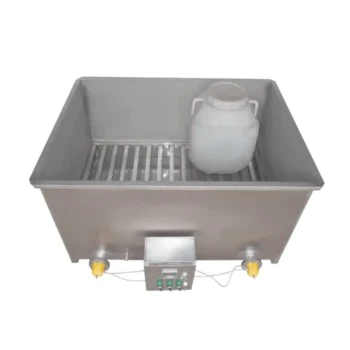
- Heavy Duty Stainless Steel Honey Processing Machine Decrystallizing Tank
- Economy Honey Homogenizer Mixer and Melting Machine for Beekeeping
- Double Wall Honey Heating Stirring Homogenizer Mixing Machine with Various Capacity
People Also Ask
- Why are fully automatic honey filling and packaging lines essential? Boost Your Honey's Market Value and Quality
- What is a fully-automatic honey filler? Streamline Your Production with High-Precision Automation
- How do automated honey filling and packaging machines affect profitability? Boost Margins with HONESTBEE Technology
- How do automated honey filling and packaging machines contribute to the market value of honey products? Maximize Your ROI
- How do industrial-grade automated honey filling and packaging machines mitigate the risk of physical contamination?