Hoffman frames are generally the better choice for brood boxes, while Manley frames are optimized for honey supers. Hoffman frames use tapered or scalloped self-spacing side bars that preserve bee space and reduce frame-to-frame contact. Manley frames use wide, straight-sided side bars that encourage thicker honeycomb and support faster, more uniform mechanical uncapping.
The practical commercial arrangement is simple: use Hoffman frames where inspection, queen laying, and brood management are priorities; use Manley frames in honey supers where extraction speed, comb thickness, and processing efficiency matter most.
How the Two Frame Designs Differ
Hoffman frames: tapered self-spacing side bars
Hoffman frames have side bars that are wider toward the top and taper toward the bottom. This creates a self-spacing profile that helps maintain the correct distance between adjacent frames.
The reduced contact area limits excessive propolis bonding and makes frames easier to separate during brood inspections. This is particularly valuable when workers must remove, rotate, and examine frames frequently.
Manley frames: wide, parallel side bars
Manley frames have wide, straight side bars with a more uniform width along their length. Their design maintains spacing while giving bees more encouragement to draw comb outward and thicker than standard brood comb.
The resulting thicker comb is well suited to honey processing. Straight, broad frame edges also provide a more consistent surface for uncapping equipment or knives.
Both designs depend on correct bee space
Neither frame type eliminates the need for accurate hive dimensions and proper spacing. Bee space is generally maintained within approximately 7.5 mm ± 1.5 mm, although exact tolerances depend on the hive system and component manufacture.
Poorly matched boxes, frames, or spacers can cause burr comb, excessive propolis, comb attachment, or irregular comb regardless of whether the frame is Hoffman or Manley.
Why Hoffman Frames Suit Brood Boxes
Easier colony inspections
Brood frames are handled often for queen checks, disease monitoring, swarm control, and colony-strength assessments. Hoffman’s tapered side bars reduce the area where adjacent frames can become tightly bonded with propolis.
This makes routine inspections less disruptive and lowers the effort required to remove individual frames.
Better support for brood management
Brood chambers require consistent frame spacing so the queen can move through the colony and workers can maintain brood comb properly. Hoffman frames provide a predictable self-spacing arrangement when installed in compatible equipment.
Their primary advantage is not maximum honey capacity. It is repeatable spacing and manageable frame handling in the colony’s most frequently inspected area.
Appropriate for expansion and replacement
Commercial apiaries commonly standardize Hoffman frames across brood chambers because uniformity simplifies replacement, inspection procedures, and staff training.
A consistent brood-frame specification also reduces sorting errors when frames move between apiary sites, warehouses, and service teams.
Why Manley Frames Suit Honey Supers
Thicker comb improves uncapping efficiency
Manley spacing encourages bees to build deeper, thicker honeycomb. This gives uncapping knives and automated equipment a more consistent working surface.
The result can be faster uncapping with less scraping and fewer interruptions during extraction, provided the comb is properly drawn and fully capped.
Fewer frames can increase honey capacity
Manley frames are often run at a lower frame count, such as eight or nine frames per super rather than ten, depending on the box, frame specification, and operating method.
Wider spacing allows each frame to carry more honey. However, the actual yield depends on nectar flow, colony strength, comb condition, box dimensions, and the apiary’s extraction process.
Better alignment with commercial processing
Honey supers are removed, transported, uncapped, extracted, and returned at scale. Manley frames are designed around this workflow rather than around frequent brood inspection.
For commercial operators, the benefit is operational: improved frame uniformity can support more predictable uncapping, extraction, cleaning, and equipment throughput.
Selecting Frame Depth for the Hive Area
Brood boxes require greater comb area
Brood chambers commonly use standard or deep frames, approximately 215 mm or 304 mm in depth, depending on the hive system. These provide substantial surface area for brood rearing and colony food reserves.
The correct depth must match the brood box. Frame style and frame depth are separate decisions: a commercial apiary may use Hoffman-style frames in either a compatible standard-depth or deep brood configuration.
Supers are usually shallower
Honey supers commonly use shallow or medium frames, approximately 140 mm or an intermediate depth, because fully loaded honey boxes are heavy.
A deep honey super can weigh up to roughly 45 kg / 100 lb when full. Shallower supers reduce lifting, transport, stacking, and extraction burdens.
Do not mix incompatible dimensions
Frame depth, box depth, top-bar length, bottom-bar design, and spacing must all match the hive standard. A Manley frame is not automatically suitable for every honey super, and a Hoffman frame is not automatically suitable for every brood box.
Before purchasing, confirm the exact hive format, frame dimensions, number of frames per box, and compatibility with existing foundations and extraction equipment.
Understanding the Trade-offs
Hoffman frames are not ideal for maximizing super capacity
Hoffman frames provide excellent handling characteristics in brood chambers, but their narrower or tapered side-bar profile is not specifically designed for thick, easily uncapped honeycomb.
They can be used in supers when an apiary prioritizes a single frame format, but this may sacrifice some uncapping and honey-capacity advantages.
Manley frames can be less convenient for brood inspections
The wide, parallel side bars that benefit honey processing can make adjacent frames more tightly constrained in practice, especially when propolis and burr comb accumulate.
Using Manley frames in brood boxes may therefore increase handling friction and reduce the inspection advantages of tapered self-spacing frames.
Fewer super frames require disciplined spacing
Running eight or nine Manley frames per super is not simply a matter of removing frames. Operators must center the frames accurately and maintain consistent spacing during installation and harvesting.
Incorrect spacing can produce uneven comb, excessive attachment, or comb that is difficult to process mechanically.
Standardization can outweigh theoretical optimization
A mixed Hoffman-and-Manley system offers functional advantages, but it also creates more purchasing, storage, labeling, and staff-training requirements.
For smaller operations, one standardized frame type may be operationally simpler. For commercial apiaries with dedicated brood and honey-processing workflows, using each frame where it performs best is usually more productive.
Making the Right Choice for Your Operation
Select the frame design based on the work performed in each hive zone and the equipment used downstream.
- If your primary focus is brood management: Choose compatible Hoffman frames for brood boxes to support self-spacing, easier frame removal, and efficient queen and colony inspections.
- If your primary focus is honey-processing efficiency: Choose compatible Manley frames for honey supers to promote thicker comb and more consistent mechanical uncapping.
- If your primary focus is lifting and transport efficiency: Use shallow or medium honey-super depths rather than deep supers, while preserving the appropriate frame style for extraction.
- If your primary focus is purchasing simplicity: Standardize dimensions and frame components across the operation, even if that means accepting a modest compromise in brood-handling or uncapping performance.
- If your primary focus is commercial scalability: Maintain separate, clearly identified brood-box and super specifications so distributors and apiary teams can replenish compatible equipment quickly and accurately.
A well-matched Hoffman brood system and Manley super system turns frame selection into a measurable improvement in inspection efficiency, harvest throughput, and supply-chain consistency.
Summary Table:
| Feature | Hoffman Frames | Manley Frames |
|---|---|---|
| Side Bars | Tapered/self-spacing | Wide/parallel |
| Best For | Brood boxes | Honey supers |
| Comb Thickness | Standard | Thicker |
| Uncap Efficiency | Standard | Enhanced |
| Frame Handling | Easy separation | More friction |
| Frame Count | Typically 10 | Often 8-9 |
Ready to optimize your apiary with the right frames? HONESTBEE offers a comprehensive range of beekeeping equipment, including Hoffman and Manley frames, expert advice, and fast delivery. For distributors and commercial beekeepers, we provide OEM/ODM support, certifications, and reliable supply to enhance your operations and profit margins. Contact us today to discuss your needs.
Related Products
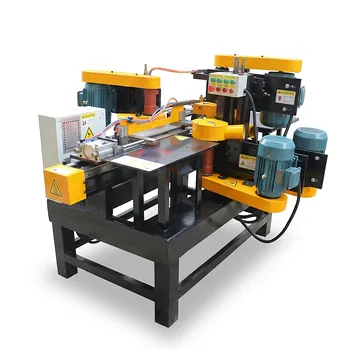
- Professional Bee Frame Machine for Side Bar Shaping
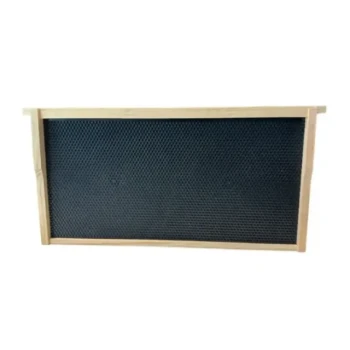
- Wooden Bee Hive Frames for Beekeeping and Wholesale
- Heart-Shaped Comb Honey Frame and Honeycomb Cassette
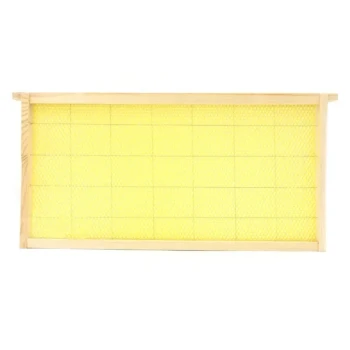
- Assembled Wooden Bee Frames with Plastic Foundation for Durability and Convenience by HONESTBEE
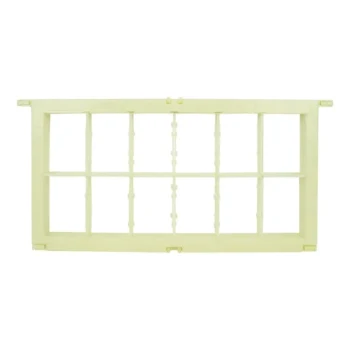
- Plastic Bee Frame Beekeeping Hive Frames for Wholesale
People Also Ask
- What types of damage on bee frames indicate they can be cleaned for reuse? Save Costs with Proper Frame Restoration
- What are the differences between wedged-top and grooved-top frames? Choose the Right Foundation System
- How long do bee frames last? A Guide to Lifespan and Replacement for Healthy Hives
- Can old bee frames be reused? Weighing the Risks vs. Rewards for Your Hive
- What should I look for in a bee frame? A Beekeeper's Guide to Hive Health Assessment