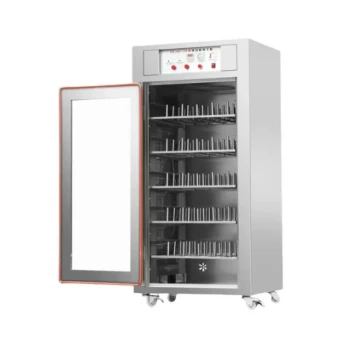
The critical technical standard for determining the moisture content of raw propolis requires an industrial-grade constant temperature drying oven precisely maintained at 105°C. This specific thermal environment ensures the complete evaporation of free moisture. To guarantee accuracy, the process relies on a gravimetric method where the sample is heated, cooled in a desiccator, and weighed repeatedly until a constant weight is achieved within milligram-level error margins.
Precision in moisture analysis relies not just on heating, but on the strict cycle of thermal stability and controlled cooling. By maintaining a steady 105°C environment and verifying weight consistency, you ensure the raw propolis adheres to quality benchmarks, such as not exceeding 6.0% moisture content.
Achieving Thermal Precision
The 105°C Standard
To analyze raw propolis effectively, your drying oven must be capable of reaching and strictly maintaining 105°C. This temperature is the threshold required to drive off free moisture completely without chemically degrading the sample structure significantly.
Industrial-Grade Stability
Standard ovens often suffer from temperature fluctuations that can skew results. You require an industrial-grade constant temperature oven designed to provide uniform heating throughout the chamber. This eliminates cold spots that could leave residual moisture in the sample.
The Gravimetric Workflow
Constant Weight Verification
The endpoint of the drying process is not determined by time, but by stability. You must weigh the sample, return it to the oven, and weigh it again. The process is only complete when the weight stops changing, known as achieving a constant weight.
Milligram-Level Accuracy
Because the moisture percentage in propolis is relatively low (ideally under 6.0%), your measurement equipment must be sensitive. The methodology requires detecting changes within milligram-level error margins to ensure the calculated moisture percentage is statistically valid.
Managing Post-Heating Variables
The Role of the Desiccator
You cannot move a sample directly from a 105°C oven to a scale. It must be cooled to room temperature first.
Preventing Re-absorption
Cooling must occur inside a desiccator. This sealed environment prevents the dried propolis from re-absorbing moisture from the ambient laboratory air while it cools, which would otherwise invalidate the dry weight measurement.
Common Pitfalls to Avoid
Inconsistent Cooling Times
Weighing a sample that is still warm creates convection currents above the scale pan. This causes unstable readings and falsely low weight measurements. Always allow the sample to reach strict thermal equilibrium in the desiccator.
Relying on Single-Cycle Drying
Assuming a fixed drying time (e.g., "dry for 3 hours") is a methodological error. The density and composition of raw propolis vary. You must rely exclusively on the constant weight metric to confirm the process is finished.
Making the Right Choice for Your Protocol
To ensure your data is robust and your product meets quality standards, consider these specific focuses:
- If your primary focus is Regulatory Compliance: Ensure your calculation confirms the moisture content does not exceed the standard quality benchmark of 6.0%.
- If your primary focus is Data Precision: Prioritize the "constant weight" verification step to eliminate variables caused by sample thickness or oven placement.
Consistency in your thermal environment and cooling procedures is the only path to reproducible results.
Summary Table:
| Requirement | Technical Standard | Importance |
|---|---|---|
| Temperature Setting | 105°C Constant | Ensures complete evaporation of free moisture |
| Weight Stability | Constant Weight Metric | Confirms end-of-drying without relying on time |
| Accuracy Level | Milligram-level margins | Essential for moisture content below 6.0% |
| Cooling Method | Desiccator at Room Temp | Prevents re-absorption of ambient moisture |
| Oven Grade | Industrial-grade stability | Eliminates cold spots and thermal fluctuations |
Elevate Your Beekeeping Standards with HONESTBEE
Precision is the backbone of quality honey and propolis production. HONESTBEE empowers commercial apiaries and distributors with the professional-grade tools required to meet global quality benchmarks. From industrial constant temperature drying ovens and honey-filling machines to a full spectrum of specialized beekeeping hardware and consumables, we provide everything needed for large-scale success.
Whether you are scaling your extraction line or sourcing premium equipment for your distribution network, our team is ready to deliver tailored solutions and expert support.
Ready to upgrade your apiary’s efficiency and accuracy? Contact HONESTBEE today and let us supply the tools for your growth!
References
- Dailen Guanche Gallardo, Jam Montalvan Copello. Physical-Chemical Characterization and Thin Layer Chromatographic Comparison of a Local Propolis with the Mangifera indica Resin. DOI: 10.20510/ukjpb/8/i1/1581041940
This article is also based on technical information from HonestBee Knowledge Base .
Related Products
- HONESTBEE Professional Cabinet Bottle Dryer
- Professional Thermostatic Conical Honey Melter
- Solar Beeswax Melter Easy Solar Wax Melter for Beeswax
- Automatic Continuous Heat Sealing Machine
- Economy Small Scale Honey Dryer Dehumidifier Thickening Machine
People Also Ask
- Why use a Cabinet Drier for pollen at 38–41°С? Protect Sample Integrity and Heavy Metal Data Accuracy
- What is the role of an industrial forced-air drying oven in bee bread fermentation? Optimize Moisture and Nutrients
- What is the primary purpose of a constant temperature drying oven in bee bread production? Achieve Perfect Fermentation
- How do forced circulation drying ovens sterilize beekeeping tools? Efficient Oxidation for Metal Equipment Safety
- How do professional-grade Pollen Drying Ovens preserve active ingredients? Ensure Bioactive Potency with Precision