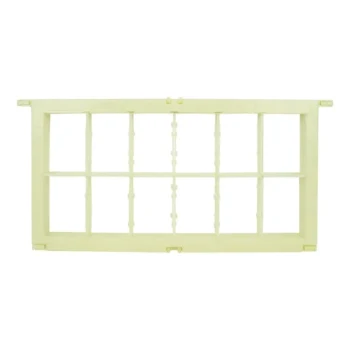
Manley frames offer two major design advantages over standard thin-sided frames: they create more usable honeycomb per super and provide a built-in guide for faster, more consistent uncapping. Their wide, straight side bars maintain uniform spacing, encouraging bees to draw deeper comb while allowing beekeepers to operate with eight or nine frames in a honey super. The same flat, rigid surfaces help guide an uncapping knife without damaging the frame.
The core benefit is operational efficiency: Manley frames are designed to produce deeper honeycomb with fewer frames and simplify the uncapping stage, although their wider profile requires compatible extraction equipment and disciplined super management.
How Manley Frame Geometry Improves Honey Supers
Wider spacing creates deeper honeycomb
Manley frames have wide, straight side bars that maintain consistent spacing throughout the super. Compared with standard thin-sided frames, this allows bees to draw the honeycomb farther outward.
The result is a fuller comb with more depth available for honey storage. In practice, beekeepers commonly use eight or nine Manley frames in a 10-frame honey super rather than filling all positions with standard-width frames.
Fewer frames can increase handling efficiency
Using fewer frames means fewer individual units to remove, inspect, uncap, and return during honey processing. This can reduce handling time across larger operations.
The approach is intended for honey supers, not brood boxes. Brood areas require tighter spacing to maintain proper colony organization and avoid excessive gaps.
Straight sides maintain uniform spacing
The parallel side bars help keep the frames rigidly positioned within the super. Consistent spacing is important because irregular gaps can encourage bees to build burr comb or cross-comb between frames.
For best results, wider-spaced Manley frames should generally contain already drawn comb. Installing undrawn foundation with excessive spacing can increase the risk of unwanted comb construction.
Why Uncapping Is Faster and More Consistent
The frame acts as a knife guide
The broad, straight wooden edges provide a flat guide for an uncapping knife. The knife can follow the frame’s geometry, helping remove wax cappings in a straighter and more uniform pass.
Standard thin-sided frames offer less supporting surface for this technique. Their narrower profile can require more careful positioning and may make consistent uncapping more dependent on operator skill.
Better control helps protect the comb
A guided knife is less likely to cut deeply into the wooden frame or remove excessive honeycomb. This helps preserve frame structure and can reduce the amount of comb that must be rebuilt after extraction.
The benefit is especially valuable for commercial or high-throughput operations where small improvements per frame accumulate across many supers.
Deeper comb can be easier to uncap
The bees’ tendency to draw the comb farther outward produces a more pronounced, straighter honey surface. That geometry can make the capping layer easier to reach and remove evenly.
The result is not simply a frame-spacing advantage; it is a coordinated design benefit involving frame width, comb depth, and processing workflow.
Why This Matters for Commercial and B2B Operations
More predictable product configuration
Manley frames provide a defined system for honey-super assembly, spacing, and extraction. Distributors and resellers can supply a coordinated package of frames, supers, foundation, runners, and compatible extractors rather than treating each component as an isolated purchase.
This supports clearer product recommendations for beekeepers choosing equipment based on apiary scale and processing method.
Improved throughput at extraction time
The wider frame design supports faster uncapping and can reduce repetitive labor during honey processing. For larger apiaries, this may be more operationally significant than the modest difference in frame count alone.
For wholesalers and commercial users, the key value proposition is therefore workflow efficiency, not merely a different wooden frame profile.
Stronger fit for standardized honey-super systems
Because Manley frames hold their spacing and foundation firmly, they can provide a consistent setup across multiple honey supers. This makes ordering, replacement, and equipment planning easier for operations managing a larger inventory.
However, the equipment must be specified as a complete system. Frame geometry, super capacity, runners, and extractor design should be compatible.
Understanding the Trade-offs
Manley frames require suitable extractors
The wider frame profile generally makes Manley frames best suited to radial honey extractors. Beekeepers using tangential extractors may find standard shallow frames with castellated runners more practical.
This is a critical purchasing consideration for distributors and resellers. A frame upgrade without compatible extraction equipment can create a workflow bottleneck rather than an efficiency gain.
Wider spacing requires correct management
Manley frames should not simply be placed farther apart without regard to comb condition. Using undrawn foundation in an overly wide arrangement can encourage cross-comb or burr comb.
Beekeepers should establish the comb correctly, maintain consistent spacing, and use the design specifically in honey supers.
Fewer frames do not automatically mean more usable honey
The eight- or nine-frame configuration works because bees are encouraged to draw the comb deeper. If spacing is inconsistent or the colony does not fully draw the comb, the expected storage and uncapping benefits may not be achieved.
Operational results depend on colony strength, drawn-comb availability, super management, and extraction equipment.
Manley frames are not a universal replacement
Standard thin-sided frames remain useful, particularly for smaller apiaries or operations already configured around tangential extractors. The right choice depends on the beekeeper’s complete system, not on frame width alone.
Making the Right Choice for Your Goal
Manley frames are most valuable when their design advantages align with the rest of the honey-processing operation.
- If your primary focus is maximizing honey storage per super: Use eight or nine properly spaced Manley frames to encourage deeper comb in honey supers.
- If your primary focus is faster uncapping: Choose Manley frames for their broad, straight guide surfaces, which support quicker and more uniform knife work.
- If your primary focus is commercial throughput: Build a coordinated system around Manley frames, compatible supers, drawn comb, and a radial extractor.
- If your primary focus is minimizing equipment changes: Stay with standard thin-sided frames when your apiary already relies on tangential extraction or conventional frame spacing.
- If your primary focus is supplying customers efficiently: Offer Manley frames alongside compatible extractors and honey-super components so buyers can source a complete, workable setup.
With the right equipment and spacing discipline, Manley frames turn frame geometry into a practical advantage in both honey storage and extraction efficiency.
Summary Table:
| Feature | Manley Frames | Standard Thin-Sided Frames |
|---|---|---|
| Side bar width | Wide, straight | Thin, narrower |
| Comb depth | Deeper comb encouraged | Shallower comb |
| Frames per super | 8 or 9 in 10-frame super | Typically 10 or 11 |
| Uncapping guide | Built-in flat surface for knife | No guide, less support |
| Extractor compatibility | Best with radial extractors | Works with tangential and radial |
| Best use case | Honey supers for efficient extraction | Versatile, brood and honey |
Ready to optimize your honey super workflow? HONESTBEE offers a comprehensive range of beekeeping equipment, including Manley frames, radial extractors, and complete honey super systems. Our wholesale solutions are designed for distributors, wholesalers, and commercial beekeepers seeking efficient, reliable sourcing. With OEM/ODM support, fast delivery, and expert guidance, we help you maximize productivity and profitability. Contact us today to discuss your needs and get a tailored quote!
Related Products
- Wooden Bee Hive Frames for Beekeeping and Wholesale
- JZBZ Langstroth Queen Rearing Frame for Beekeeping
- Professional Sectional Comb Honey Frame with 250g Cassette System for Beekeeping
- Assembled Wooden Bee Frames with Beeswax Foundation Ready to Use by HONESTBEE
- Assembled Wooden Bee Frames with Plastic Foundation for Durability and Convenience by HONESTBEE
People Also Ask
- How do wooden and plastic hive frames compare in terms of durability? Wood vs. Plastic Longevity & Repairability
- How does balancing the number of frames impact hive productivity? Optimize Your Apiary's Biological Output
- What are the main considerations when choosing between wooden and plastic bee hive frames? Optimize Your Apiary's Efficiency
- How should beehive frames be maintained to prolong their lifespan? 5 Pro Tips for Durable Beekeeping Equipment
- What is the primary function of frames within a beehive system? Structural Foundation and Hive Management