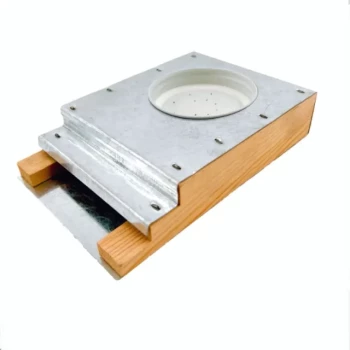
The feeder serves as the central interface for introducing medicated syrups to the honey bee colony. It functions as the primary administration port, enabling the precise delivery and regular re-administration of drugs to maintain effective concentrations within the hive.
The feeder is not just a food source; it is a controlled delivery system that allows apiarists to simulate commercial practices and sustain therapeutic drug levels necessary for long-term treatment efficacy.
The Mechanics of Medicinal Delivery
Precise Dosage Control
In the context of treatment, the feeder acts as a regulated input channel. It allows apiarists to administer specific volumes of medicated syrup, ensuring the colony receives the exact intended dosage.
Maintaining Drug Concentrations
Effective treatment often requires sustaining a specific level of medication in the hive over time. The feeder facilitates regular re-administration, preventing the drop in drug concentration that might occur with a single-application method.
Systemic Distribution
By mixing medication into syrup, the feeder leverages the bees' natural feeding behavior. This ensures the treatment is ingested and distributed throughout the population via their social food-sharing (trophallaxis).
Commercial Simulation and Research Validity
Replicating Industry Standards
For research to be applicable, it must mirror the real world. Using feeders helps simulate the actual management practices employed by commercial apiaries.
Studying Long-Term Effects
Feeders provide a stable environment for observing how treatments impact colony behavior over time. This setup allows researchers to study side effects, such as changes in the natural cleaning instincts of worker bees.
Establishing a Baseline
While primarily for medicine in this context, feeders also control nutritional variables. By ensuring bees are not stressed by starvation, observers can confirm that behavioral changes are due to the medicinal treatment, not nutritional stress.
Understanding the Trade-offs
Ingestion vs. Contact Application
Feeders are designed for treatments that must be ingested. They are ineffective for treatments requiring external contact, such as oxalic acid, which relies on coating the bee's body to kill mites.
The Limitation of Passive Uptake
Feeders rely on the bees' willingness to consume the syrup. During heavy nectar flows, bees may ignore the feeder, potentially leading to inconsistent dosing compared to active application methods like spraying.
Environmental Specificity
A sprayer is better suited for creating an immediate acidic environment on the hive frames. A feeder cannot replicate this "environmental change" effect as it localizes the substance to the feeding port.
Making the Right Choice for Your Goal
Selecting the correct administration method depends entirely on the mechanism of the medication and the objective of your intervention.
- If your primary focus is systemic medication: Use a feeder to deliver medicated syrups that require ingestion to maintain steady drug concentrations within the population.
- If your primary focus is contact-based parasite control: Use a sprayer to apply solutions like oxalic acid, ensuring the substance physically coats the bees and hive frames.
- If your primary focus is experimental consistency: Use feeders to standardize nutrient intake, eliminating starvation or environmental stress as variables in your study.
Properly matching the delivery device to the treatment type is the single most critical factor in achieving a successful therapeutic outcome.
Summary Table:
| Feature | Function in Medicinal Delivery | Benefit |
|---|---|---|
| Dosage Control | Regulated input channel for specific volumes | Ensures precise medicinal intake |
| Sustained Levels | Facilitates regular re-administration | Maintains effective drug concentrations |
| Distribution | Leverages natural trophallaxis (food sharing) | Spreads treatment throughout the colony |
| Research Tool | Simulates commercial apiary management | Provides valid data on long-term effects |
| Variable Control | Standardizes nutritional intake | Eliminates starvation as a study bias |
Maximize Your Colony Health with HONESTBEE Professional Equipment
For commercial apiaries and distributors, precision is the difference between a thriving hive and a lost season. HONESTBEE provides the industry's most comprehensive range of beekeeping tools, from specialized hive-making and honey-filling machinery to professional-grade feeders designed for accurate medicinal delivery.
Whether you are looking to scale your operations or supply your network with high-quality consumables and hardware, our wholesale solutions are tailored to your success.
Ready to upgrade your apiary's efficiency? Contact us today to discuss your wholesale needs and see how our expertise can support your growth.
References
- Hassan M. Sobhy, Ahmed A.EL-Wakeel. Effect of Some Substances as Therapy Treatments On The Hygienic Behavior of Honey Bee Worker, Apis mellifera L.. DOI: 10.22192/ijarbs.2017.04.02.002
This article is also based on technical information from HonestBee Knowledge Base .
Related Products
- HONESTBEE Round Hive Top Bee Feeder for Syrup
- HONESTBEE Entrance Bee Feeder Efficient Hive Front Liquid Feeding Solution for Beekeeping
- HONESTBEE Entrance Bee Feeder Professional Hive Nutrition Solution for Beekeeping
- HONESTBEE Professional Entrance Bee Feeder Hive Nutrition Solution
- HONESTBEE Square Top Hive Bee Feeder Top Bee Feeder
People Also Ask
- What can the round hive top feeder be used for? A Guide to Efficient, Safe Bee Feeding
- What types of hive boxes is the round hive top feeder compatible with? Universal Fit for 8 & 10-Frame Langstroth Hives
- What is the capacity of the round hive top feeder for syrup and pollen? A Guide to Targeted Apiary Support
- What types of feed can be used with the round hive top feeder? Versatile Feeding for Optimal Apiary Health
- How do you use a top feeder for bees? Expert Guide to Installation and High-Volume Hive Feeding