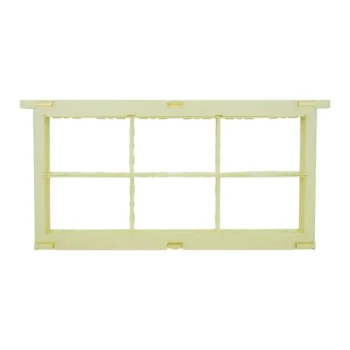
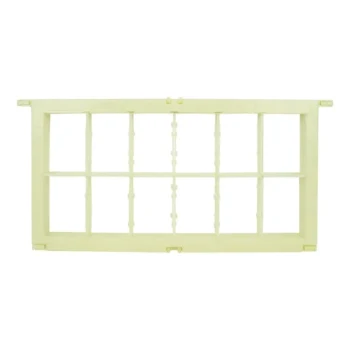
The primary function of a measurement frame with 5x5 centimeter grids is to standardize the assessment of a honeycomb surface, allowing for the conversion of visual patterns into precise numerical data. This tool divides the comb into 25-square-centimeter sections, enabling technicians to calculate the exact area of capped brood, honey, and pollen, which is then converted into cell counts or weight estimates.
Core Takeaway By overlaying a standardized geometric grid onto an irregular organic structure, this tool transforms subjective visual observations into objective, quantitative metrics, enabling the precise tracking of colony population potential and resource reserves.
The Mechanics of Quantitative Assessment
Standardizing the Comb Surface
Honeybees build combs in irregular patterns that are difficult to measure with the naked eye. The measurement frame imposes a standardized geometry over this organic structure.
By breaking the comb into 5x5 centimeter grids, the frame creates manageable 25-square-centimeter units. This segmentation allows the observer to quickly quantify large areas of the hive without needing to count every individual cell.
Converting Area to Cell Counts
The defining feature of this tool is its ability to facilitate mathematical conversion.
Because the cell density of a honeycomb is a known variable—cited in this context as approximately 4 worker cells per square centimeter—the total area measured by the grid can be instantly translated into a population count.
For example, measuring the area of capped brood allows an observer to estimate the number of emerging workers, providing a concrete data point for the colony’s future strength.
Estimating Resource Weights
The grid system is not limited to population metrics; it is equally vital for resource management.
Technicians use the grid to measure areas containing honey and pollen. Using the same area-to-volume principles, these measurements can be converted into weight estimates (e.g., kilograms of honey), offering a precise inventory of the colony's nutritional reserves.
Applications in Colony Management
Predicting Population Dynamics
The most critical application of the 5x5 grid is the assessment of capped brood.
By quantifying the area of sealed pupae, beekeepers can predict the "overwintering potential" and population replacement rate of the colony. This provides a clear timeline for when new adult bees will emerge to replace the aging workforce.
Evaluating Colony Health and Treatments
Quantitative data allows for objective comparisons over time.
By recording exact grid counts before and after specific interventions—such as supplementary feeding or disease treatments—technical personnel can measure the direct impact on the queen’s egg-laying rate and overall colony vitality.
Understanding the Limitations
The Trade-off of Approximation
While the grid system offers high precision compared to visual guessing, it remains an estimation tool.
The accuracy of the final data relies heavily on the consistency of the conversion factor (the cells-per-centimeter ratio). Variations in natural comb construction or drone comb density can introduce slight margins of error.
Handling Irregular Patterns
Honeybees rarely fill combs in perfect squares.
When a patch of brood or honey only partially fills a 5x5 cm grid square, the technician must estimate the percentage of fill. This human element of estimation requires training to ensure consistency across different inspections.
Making the Right Choice for Your Goal
When employing a measurement frame for colony assessment, tailor your approach to your specific objective:
- If your primary focus is Population Forecasting: Prioritize measuring capped brood areas to generate accurate projections of the workforce that will be available in the coming weeks.
- If your primary focus is Resource Management: Focus on quantifying honey and pollen areas to calculate precise weight estimates of winter stores, ensuring the colony has sufficient fuel to survive.
By rigorously applying this standardized measurement technique, you move beyond guesswork and gain the actionable data necessary to manage colony health with scientific precision.
Summary Table:
| Metric Category | Unit of Measurement | Primary Function |
|---|---|---|
| Grid Dimensions | 5x5 Centimeters | Standardizes the assessment of irregular comb surfaces |
| Unit Area | 25 Square Centimeters | Enables manageable segmentation for quick quantification |
| Population Data | Capped Brood Area | Estimates future workforce through area-to-cell conversion |
| Resource Data | Honey & Pollen Area | Calculates weight estimates (kg) of nutritional reserves |
| Conversion Factor | ~4 Worker Cells / cm² | Provides the mathematical basis for objective population metrics |
Maximize Your Colony Productivity with HONESTBEE
Precision in the field requires precision in your equipment. At HONESTBEE, we specialize in supporting commercial apiaries and distributors by providing the industry's most comprehensive range of wholesale beekeeping solutions.
Whether you need standardized beekeeping tools for accurate colony assessment, high-capacity honey-filling machines, or durable hive-making machinery, we deliver the specialized hardware necessary to scale your operations. From essential consumables to honey-themed merchandise, our portfolio is designed to enhance your efficiency and profitability.
Ready to upgrade your apiary’s performance?
Contact HONESTBEE Today to discuss our wholesale offerings and discover how our expertise can benefit your business.
References
- S. Lazarov, Zlatko Puškadija. Impact of Different Sugar Syrups on the Development of the Fat Body in Worker Bees (Apis mellifera macedonica). DOI: 10.3390/agriculture15010083
This article is also based on technical information from HonestBee Knowledge Base .
Related Products
- Assembled Wooden Bee Frames with Plastic Foundation for Durability and Convenience by HONESTBEE
- Assembled Wooden Bee Frames with Beeswax Foundation Ready to Use by HONESTBEE
- HONESTBEE Wired and Assembled Wooden Bee Frames Foundation for a Thriving Hive
- Professional 500g Sectional Comb Honey Frame System for Beekeeping
- Honey Bee Lifecycle Model: A Detailed Honeycomb Display of Bee Development
People Also Ask
- When should frames with new foundation be given to colonies? Master Timing for a Thriving Hive
- Can beekeepers switch between wooden and plastic frames? Optimize Your Hive's Performance
- What types of bee frames can be cleaned and returned to service? A Guide to Safe Apiary Refurbishment
- What are bee frames and how are they sized? A Professional Guide to Standardization & Material Choice
- How do you re-wax bee frames? A Simple Guide to Faster Comb Building