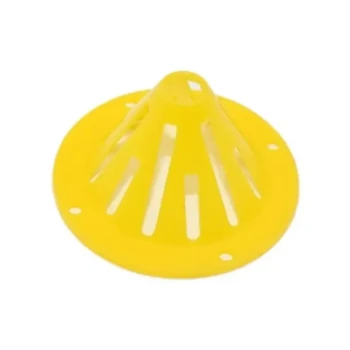
A One-way Escape Cone serves as a unidirectional check valve for bee traffic. Installed directly over the entrance of an established colony, its primary function is to allow worker bees to exit for foraging while physically preventing them from re-entering the original hive. This structural intervention forces the displaced workforce to gradually relocate into a temporary "trap-out" hive positioned nearby, enabling colony removal without destroying the building or tree where they are nesting.
By manipulating the bees' access points, the escape cone leverages natural foraging instincts to deplete the original colony's population and safely migrate them to a manageable box without the use of chemicals or demolition.
The Mechanics of Relocation
Creating a Clear Exit Path
The cone is designed to fit securely over the colony's current entry point. From the inside, bees see light at the end of the funnel and can navigate through the wide base toward the narrow tip to leave. This ensures that normal foraging activities continue interruption-free.
The Structural Blockade
The critical function lies in the return trip. Honeybees are creatures of habit and will attempt to re-enter exactly where they exited. However, the cone's tip is too narrow and positioned in such a way that returning bees cannot locate or navigate the opening from the outside.
Forcing the Adoption of New Shelter
Denied access to their original home, the returning foragers become displaced. With the escape cone blocking the old entrance, these bees are compelled to seek the nearest available shelter. This guides them into a temporary trap-out hive placed immediately adjacent to the cone.
Understanding the Trade-offs
High Time Investment
This method is not instantaneous. Because the cone relies on individual bees leaving voluntarily to forage, it takes time to deplete the workforce. The process requires patience and can take several weeks to move the majority of the colony.
The Queen and Brood Limitation
The escape cone primarily removes the flying workforce. The queen and the brood (developing bees) typically remain inside the original cavity because they do not leave to forage. While the workforce is relocated, the original nest eventually dwindles, but the queen often requires a secondary strategy for final removal.
Applying the Strategy to Your Project
The One-way Escape Cone is a precision tool, but it must be matched to your specific removal goals.
- If your primary focus is Non-Destructive Removal: The cone is the superior choice, as it removes bees from walls or trees without requiring you to cut into the structure.
- If your primary focus is Speed: This method is likely unsuitable; a structural "cut-out" is the only way to remove a colony immediately.
The escape cone transforms a complex removal problem into a manageable migration by working with the biology of the bee rather than against it.
Summary Table:
| Feature | Function & Impact |
|---|---|
| Unidirectional Flow | Allows foragers to exit toward light but blocks re-entry at the narrow tip. |
| Population Migration | Displaced workers are forced to relocate to a nearby bait hive or trap-out box. |
| Structural Integrity | Eliminates the need for cutting into walls, roofs, or trees to remove a colony. |
| Natural Process | Utilizes foraging instincts for a chemical-free, non-destructive removal method. |
| Timeline | High-precision, low-impact process typically requiring several weeks for completion. |
Optimize Your Apiary with HONESTBEE
Whether you are a commercial apiary managing large-scale removals or a distributor seeking high-quality beekeeping supplies, HONESTBEE is your strategic partner. We provide a comprehensive range of professional tools, from high-precision escape cones and hive-making machinery to essential industry consumables.
Why partner with us?
- Wholesale Excellence: Full spectrum of beekeeping hardware and honey-filling machinery.
- Commercial Reliability: Durable equipment designed for professional-grade field operations.
- Global Distribution: Supporting distributors with consistent supply and cultural merchandise.
Ready to enhance your efficiency and service quality? Contact us today to discuss our wholesale offerings and customized machinery solutions.
References
- Mary Bammer, Amy T. Vu. Best Management Practices for Live Bee Removals in Florida: A Beekeeper’s Guide. DOI: 10.32473/edis-in1297-2020
This article is also based on technical information from HonestBee Knowledge Base .
Related Products
- Heavy Duty Metal Corner Bee Escape for Reliable Hive Clearing
- Professional Durable Two-Piece Plastic Bee Escape
- Professional Cone Style Bee Escape for Efficient Honey Harvesting
- HONESTBEE 4-Way Metal Corner Wooden Bee Escape Board
- Durable 16 Way Circular Bee Escape for Efficient Honey Harvesting
People Also Ask
- What are some common types of bee escapes and how are they typically mounted? Optimize Your Honey Harvest Efficiency
- What is the primary function of a bee escape? Simplify Your Honey Harvest with Stress-Free Hive Management
- How can a bee escape be adapted for use in a Warre hive? Effective Customization Methods for Successful Harvesting
- How can bees be cleared off honey supers in a Langstroth hive? Use a Gentle Bee Escape
- How long should a bee escape be placed before harvesting honey? The 24-48 Hour Guide to a Stress-Free Harvest