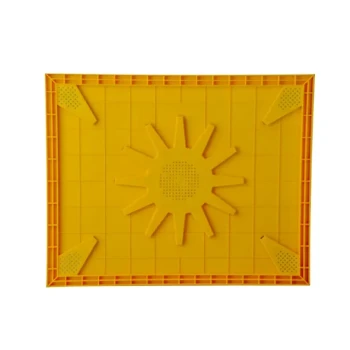
Large plastic boards or plywood sheets serve as a specialized collection interface designed to capture biological material dislodged from abandoned beehives. During the visual screening process, operators vigorously shake hive frames over these flat surfaces to dislodge pests, specifically adult small hive beetles and ants. This technique creates a controlled area for inspection, preventing target insects from escaping into the surrounding environment before they can be counted.
By converting the inspection area from complex hive frames to a flat, two-dimensional surface, these boards ensure that field survey data is accurate, consistent, and free from the errors caused by insect evasion.
The Mechanics of Visual Screening
Creating a Collection Interface
The primary role of the sheet is to act as a catch-all platform. When frames are shaken, all biological components—debris, wax, and insects—fall onto this surface.
This allows the operator to separate the insects from the hive structure instantly. Without this barrier, pests would be lost in the grass or soil immediately upon being dislodged.
Enhancing Visual Contrast
These boards provide a clear, open background against which dark insects stand out.
Visual screening relies heavily on the operator's ability to spot movement and distinct shapes. A plain plastic or plywood surface minimizes visual noise, allowing for the rapid identification of specific pests like small hive beetles.
Ensuring Data Accuracy
Preventing Specimen Escape
Abandoned hives often contain agile pests that attempt to flee when disturbed. The smooth surface of a plastic board or plywood sheet hinders their movement just long enough for the operator to react.
This containment is critical for maintaining the integrity of field survey data. If insects escape before counting, infestation estimates will be artificially low.
Facilitating Exact Counts
Once the biological matter is spread across the flat surface, operators can systematically count the population.
This method transforms a qualitative observation (seeing bugs in a hive) into a quantitative dataset (an exact count of beetles or ants). This precision is necessary for accurately assessing the health of the hive and the severity of the infestation.
Common Pitfalls to Avoid
Surface Texture and Condition
To function correctly, the collection board must remain smooth and free of deep scratches or debris.
If the board is rough or warped, small insects like ants can hide in crevices. This defeats the purpose of the open background and can compromise the accuracy of the count.
The Risk of Overloading
While the board is designed to catch falling debris, shaking too many frames at once can clutter the viewing area.
An overloaded board makes it difficult to distinguish pests from wax crumbs or propolis. For the best results, the "shakedown" process should be managed to keep the visual field relatively clear.
Optimizing Your Inspection Strategy
To get the most reliable data from your visual screening, align your use of these tools with your specific objectives:
- If your primary focus is Pest Quantified Data: Ensure the board surface is light-colored and smooth to maximize contrast against dark beetles and ants for an exact count.
- If your primary focus is Speed of Inspection: Use a larger sheet of plywood to allow for more vigorous shaking without the risk of biological material falling off the edges.
The effectiveness of your survey ultimately depends on maintaining a controlled interface that renders the invisible visible.
Summary Table:
| Feature | Function in Visual Screening | Impact on Data Quality |
|---|---|---|
| Collection Interface | Captures dislodged pests (beetles/ants) from shaken frames | Prevents specimen loss in grass/soil |
| Visual Contrast | Provides a flat, plain background | Enhances identification of dark-colored pests |
| Movement Barrier | Hinders rapid insect escape | Ensures higher counts and accurate infestation levels |
| Surface Area | Converts 3D hive space to a 2D plane | Facilitates systematic, quantitative counting |
Maximize Your Apiary Productivity with HONESTBEE
For commercial apiaries and distributors, precision in pest management is the foundation of a healthy honey yield. HONESTBEE provides the professional-grade tools you need to maintain that standard. From high-durability beekeeping hardware to advanced hive-making and honey-filling machinery, we supply everything the modern honey industry requires.
Partner with us to access a comprehensive wholesale portfolio of specialized equipment and essential consumables designed for large-scale success. Contact us today to optimize your apiary operations!
References
- Peter Neumann, Randall Hepburn. Differences in absconding between African and European honeybee subspecies facilitate invasion success of small hive beetles. DOI: 10.1007/s13592-018-0580-4
This article is also based on technical information from HonestBee Knowledge Base .
Related Products
- Solid Bottom Board Australian Pine Wood Langstroth Bottom Board for Wholesale
- Precision Stainless Steel Frame Cleaner for Hive Grooves and Corners
- Heavy Duty Castellated Iron Frame Spacer for Honey Supers
- HONESTBEE Multi Exit Plastic Bee Escape Board for Efficient Honey Harvesting
- Australian Pine Wood Langstroth Screen Bottom Board for Wholesale
People Also Ask
- In what conditions is a solid bottom board preferred over a screened bottom board? Maximize Hive Heat and Treatment
- What are the characteristics of a solid bottom board? A Guide to Hive Foundation & Climate Control
- What is the primary function of a solid bottom board on a beehive? Key Benefits for Hive Stability and Insulation
- What are the benefits of a solid bottom board? Boost Hive Health with Superior Insulation & Defense
- What is the purpose of a solid bottom board in a hive? Essential for Winter Survival & Insulation