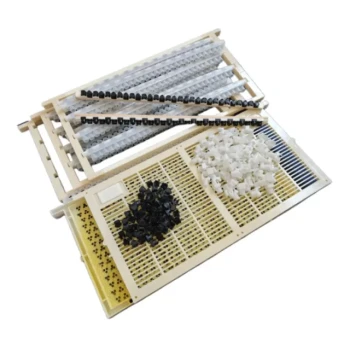
The Hahnemann lattice acts as a selective physical filter. In the partial queenless method of royal jelly production, this device is embedded within a solid diaphragm to isolate the queen bee from the rearing area. Its primary function is to physically prevent the queen from accessing and destroying artificial queen cells, while simultaneously allowing worker bees to pass through freely to feed larvae and maintain colony cohesion.
The lattice acts as a biological valve, separating the queen to protect the harvest while preserving the social structure required for high-volume royal jelly secretion.
The Mechanics of Queen Isolation
Selective Permeability
The effectiveness of the Hahnemann lattice relies on precise pore size. The openings are calibrated to be smaller than the thorax of a queen bee but sufficiently large for worker bees.
This strictly confines the queen to a specific zone of the hive. However, it ensures that the workforce—the nurse bees—can circulate without restriction between the queen and the production area.
Preventing Cell Destruction
If left unrestricted, a queen bee will naturally identify artificial queen cells as rivals. Her instinct is to destroy these cells immediately.
By physically blocking the queen, the lattice creates a safe rearing zone. This allows the larvae within the artificial cups to develop undisturbed, ensuring the royal jelly deposited there can be harvested.
Maintaining Colony Dynamics
Preserving Social Cohesion
Unlike total queen removal, which can cause significant colony stress, the partial queenless method relies on the "queenright" illusion.
The lattice facilitates this by allowing worker bees to interact with the queen and transfer her pheromones throughout the hive. This keeps the colony stable and prevents the behavioral disruptions associated with queenlessness.
Ensuring Nursing Motivation
High yields of royal jelly depend on the active participation of nurse bees.
Because workers can move freely through the lattice, they maintain their natural nursing motivation. They continue to feed the larvae in the isolated section aggressively, resulting in the secretion of royal jelly into the artificial cells.
Understanding the Trade-offs
Mechanical Complexity
Implementing a solid diaphragm with an embedded lattice introduces mechanical complexity to the hive. The barrier must be fitted precisely.
Any gap between the diaphragm and the hive walls essentially renders the lattice useless, as the queen may bypass the filter and destroy the crop.
Maintenance Requirements
The lattice creates a bottleneck for worker traffic. Over time, bees may attempt to bridge these gaps with wax or propolis.
Regular inspection is required to ensure the pores remain open. If the lattice becomes clogged, it isolates the rearing section too strictly, potentially reducing the flow of nurse bees and diminishing the yield.
Making the Right Choice for Your Goal
To maximize the utility of the Hahnemann lattice in your production cycle, consider your specific objectives:
- If your primary focus is crop security: Ensure the lattice is embedded in a completely flush solid diaphragm to guarantee the queen cannot bypass the barrier and access the artificial cells.
- If your primary focus is colony longevity: Monitor the lattice traffic to ensure maximum worker movement, as this social flow minimizes stress and maintains the nursing instinct over long production seasons.
The Hahnemann lattice is the critical component that allows a hive to function simultaneously as a stable society and a specialized production unit.
Summary Table:
| Feature | Function in Royal Jelly Production |
|---|---|
| Selective Pore Size | Blocks the queen's thorax while allowing worker bee passage. |
| Physical Barrier | Prevents the queen from instinctually destroying artificial queen cells. |
| Pheromone Transfer | Permits worker movement to circulate queen scents and reduce hive stress. |
| Nursing Motivation | Encourages nurse bees to continuously feed larvae in the production zone. |
Scale Your Royal Jelly Production with HONESTBEE
Maximize your apiary's efficiency with precision-engineered equipment designed for high-volume output. HONESTBEE specializes in supporting commercial apiaries and global distributors with a comprehensive range of professional beekeeping tools and machinery.
Whether you need specialized hive-making components, high-performance honey-filling machines, or essential consumables, we provide the hardware and expertise to streamline your operations. From protecting your harvest with the right isolation tools to modernizing your extraction line, our portfolio is built to enhance your bottom line.
Ready to upgrade your wholesale supply? Contact us today to discover how HONESTBEE can power your beekeeping business.
References
- O. Mischenko, D. Kryvoruchko. The influence of honey harvest conditions on the production of the royal jelly by queen bees. DOI: 10.31073/agrovisnyk202104-06
This article is also based on technical information from HonestBee Knowledge Base .
Related Products
- No Grafting Queen Rearing Kit: System for Royal Jelly Production and Queen Rearing
- Plastic Chinese Queen Grafting Tool for Bee Queen Rearing
People Also Ask
- What is the primary function of a queen rearing kit? Eliminate Manual Grafting for Superior Bee Breeding
- How do specialized queen rearing kits and queen management tools improve the success rate of bee colony expansion?
- What are some alternative methods to grafting for queen cell production? Discover Graft-Free Queen Rearing Systems
- Are queen rearing systems generally suitable for all honeybee species? Master Efficient Breeding Methods
- Are queen rearing systems suitable for all beekeepers? Modern Tools for Every Experience Level