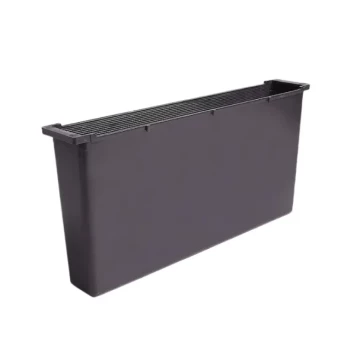
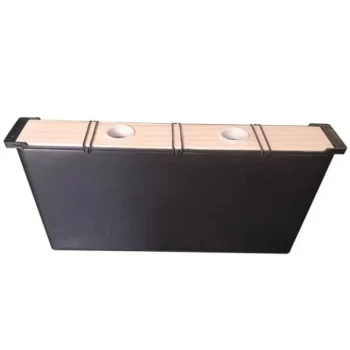
An internal feeder with a physical partition design is essential for maintaining the absolute integrity of input variables in honey storage experiments. By creating a mechanical barrier, this design ensures that different sugar concentrations or liquids containing specific markers remain completely independent and unmixed before they are accessed by honeybees.
By preventing liquids from mixing within the feeder, the physical partition isolates bee behavior as the sole variable. This ensures that any patterns found in the hive are the result of the bees' decisions, not the physics of the feeder.
The Mechanics of Experimental Control
Preventing Premature Mixing
The primary function of the physical partition is to stop experimental materials from interacting before collection. Without this barrier, liquids of different densities or compositions could blend naturally.
This design guarantees that the "input" remains exactly as the researcher intended.
Ensuring Component Independence
In experiments involving distinct sugar concentrations or chemical markers, purity is paramount. The partition maintains the specific characteristics of each solution.
This allows researchers to introduce multiple variables simultaneously without the risk of cross-contamination.
Isolating Biological Variables
Attributing Results to Active Strategies
The ultimate goal of using a partitioned feeder is to determine the cause of honey distribution within the hive. Researchers need to know if the bees are making active choices about where to store specific resources.
The partition eliminates the alternative explanation: that the food was already mixed before it entered the hive.
Validating Patchy Distribution
When researchers observe a "patchy distribution" of different honey concentrations in the comb, they need to validate the source of this pattern.
Because the feeder physically prevents mixing, any mixing or segregation observed inside the hive can be definitively attributed to the active storage strategies of the honeybees.
Common Pitfalls in Experimental Design
The Risk of Physical Mixing
Without a physical partition, the results of a storage experiment become ambiguous. Fluids can mix due to diffusion or bee movement within a standard open feeder.
If this occurs, it becomes impossible to distinguish between the bees' biological intent and simple fluid dynamics.
Loss of Controllability
Omitting the partition sacrifices the controllability of input components. In precise behavioral studies, knowing the exact composition of the liquid at the point of collection is non-negotiable.
Ensuring Experimental Validity
If your primary focus is behavioral analysis: Ensure the partition is intact to confirm that hive storage patterns are driven by the bees' active sorting strategies.
If your primary focus is input control: Use the physical design to maintain strict separation between different sugar concentrations or markers until the moment of collection.
A physical partition transforms a feeder from a simple container into a precise scientific instrument capable of isolating biological intent.
Summary Table:
| Feature | Purpose in Experiments | Benefit to Research |
|---|---|---|
| Mechanical Barrier | Prevents premature mixing of liquids | Maintains integrity of input variables |
| Component Isolation | Keeps different sugar concentrations separate | Ensures purity of chemical markers |
| Controlled Input | Eliminates fluid dynamics as a factor | Isolates bee behavior as the sole variable |
| Distribution Logic | Validates active storage strategies | Confirms bees' active sorting vs. passive mixing |
Elevate Your Apiary Operations with HONESTBEE
At HONESTBEE, we understand that precision is the backbone of successful beekeeping, whether in scientific research or commercial production. As a leading provider for commercial apiaries and distributors, we offer a comprehensive wholesale range of high-quality beekeeping tools, specialized machinery, and essential consumables.
From hive-making and honey-filling machines to specialized feeders and honey-themed cultural merchandise, we supply the hardware you need to scale your business. Partner with us to access professional-grade equipment that ensures efficiency and reliability across your entire operation.
Ready to upgrade your equipment? Contact us today to discuss our wholesale offerings and how we can support your growth.
References
- Mark Greco, Karl Crailsheim. Sugar concentration influences decision making in <i>Apis mellifera</i> L. workers during early-stage honey storage behaviour. DOI: 10.4236/ojas.2013.33031
This article is also based on technical information from HonestBee Knowledge Base .
Related Products
- Professional In-Hive Bee Feeder HONESTBEE Frame for Beekeeping
- White Plastic 0.5L Beekeeping Entrance Feeder for Bees
- In-Hive Dual Compartment Frame Bee Feeder for Targeted Colony Nutrition
- 3.5L Plastic Beehive Frame Feeder Deep Frame Water Feeder for In Hive Use
- Boardman Entrance Bee Feeder Durable Galvanized Steel and Wood Construction for Beekeeping
People Also Ask
- When should beekeepers stop feeding their bees? Let Your Bees Tell You
- Why is the use of a beekeeping feeder for syrup supplementation important? Boost Colony Growth and Survival
- What are the common types of internal and external feeders used in beekeeping? Choose the Right Feeder for Your Hive
- What is a feeder in the context of beekeeping? Optimize Your Hive Nutrition and Growth
- How do specialized feeders contribute to effective artificial feeding? Scientific Apiary Management & Colony Health