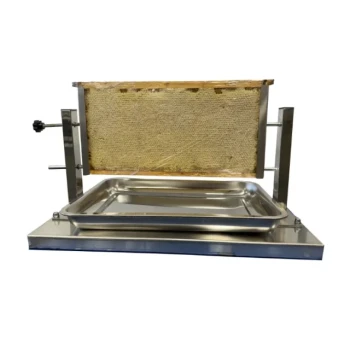
The primary function of high-specification iron stands is to provide a rigid, immobile support structure that maintains a precise fixed vertical height for induction feeders. In outdoor research environments, these stands are essential for preventing positional shifts caused by wind, weather, or biological disturbances.
By stabilizing the physical position of the feeder, these stands eliminate environmental variables. This consistency allows stingless bees to establish accurate spatial memories, ensuring that foraging behavior data remains valid and reproducible.
The Mechanics of Experimental Stability
Maintaining Fixed Vertical Height
The core technical requirement of these stands is to lock the induction feeder at a specific, unchanging elevation.
In foraging studies, the vertical position of a food source is a critical variable. The iron stand ensures that once this variable is set, it does not drift or sag over time.
Resisting Environmental Disturbances
Outdoor field research is subject to unpredictable physical forces. High-specification iron is used specifically for its mass and structural rigidity.
This heavy-duty construction prevents the equipment from shifting due to wind gusts or physical contact from animals (biological disturbances). Without this stability, the data could be corrupted by the unintentional movement of the food source.
The Impact on Bee Behavior and Data
Facilitating Spatial Memory
Stingless bees rely heavily on spatial memory to navigate back to profitable food sources.
For a bee to forage efficiently, the target must be exactly where it remembers it to be. A stable stand ensures the "target" remains static, allowing the bees to navigate based on established memory rather than constant re-searching.
Standardizing the Foraging Context
Just as standardized beehives ensure comparability across different colonies, stable feeder stands ensure comparability across foraging trials.
If the feeder moves, you are introducing an uncontrolled variable. By fixing the position, researchers can be confident that they are observing natural foraging preferences, not reactions to a moving target.
Operational Considerations and Trade-offs
Portability vs. Stability
The very attribute that makes these stands effective—their high-specification iron construction—also limits their flexibility.
They are likely heavy and difficult to relocate once installed. This makes them excellent for long-term stationarity but less ideal for studies requiring frequent, rapid relocation of feeding sites.
Setup Precision
The value of a high-specification stand is nullified if the initial installation is flawed.
Because the stand is designed to be fixed, any error in the initial height setting or leveling is difficult to correct mid-experiment without disturbing the bees. Rigorous initial setup is mandatory.
Making the Right Choice for Your Research
If your primary focus is behavioral accuracy: Prioritize high-mass iron stands to ensure the spatial constancy required for bees to form reliable memories.
If your primary focus is colony management: Focus your attention on the hive architecture (as noted in supplementary contexts) rather than the feeder stands, ensuring the nest mimics natural hollows for health and protection.
If your primary focus is data comparability: Utilize identical high-specification stands across all trial sites to eliminate environmental variance as a potential error source.
Reliable behavioral data begins with the mechanical rigidity of your experimental setup.
Summary Table:
| Feature | Purpose in Research | Benefit for Stingless Bee Studies |
|---|---|---|
| Rigid Iron Construction | Provides high mass and structural integrity | Prevents shifts from wind, weather, or animal contact |
| Fixed Vertical Height | Maintains unchanging elevation of feeder | Eliminates height as an uncontrolled variable |
| Positional Stability | Ensures the feeder remains in a static location | Facilitates accurate spatial memory for foraging bees |
| Standardized Setup | Uniformity across multiple trial sites | Ensures comparability and reproducibility of behavioral data |
Elevate Your Bee Research and Commercial Operations with HONESTBEE
At HONESTBEE, we understand that precision is the foundation of success, whether you are conducting rigorous field research or managing large-scale commercial apiaries. As a premier provider for distributors and commercial beekeeping enterprises, we offer more than just supplies; we provide the professional-grade infrastructure needed for excellence.
Our comprehensive wholesale portfolio includes:
- Precision Machinery: Advanced honey-filling and hive-making machines to scale your production.
- Specialized Equipment: High-durability hardware and beekeeping tools designed to withstand the rigors of any environment.
- Industry Consumables: A full spectrum of essential supplies for the modern apiary.
- Cultural Merchandise: Unique honey-themed products to expand your brand's reach.
Ready to upgrade your equipment or stock your distribution network with the best in the industry? Contact us today to discuss how HONESTBEE can deliver the quality and reliability your business deserves.
References
- Neeltje J. Boogert, Ingrid Aguilar Monge. The use of food source scent marks by the stingless bee<i>Trigona corvina</i>(Hymenoptera: Apidae): the importance of the depositor’s identity. DOI: 10.1051/apido:2006001
This article is also based on technical information from HonestBee Knowledge Base .
Related Products
- Metal Bee Hive Stand Bee Box Stand for Beekeeping
- Boardman Entrance Bee Feeder Durable Galvanized Steel and Wood Construction for Beekeeping
- Professional In-Hive Bee Feeder HONESTBEE Frame for Beekeeping
- HONESTBEE Professional Entrance Bee Feeder Hive Nutrition Solution
- Professional In-Hive Frame Bee Feeder by HONESTBEE
People Also Ask
- What height should a bee hive stand be? Optimize for Your Back and Hive Health
- What are the potential risks of plastic bee hive stands? Avoid Structural Failure in Your Apiary
- What are the essential technical specifications for a high-quality bee hive stand? Maximize Stability and Hive Safety
- What are the benefits of elevating a bee hive with a stand or base? Protect Your Colony and Your Back
- Why are specialized beehive stands or protective barriers necessary for pest management in apiaries? Secure Your Colony