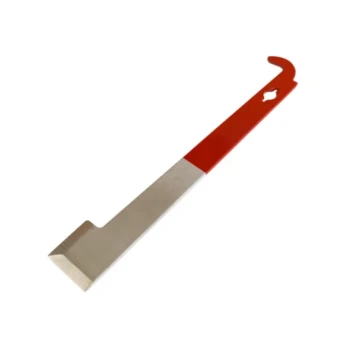
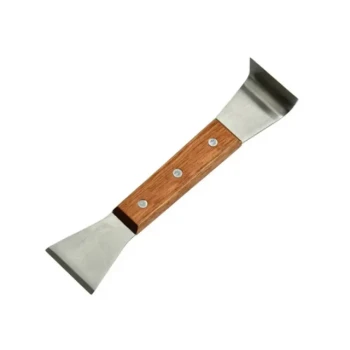
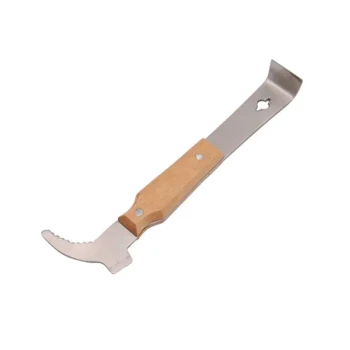
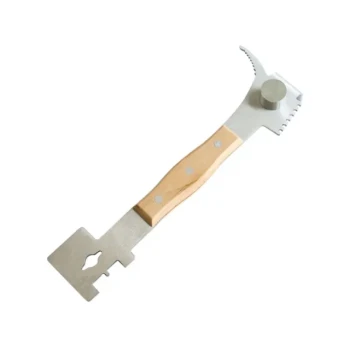
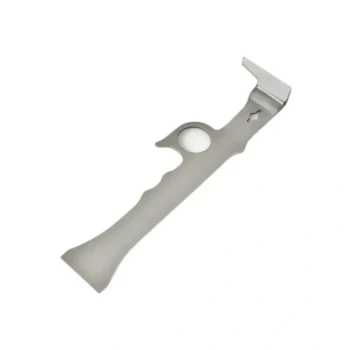
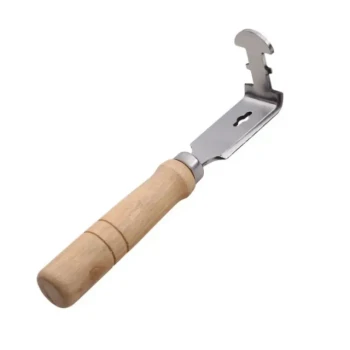
Professional hive tools serve as the primary mechanical interface for apiary management, functioning as a lever to breach the seal created by bees. By utilizing high-hardness metal and the principle of physical leverage, these tools allow beekeepers to pry open honey supers, hive covers, and frames that have been tightly sealed with propolis.
Core Takeaway
Bees naturally seal their habitat with propolis, a resinous substance that effectively glues hive components together. A professional hive tool provides the precise leverage required to separate these components without destroying the wooden or composite structure, making it fundamental for efficient inspection and routine operations.
The Mechanics of Hive Access
Overcoming the Propolis Seal
Bees instinctively seal gaps in the hive with propolis, a resin mixture that hardens significantly over time.
Without a specialized tool, separating boxes or frames is nearly impossible without causing structural damage.
The hive tool acts as a wedge, breaking this strong chemical bond to allow access to the colony.
The Role of Material Hardness
Professional tools are manufactured from high-hardness metal.
This ensures the tool does not bend or deform when applying the significant force needed to crack the propolis seal.
Inferior materials would fail under the stress required to separate well-established hive components.
Precision Leverage
The design of the tool focuses on physical leverage.
It converts a small amount of operator force into a high-magnitude force at the fulcrum point.
This allows for the controlled lifting of heavy supers and sticky frames with minimal physical exertion.
Operational Efficiency and Safety
Protecting Hive Integrity
A primary function of the hive tool is to ensure the separation of components without damage.
Improper prying methods can splinter wooden frames or crack composite hive bodies.
By applying force precisely at the joints, the tool preserves the modular dimensions of the equipment, ensuring frames remain interchangeable across the apiary.
Preventing Bee Injury
Specialized tools allow for a controlled, slow separation of parts.
This prevents the sudden snapping or shifting of frames that often results in crushing bees.
Avoiding physical harm to the bees creates a calmer environment for inspection and reduces defensive behavior.
Sanitation and Pest Control
Beyond leverage, these tools are essential for scraping away excess waste wax and debris.
This cleaning function removes breeding grounds for pests such as wax moths or parasites like Varroa mites.
Regular scraping acts as a physical defense, maintaining colony health and preventing disease outbreaks.
Understanding the Trade-offs
Force vs. Finesse
While the tool provides significant leverage, misapplication of force is a common pitfall.
Because the metal is harder than the hive material, aggressive prying can gouge wood or dent polystyrene.
The operator must rely on the tool's geometry, not brute strength, to avoid damaging the equipment it is meant to protect.
Making the Right Choice for Your Goal
To maximize the effectiveness of your apiary maintenance, consider your specific operational focus:
- If your primary focus is Equipment Longevity: Prioritize using the tool's leverage to gently crack propolis seals at the joints, ensuring you do not splinter the wood or composite edges.
- If your primary focus is Pest Management: Utilize the tool's scraping edge during every inspection to remove burr wax and debris where mites and larvae often hide.
Ultimately, the hive tool transforms the brute force required to open a sealed hive into a precise operation that protects both the colony and the infrastructure.
Summary Table:
| Key Role | Primary Benefit | Technical Mechanism |
|---|---|---|
| Propolis Breach | Easy access to hive components | High-magnitude physical leverage |
| Structural Integrity | Prevents splintering/cracking of wood | Precise wedge application at joints |
| Bee Protection | Minimizes colony stress and injury | Controlled, slow separation of frames |
| Sanitation | Pest and disease prevention | Scraping edge for wax/debris removal |
| Durability | Tool longevity under high stress | High-hardness metal construction |
Elevate Your Beekeeping Operations with HONESTBEE
At HONESTBEE, we understand that professional-grade tools are the backbone of a successful commercial apiary. As a premier provider for distributors and commercial beekeepers, we offer a comprehensive wholesale portfolio—from precision hive-making and honey-filling machinery to high-durability hardware and essential consumables.
Our specialized beekeeping equipment is designed to enhance operational efficiency, protect your hive infrastructure, and maximize honey production. Whether you are scaling your apiary or supplying the next generation of beekeepers, we provide the industrial-strength solutions you need to thrive.
Ready to scale your business with the industry's most reliable equipment?
Contact Us Today to Discuss Wholesale Solutions
References
- P.P. Snegur, M. Yu. Dyakov. On the profitability of beekeeping in conditions of Kamchatka Territory. DOI: 10.30766/2072-9081.2025.26.2.426-436
This article is also based on technical information from HonestBee Knowledge Base .
Related Products
- Professional Multi-Function Stainless Steel Hive Tool
- Professional Stainless Steel J-Hook Hive Tool
- Professional Stainless Steel Pry-Bar Hive Tool
- HONESTBEE Professional Long Handled Hive Tool with Precision Cutting Blade
- Professional Dual-End Stainless Steel Hive Tool for Beekeeping
People Also Ask
- Why are professional hive tools considered indispensable? Master Beekeeping Maintenance with Precision Leverage
- What are the benefits of a multi-functional hive tool? Streamline Your Apiary Workflow with One Tool
- What advantages do multi-functional hive tools offer? Maximize Your Apiary Efficiency and Workflow
- What are the common construction features of hive tools? Key Insights for Superior Beekeeping Efficiency
- Which intervention materials and management tools are used in commercial apiaries? Protect Your Bees from Pesticides