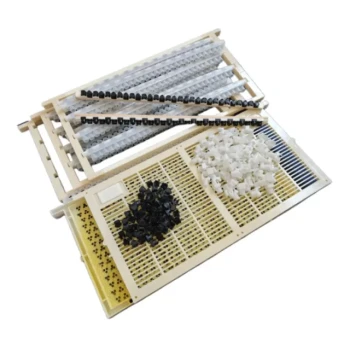
A high-performance stereo microscope acts as the essential visual command center during queen bee insemination, providing the magnification and depth perception required for real-time monitoring. Its primary technical function is to guide the operator in inserting the insemination capillary to a precise depth of approximately 1.0 mm, ensuring safe navigation past internal anatomical barriers.
The Core Insight: While mechanical instruments hold the queen in place, only the stereo microscope provides the depth of field necessary to navigate the "valve fold." This visual precision is the single most critical factor in preventing injury to the queen and ensuring the semen reaches the oviducts for a successful insemination.
Visualizing Micro-Anatomy in Real-Time
The Role of Depth of Field
Standard magnification is insufficient for this procedure; the operator requires a 3D view of the anatomy.
A stereo microscope provides high-quality depth of field, allowing the operator to judge distances accurately within the queen's posterior.
Continuous Monitoring
The insemination process is dynamic, not static.
The microscope enables real-time monitoring of fine movements, ensuring the operator can react instantly to minor anatomical variances during the procedure.
Navigating the Critical "Valve Fold"
Exposing the Pathway
Before the microscope acts as a guide, high-precision mechanical instruments prepare the site.
Specialized ventral and sting hooks separate the sting chamber to expose the vaginal opening, creating a clear line of sight for the operator.
The 1.0 mm Precision Threshold
The most delicate aspect of the operation involves the insemination capillary.
Under microscopic guidance, the operator must insert this capillary into the vagina to a depth of approximately 1.0 mm.
Bypassing Internal Obstacles
The vagina contains a structure known as the valve fold, which acts as a natural barrier.
The microscope allows the operator to visually verify that the capillary has successfully navigated past this fold to inject semen directly into the median or lateral oviducts.
Operational Risks and Trade-offs
The Consequence of Poor Visibility
Without the depth perception provided by a stereo microscope, the procedure becomes a guessing game.
Failure to visualize the valve fold accurately leads to improper insertion depth, which can physically damage the queen or result in failed insemination.
Equipment Synergy
It is important to understand that the microscope does not perform the insemination; it only facilitates it.
Success relies on the synchronization between the optical clarity of the microscope and the mechanical stability of the insemination hooks.
Ensuring Procedure Success
To maximize the quality of your queen bee insemination operations, focus on these critical objectives:
- If your primary focus is Success Rate: Prioritize a microscope with superior depth of field to ensure the capillary bypasses the valve fold without causing trauma.
- If your primary focus is Workflow Efficiency: Ensure your mechanical hooks are calibrated to provide optimal exposure of the sting chamber, allowing for unobstructed viewing through the microscope.
The stereo microscope transforms a blind mechanical process into a precise, visually verified medical procedure.
Summary Table:
| Feature | Technical Support Function | Benefit to Insemination |
|---|---|---|
| 3D Stereoscopic View | Provides high-quality depth perception | Enables accurate distance judgment within the queen's posterior |
| 1.0 mm Precision Guidance | Visual monitoring of capillary insertion depth | Prevents injury to the queen while ensuring semen reaches the oviducts |
| Real-Time Monitoring | Continuous tracking of fine movements | Allows instant reaction to minor anatomical variances and obstacles |
| Valve Fold Navigation | Clear visualization of internal anatomy | Ensures the capillary bypasses natural barriers for successful injection |
Elevate Your Bee Breeding Success with HONESTBEE
Precision is the foundation of a thriving commercial apiary. HONESTBEE empowers commercial beekeepers and global distributors with professional-grade equipment, from high-performance stereo microscopes and insemination instruments to specialized honey-filling machinery and hive-making tools.
Whether you are scaling your breeding program or supplying the industry with premium consumables and cultural merchandise, our comprehensive wholesale offerings are designed to enhance your operational efficiency and biological success rates.
Ready to optimize your apiary’s performance? Contact HONESTBEE Today to Explore Our Full Equipment Range
References
- Piotr Dziechciarz, Grzegorz Borsuk. Breakthrough research on reinsemination of bee queens with imaging of reproductive system elements. DOI: 10.1038/s41598-025-03278-z
This article is also based on technical information from HonestBee Knowledge Base .
Related Products
- Queen Bee Artificial Insemination Instrument Equipment for Instrumental Insemination
- Portable Queen Bee Incubator with 12V Car Adapter for Safe Transport
- JZBZ Langstroth Queen Rearing Frame for Beekeeping
- Twin Queen Styrofoam Honey Bee Nucs Mating and Breeding Box
- Double Head Beekeeping Grafting Tools for Beekeepers
People Also Ask
- Why is maintaining sanitary conditions important during artificial insemination? Protect Your Queen from Fatal Infections
- Why are artificial insemination instruments critical in bee hybridization? Master Genetic Control & Pure Breeding
- What is the core value of bee artificial insemination instruments in breed improvement? Achieve Precise Genetic Control
- Why is professional bee artificial insemination equipment considered a core tool for genetic control in honeybee breeding? Ensure 100% Purity
- Why is high-purity CO2 used for queen bee artificial insemination? Unlock Precision Breeding & Faster Egg-Laying