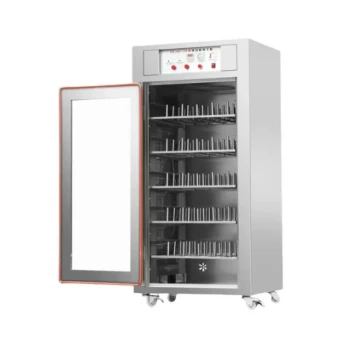
Constant temperature control cabinets are critical for honey research because they create the stable, simulated environments necessary to accurately measure how storage conditions impact honey's physicochemical properties. Without this precise control over temperature and humidity, it is impossible to isolate variables and quantify the acceleration of aging markers like diastase decline and Hydroxymethylfurfural (HMF) increase.
Honey is a heat-sensitive biological product where quality is defined by chemical stability. Control cabinets allow researchers to standardize these variables, ensuring that changes in enzyme activity and composition are attributed to time and temperature rather than random environmental fluctuations.
Quantifying Chemical Changes
Research into honey storage is primarily focused on determining shelf life and quality retention. To do this, scientists track specific chemical markers that react predictably to heat.
Measuring Diastase Activity
Diastase is a natural enzyme found in honey and a key indicator of freshness. Its activity levels decline naturally over time, but this process accelerates rapidly with heat.
Control cabinets allow researchers to hold samples at precise temperatures to map this rate of decline. This data is used to establish "freshness" expiration dates based on enzyme viability.
Tracking HMF Content
Hydroxymethylfurfural (HMF) is a compound formed during the decomposition of sugars. High HMF levels indicate that honey has been aged or overheated.
By using a constant temperature environment, researchers can observe the exact correlation between specific temperatures and the rate of HMF increase. This helps optimize storage recommendations to keep HMF levels within regulatory standards.
Preserving Physical and Sensory Quality
Beyond chemical markers, the physical state of honey determines its market value and consumer appeal. Control cabinets maintain the conditions required to study these physical changes without interference.
Controlling Crystallization
Honey is prone to crystallization, a process heavily influenced by temperature fluctuations. Rapid changes in the environment can induce uneven crystallization.
Constant temperature cabinets simulate dry, stable conditions that prevent environmentally induced crystallization. This allows researchers to study the natural crystallization properties of different honey varieties in isolation.
Preventing Non-Enzymatic Browning
Honey darkens over time due to chemical reactions, a process known as non-enzymatic browning. This reaction compromises the light color characteristic of premium raw honey.
Maintaining a constant temperature helps researchers determine the threshold at which browning accelerates, protecting the visual quality of the product.
Retaining High-Intensity Aroma
The volatile compounds responsible for honey’s aroma are easily lost in unstable environments.
Control cabinets simulate dark, constant conditions to preserve these aromatics. This allows for accurate sensory profiling of long-term storage effects on flavor complexity.
Understanding the Trade-offs
While control cabinets are essential for scientific accuracy, reliance on them presents specific challenges that researchers must acknowledge.
Laboratory vs. Real-World Conditions
A constant temperature cabinet represents an idealized storage environment. It does not account for the thermal shocks and humidity spikes honey experiences during actual transport and retail display.
Data derived solely from constant temperature studies may overestimate shelf life compared to real-world supply chains.
Equipment Sensitivity
Because honey is a biological product, even minor deviations in cabinet performance can skew long-term data.
A cabinet that fluctuates by even a few degrees can alter the rate of crystallization or enzyme loss, leading to inconsistent shelf-life models. Rigorous calibration is required to ensure the "constant" environment is truly maintained.
Making the Right Choice for Your Research
When designing a study on honey storage, understanding your specific analytical goals will determine how you utilize temperature control.
- If your primary focus is regulatory compliance: Prioritize tracking HMF levels and Diastase activity to establish precise shelf-life parameters.
- If your primary focus is consumer appeal: Concentrate on maintaining constant low temperatures to study the prevention of crystallization and browning.
- If your primary focus is sensory analysis: Ensure the environment is dark and stable to preserve volatile aromatic compounds.
By controlling the environment, you transform honey storage from a passive process into a quantifiable science.
Summary Table:
| Key Research Metric | Impact of Temperature Control | Scientific Goal |
|---|---|---|
| HMF Content | Monitors sugar decomposition rates | Establish shelf-life and regulatory compliance |
| Diastase Activity | Maps the rate of enzyme decline | Determine freshness and thermal history |
| Crystallization | Prevents fluctuation-induced granulation | Study natural crystallization of honey varieties |
| Non-Enzymatic Browning | Controls Maillard reaction thresholds | Protect visual quality and market value |
| Volatile Compounds | Preserves delicate aromatic profiles | Ensure accurate long-term sensory profiling |
Elevate Your Honey Quality Standards with HONESTBEE
Maintaining the integrity of your honey products requires the right equipment. HONESTBEE provides commercial apiaries and distributors with high-performance honey-filling machines, specialized hive-making hardware, and a comprehensive range of beekeeping tools designed for excellence.
Whether you are scaling up your production or seeking professional-grade consumables, our wholesale solutions are tailored to meet the rigorous demands of the honey industry.
Contact Us Today to Optimize Your Apiary Operations
References
- Issa Nombré, Jeanne Millogo Rasolodimby. Impacts of storage conditions on physicochemical characteristics of honey samples from Burkina Faso.. DOI: 10.5897/ajfs.9000161
This article is also based on technical information from HonestBee Knowledge Base .
Related Products
- HONESTBEE Commercial Upright Honey Melter
- Langstroth Solid Bottom Board for Beekeeping
- Professional Thermostatic Conical Honey Melter
- HONESTBEE Professional Cabinet Bottle Dryer
- HONESTBEE AC Powered Wire Embedder with Alligator Clips
People Also Ask
- What is melter honey used for? A Low-Cost Ingredient for Bakers and Brewers
- How do you melt a bucket of honey? Safely Reliquefy Crystallized Honey Without Damage
- How does a honey melter address the issue of crystallized honey in storage? Restore Flow and Quality Efficiently
- When is a honey melter necessary? Optimize Your Facility's Workflow for Crystallized Honey
- What methods are used to heat honey, and what precaution should be taken? Expert Guide to Safe Honey Liquefaction