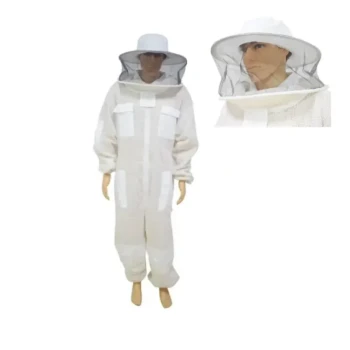
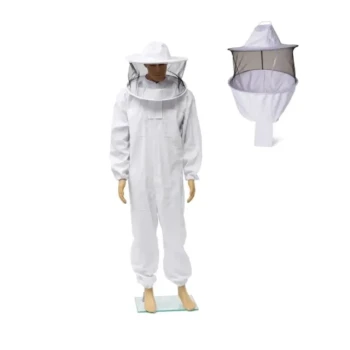
Heavy-duty full bee suits are recommended for commercial beekeeping because they provide more reliable, whole-body protection during repetitive, high-volume hive work. Lightweight half-jackets leave the legs, waist, and lower body more exposed, while lighter fabrics are more vulnerable to tearing against hive boxes, frames, tools, and other woodenware. A heavy-duty full suit creates a durable physical barrier that reduces sting exposure and supports safer, more consistent field operations.
Commercial beekeeping requires protective equipment that withstands repeated movement, contact with equipment, and prolonged hive inspections. Full suits offer stronger coverage, fewer entry points, and better protection than lightweight half-jackets, making them the more dependable choice when operator safety and durability are priorities.
Why Commercial Operations Need More Coverage
Half-jackets leave practical exposure points
A half-jacket typically protects the upper body but does not provide the same coverage for the legs and waist. During lifting, bending, climbing, or moving between colonies, gaps can form between the jacket, trousers, gloves, and footwear.
A full suit covers the body as one integrated system, significantly reducing the chance that bees will reach exposed skin through the waist or lower-body area.
Intensive work increases contact with equipment
Commercial beekeepers repeatedly handle hive bodies, covers, frames, tools, and other woodenware. This creates more opportunities for lightweight fabric to catch, tear, or wear thin.
Heavy-duty fabric is designed to tolerate this repeated physical contact. Its durability matters especially when the same protective equipment is used across many colonies and long working sessions.
Longer inspections increase exposure time
Commercial inspections and harvesting can require extended periods beside active colonies. The longer the beekeeper works in the apiary, the more important it becomes to maintain consistent protection throughout the task.
Full-body coverage helps operators concentrate on inspections, manipulation, and harvesting without repeatedly worrying about exposed areas or shifting clothing.
How Full Suits Improve Operator Safety
Heavy-duty fabric helps prevent sting penetration
A high-quality heavy-duty suit provides a thicker physical barrier between the beekeeper and the bees. This reduces the likelihood that stings will penetrate the fabric during close contact or defensive activity.
The suit is not a substitute for calm handling, suitable hive-management practices, gloves, or a properly secured veil. It is one layer of a complete safety system.
Integrated veils protect the face and neck
The head and neck are particularly vulnerable during hive work. Full suits with integrated hood hoops hold the veil away from the face and nose, reducing the risk of bees contacting exposed skin through the mesh.
A properly supported veil also improves visibility and comfort, which helps the operator maintain control during detailed inspections.
Fewer gaps reduce the risk of entry
Full suits commonly use elastic seals or other closures at the wrists, ankles, and openings. Combined with the one-piece design, these features reduce the number of routes bees can use to enter the clothing.
This is a practical advantage over separate garments that can shift apart while the beekeeper bends, reaches, or lifts hive equipment.
Why Protection Supports Commercial Productivity
Confidence improves precision
Fear of stings can cause rushed movements, hesitation, or unnecessary interruptions. A dependable full suit reduces this psychological burden and allows the beekeeper to work with greater composure.
More controlled handling benefits both the operator and the colony because careful, deliberate movements are less likely to agitate the bees.
Standardized protection simplifies field operations
Commercial teams benefit when protective equipment provides a consistent level of coverage for different workers and tasks. Full suits can serve as a standard baseline for inspections, harvesting, and work around defensive colonies.
For distributors and B2B buyers, this makes a full suit a practical core product within a broader beekeeping portfolio that may also include gloves, veils, smokers, tools, and replacement components.
Durability supports long-term value
A suit that tears easily can create replacement costs, downtime, and urgent sourcing requirements. Heavy-duty construction generally provides better resilience for repeated professional use.
The purchasing decision should therefore consider total cost of ownership, not only the initial unit price. Reliable construction, available sizing, responsive service, and efficient order fulfillment all matter when supplying active commercial operations.
Choosing Features for Professional Use
Select a detachable hood when flexibility matters
Detachable or unzippable hoods make cleaning, storage, and replacement more convenient. They can also simplify product maintenance for distributors managing spare parts or replacement inventory.
The connection must remain secure during use, and the veil should maintain adequate separation from the face when the hood is attached.
Consider ventilated fabric in warm conditions
Full suits can retain more heat than lightweight jackets because they cover more of the body. In warm climates or during long harvesting sessions, ventilated versions can improve airflow while preserving full coverage.
Ventilation should be treated as a configuration choice, not a reason to sacrifice protection. The appropriate fabric depends on climate, workload, and colony behavior.
Match the suit to colony behavior
More defensive colonies and intensive systems increase the value of high-specification full-body protection. A heavy-duty suit is particularly appropriate where workers conduct frequent inspections or harvesting around colonies with a higher likelihood of defensive behavior.
Even experienced beekeepers benefit from protection that remains dependable when colony conditions change unexpectedly.
Understanding the Trade-offs
Full suits can reduce mobility
A full suit is more substantial than a half-jacket and may feel less flexible during fast or physically demanding work. Correct sizing and well-designed construction are important for maintaining a practical range of movement.
Buyers should evaluate arm mobility, leg movement, closure design, and overall fit rather than judging protection by fabric weight alone.
Heat management requires planning
More coverage can increase heat retention, especially during summer work or prolonged inspections. Ventilated materials, appropriate garment sizing, hydration, and work scheduling help manage this limitation.
For commercial purchasing, offering both heavy-duty standard and ventilated full-suit options can address different operating environments without abandoning the full-coverage design.
Higher protection does not remove every risk
A full suit can reduce sting exposure, but protection depends on correct use. Torn fabric, unsecured zippers, poorly fitted closures, damaged veils, and gaps at the wrists or ankles can compromise the barrier.
Routine inspection and timely replacement are essential parts of a professional protective-equipment program.
Making the Right Choice for Your Goal
The best specification depends on the work intensity, colony behavior, climate, and purchasing model.
- If your primary focus is maximum operator safety: Choose a heavy-duty full suit with an integrated veil, supported hood hoop, secure elastic seals, and complete leg and waist coverage.
- If your primary focus is durability for high-volume operations: Prioritize tear-resistant construction, robust closures, replaceable or detachable hoods, and sizing that supports repeated movement around hive equipment.
- If your primary focus is worker comfort in warm conditions: Select a ventilated full-body design that maintains complete coverage while improving airflow during long inspections.
- If your primary focus is reliable B2B supply: Build a standardized full-suit range across sizes and configurations, supported by complementary protective products, responsive service, and efficient order fulfillment.
For commercial beekeeping, the full suit is not simply heavier clothing; it is a more complete and durable safety barrier designed for sustained professional work.
Summary Table:
| Feature | Heavy-Duty Full Suit | Lightweight Half-Jacket |
|---|---|---|
| Coverage | Full body: torso, legs, arms, head | Upper body only; legs exposed |
| Durability | High: withstands repeated contact with equipment | Lower: prone to tearing |
| Sting protection | Thicker fabric reduces penetration | Thinner fabric offers less resistance |
| Entry points | Integrated design with elastic seals | Gaps at waist and legs possible |
| Suitability | Professional, high-volume operations | Casual, low-risk tasks |
Upgrade your commercial beekeeping operations with HONESTBEE's premium full suits and comprehensive beekeeping equipment. We offer one-stop sourcing for distributors, wholesalers, and B2B resellers, with a full-spectrum product portfolio, fast delivery, and dedicated support. Maximize profitability with our OEM/ODM services, certified quality, and reliable supply chain. Contact us today to equip your team with the best!
Related Products
- Premium Three Layer Ventilated Bee Suit with Round Veil
- Premium Cotton Beekeeper Suit with Reinforced Fencing Veil
- Professional Beekeeper Suit with Square Folding Cotton Veil
- Three-Layer Ventilated Beekeeper Suit with Structured Fencing Veil
- Professional Cotton Beekeeper Suit with Round Veil Design for Commercial Apiaries
People Also Ask
- What are the features of a ventilated bee suit? Stay Cool and Protected in Hot Weather
- What is the function of professional protective consumables? Scale Your Apiary with Ventilated Bee Suits
- What should be considered when purchasing a ventilated bee suit? Ensure Maximum Safety and Comfort
- What is the advantage of ventilated bee suits over traditional ones? Stay Cool and Protected with Mesh Technology
- What materials are used in ventilated bee suits? Choose Between 3-Layer Mesh & Foam for Optimal Protection