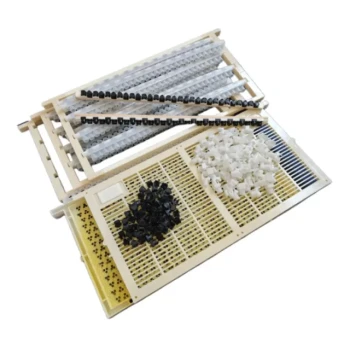
Pre-treating queen cell cups with a 1:1 royal jelly aqueous solution is a critical technique used to create a biological buffer for grafted larvae. This specific dilution serves two simultaneous purposes: it physically protects the fragile micro-larvae from environmental stress and chemically signals the colony to accept the artificial graft as a legitimate queen cell.
Core Takeaway The 1:1 royal jelly pre-treatment bridges the gap between artificial manipulation and natural hive behavior. It dramatically increases success rates by preventing larval dehydration while simulating the scent of a natural cell to trigger immediate nurse bee care.
The Physical Survival of the Larva
Preventing Dehydration
Micro-larvae are extremely susceptible to drying out. The 1:1 solution creates a moist micro-environment at the bottom of the cup, ensuring the larva remains hydrated during the transfer process.
Buffering Temperature Fluctuations
Removing larvae from the hive exposes them to potentially fatal thermal shock. The liquid solution acts as a thermal mass, stabilizing the temperature around the larva and mitigating the stress of moving between environments.
Providing Immediate Nutrition
There is a time lag between grafting the larva and the arrival of nurse bees. The pre-treatment provides a readily available food source, ensuring the larva has immediate nutrition to survive this transitional period.
The Mechanics of Colony Acceptance
Simulating Natural Chemistry
Success in grafting relies on "tricking" the hive. The royal jelly solution mimics the specific chemical scent of a natural queen cell, masking the artificial nature of the cup (whether wax or acrylic).
Inducing Nurse Bee Behavior
A dry cup acts as a foreign object to the colony. The presence of the royal jelly solution acts as a chemical signal, compelling nurse bees to begin feeding and tending to the grafted larvae much faster than they would otherwise.
Improving Production Efficiency
By reducing the rejection rate, the colony commits resources to the grafts more efficiently. This leads to a higher percentage of successfully capped queen cells and improved overall royal jelly production.
Understanding the Trade-offs
The Importance of the Ratio
The 1:1 ratio is not arbitrary; it balances viscosity and potency. Pure royal jelly can be too thick to coat the cup evenly, while a solution that is too watery risks drowning the larva or diluting the necessary chemical signals.
Hygiene and Sterility
While the solution improves acceptance, it introduces organic material that can spoil. It is essential to use sterile water for the dilution to prevent introducing pathogens into the vulnerable cell environment.
Making the Right Choice for Your Goal
To maximize your grafting results, apply this understanding as follows:
- If your primary focus is Larval Survival: Prioritize the pre-treatment to act as a hydration buffer, preventing the high mortality rates associated with dry grafting.
- If your primary focus is High Acceptance Rates: Rely on the solution to provide the necessary chemical cues that trigger nurse bees to adopt and feed the larvae immediately.
By mimicking the hive's natural environment, you transform an artificial mechanical process into a biological interaction the bees instinctively understand.
Summary Table:
| Benefit Category | Impact of 1:1 Royal Jelly Pre-treatment | Key Advantage |
|---|---|---|
| Physical Protection | Creates a moist micro-environment and thermal mass | Prevents dehydration and thermal shock |
| Biological Signaling | Mimics natural queen cell scent and chemistry | Triggers immediate nurse bee care |
| Larval Nutrition | Provides immediate, accessible food source | Bridges the gap until nurse bees arrive |
| Production Efficiency | Reduces rejection rates of artificial cups | Maximizes yield of capped cells and jelly |
| Optimal Viscosity | Balanced 1:1 ratio of jelly to sterile water | Ensures even coating without drowning larvae |
Maximize Your Colony Productivity with HONESTBEE
Success in queen rearing and royal jelly production starts with the right technique and professional-grade equipment. At HONESTBEE, we specialize in supporting commercial apiaries and distributors by providing a comprehensive range of high-quality beekeeping tools. From precision grafting tools and cell cups to advanced honey-filling machines and hive-making hardware, our portfolio is designed to enhance your operational efficiency.
Ready to scale your beekeeping business? Our team is dedicated to providing wholesale solutions, industry consumables, and specialized machinery tailored to your needs. Contact us today to discover how HONESTBEE can empower your apiary with the tools for success!
References
- H. El-Kady, Noura Abd Al-Hady. Effect of Genotype of Grafted Larvae and Rearing Bar Level on some Economic Traits in Commercial Production of Honeybee Queens under Damietta Governorate Conditions, North Egypt. DOI: 10.21608/jppp.2021.153280
This article is also based on technical information from HonestBee Knowledge Base .
Related Products
People Also Ask
- What is the primary function of a queen rearing kit? Eliminate Manual Grafting for Superior Bee Breeding
- How do specialized queen rearing kits and queen management tools improve the success rate of bee colony expansion?
- What are some alternative methods to grafting for queen cell production? Discover Graft-Free Queen Rearing Systems
- Are queen rearing systems generally suitable for all honeybee species? Master Efficient Breeding Methods
- Are queen rearing systems suitable for all beekeepers? Modern Tools for Every Experience Level