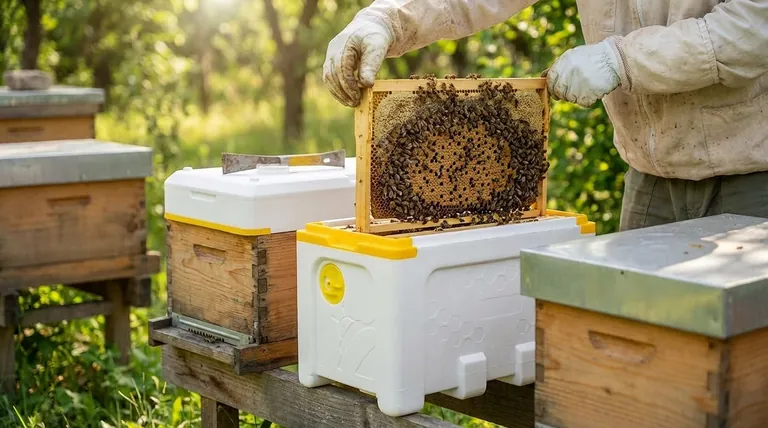
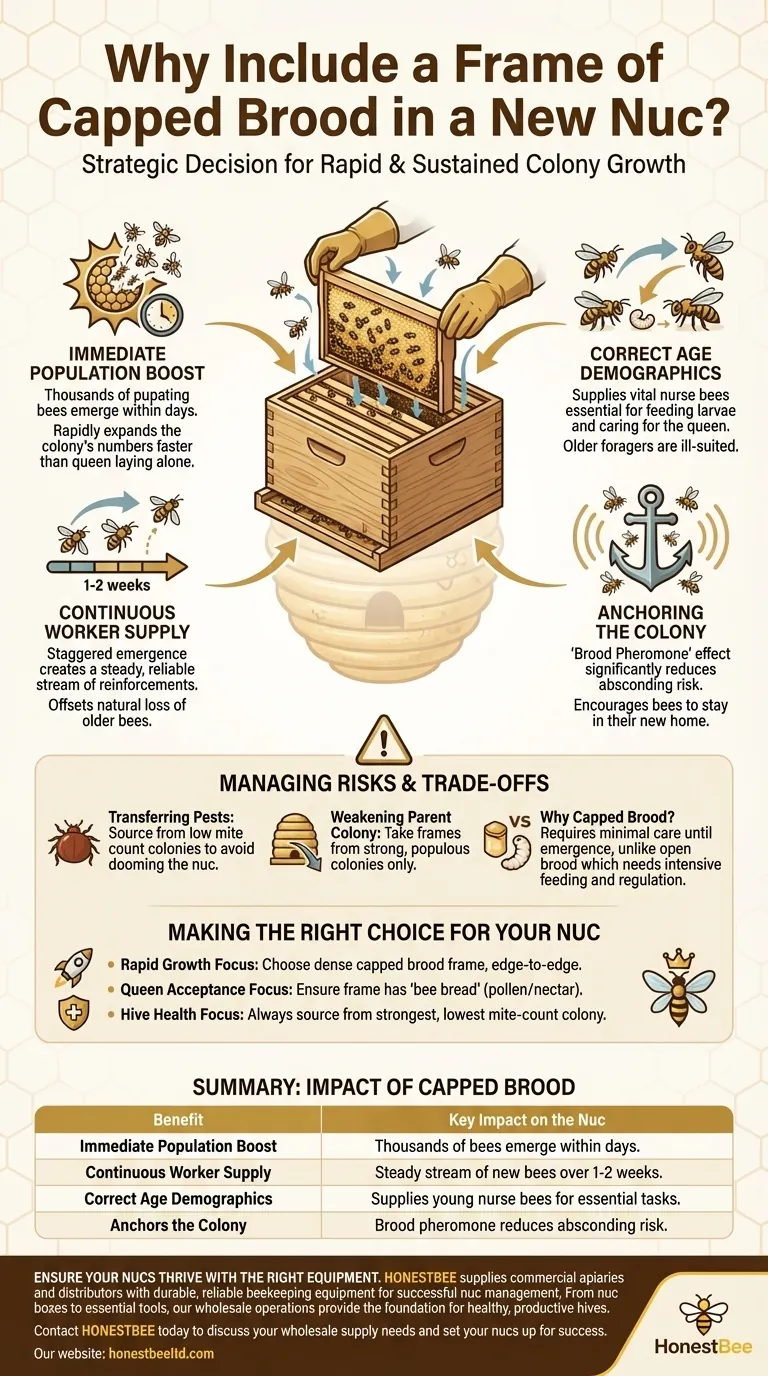
Including a frame of capped brood is one of the most critical steps in establishing a new nucleus hive (nuc). This is a strategic decision designed to provide a rapid and sustained population boost. As these capped cells contain pupating bees, they will soon emerge as new adult workers, immediately increasing the colony's workforce and ensuring its viability.
A frame of capped brood is the lifeblood of a new nuc. It's not just about adding bees; it's about injecting a continuous stream of young workers with specific roles, which stabilizes the fragile new colony and provides the critical momentum needed for successful growth.
The Strategic Role of Capped Brood
A nuc is, by definition, a small and vulnerable colony. Its success depends entirely on its ability to grow its population quickly enough to defend itself, forage for resources, and care for the queen. A frame of capped brood directly addresses this fundamental challenge.
The Immediate Population Boost
A dense frame of capped brood can contain thousands of pupating bees. These bees will begin to emerge within days of being placed in the nuc.
This provides a guaranteed infusion of new bees, rapidly expanding the colony's numbers far faster than a new queen could by laying eggs alone.
A Continuous Supply of New Workers
The bees on a capped brood frame don't all emerge at once. They hatch over a period of one to two weeks.
This staggered emergence creates a steady, reliable stream of reinforcements for the nuc. It's a time-release capsule of population growth, crucial for offsetting the natural loss of older bees.
Establishing Correct Age Demographics
A healthy colony requires bees of all ages to perform different tasks. The youngest adult bees serve as nurse bees, feeding larvae and tending to the queen.
Including a frame of capped brood ensures the nuc has an immediate supply of these vital nurse bees. The older, forager bees that were shaken into the nuc are ill-suited for these tasks and may drift back to their original hive.
Anchoring the Colony
Bees are biologically programmed to care for their young. The presence of brood—the colony's nursery—provides a powerful incentive for the entire population to stay in the new nuc box.
This "brood pheromone" effect significantly reduces the risk of the bees absconding or drifting away, effectively anchoring them to their new home.
Understanding the Trade-offs and Risks
While essential, adding a frame of brood is not without risks that require careful management. Acknowledging these trade-offs is key to responsible beekeeping.
The Risk of Transferring Pests
Capped brood cells are the primary reproductive site for the Varroa destructor mite, the most significant pest in beekeeping.
It is absolutely critical to source your brood frame from a strong, healthy colony with a very low mite count. Transferring a frame with a high mite load can doom the nuc from the start.
Weakening the Parent Colony
Removing a frame of brood and the bees on it is a resource drain on the donor hive.
Always take frames from your strongest and most populous colonies. Never take so much brood that you compromise the health and productivity of the parent hive.
Why Capped Brood is Preferred
It is specifically capped brood that is recommended over open brood (eggs and young larvae). Open brood requires intensive feeding and temperature regulation by nurse bees.
A small nuc population can be easily overwhelmed by the needs of too much open brood. Capped brood, on the other hand, requires minimal care until the bees emerge, making it a much safer and more effective choice.
Making the Right Choice for Your Nuc
The goal is to select a frame that provides the maximum benefit with the minimum risk. Use these guidelines to select the ideal frame.
- If your primary focus is rapid growth: Choose a frame with a solid, dense pattern of capped brood from edge to edge to maximize the number of emerging bees.
- If your primary focus is queen acceptance: Ensure the frame also has a band of pollen and nectar ("bee bread") along the top, as this creates a complete, resource-rich environment for a new queen.
- If your primary focus is hive health: Always source your brood frame from your strongest, healthiest, and lowest mite-count colony to avoid spreading problems.
Ultimately, selecting the right frame of capped brood is the single most effective action you can take to ensure a new nucleus colony thrives.
Summary Table:
| Benefit of Capped Brood | Key Impact on the Nuc |
|---|---|
| Immediate Population Boost | Thousands of bees emerge within days, rapidly increasing workforce. |
| Continuous Worker Supply | Staggered emergence provides a steady stream of new bees over 1-2 weeks. |
| Correct Age Demographics | Supplies young nurse bees essential for feeding larvae and caring for the queen. |
| Anchors the Colony | Brood pheromone encourages bees to stay, reducing absconding risk. |
Ensure Your Nucs Thrive with the Right Equipment
Building a strong nucleus colony starts with high-quality beekeeping supplies. HONESTBEE supplies commercial apiaries and beekeeping equipment distributors with the durable, reliable equipment needed for successful nuc management.
From nuc boxes to essential tools, our wholesale-focused operations provide the foundation for healthy, productive hives.
Contact HONESTBEE today to discuss your wholesale supply needs and set your nucs up for success.
Visual Guide
Related Products
- Assembled Wooden Bee Frames with Plastic Foundation for Durability and Convenience by HONESTBEE
- Heart-Shaped Comb Honey Frame and Honeycomb Cassette
- Professional Sectional Comb Honey Frame with 250g Cassette System for Beekeeping
- Assembled Wooden Bee Frames with Beeswax Foundation Ready to Use by HONESTBEE
- Professional Galvanized Steel Frame Rest for Beehives
People Also Ask
- When should frames with new foundation be given to colonies? Master Timing for a Thriving Hive
- What are bee frames and how are they sized? A Professional Guide to Standardization & Material Choice
- How do you re-wax bee frames? A Simple Guide to Faster Comb Building
- What types of bee frames can be cleaned and returned to service? A Guide to Safe Apiary Refurbishment
- Do you have to wire bee frames? Essential Guide to Frame Strength & Honey Harvesting