The Unwritten Blueprint
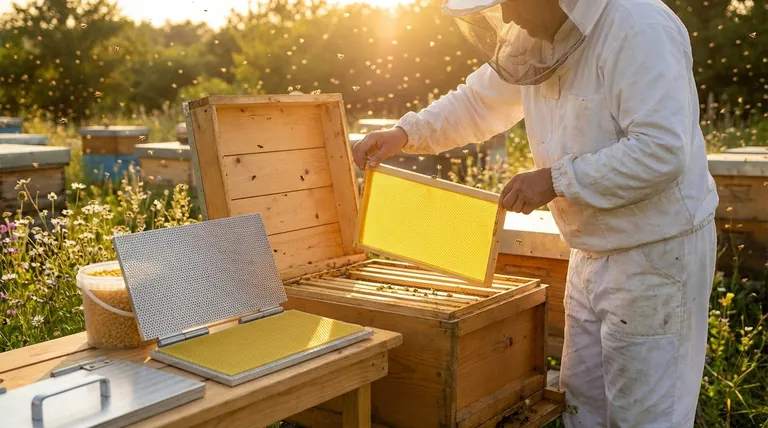
A beekeeper opens a hive, full of anticipation. Inside, new frames of pristine foundation sit untouched, ignored by the thousands of busy inhabitants. It’s a common and deeply frustrating sight—a plan for expansion rejected by the very workforce meant to execute it.
This frustration stems from a fundamental misunderstanding. We tend to view the hive as a factory we can manage with simple inputs and outputs. But a beehive is not a factory; it's a complex, adaptive organism. It operates on a biological logic that we can't command, only influence.
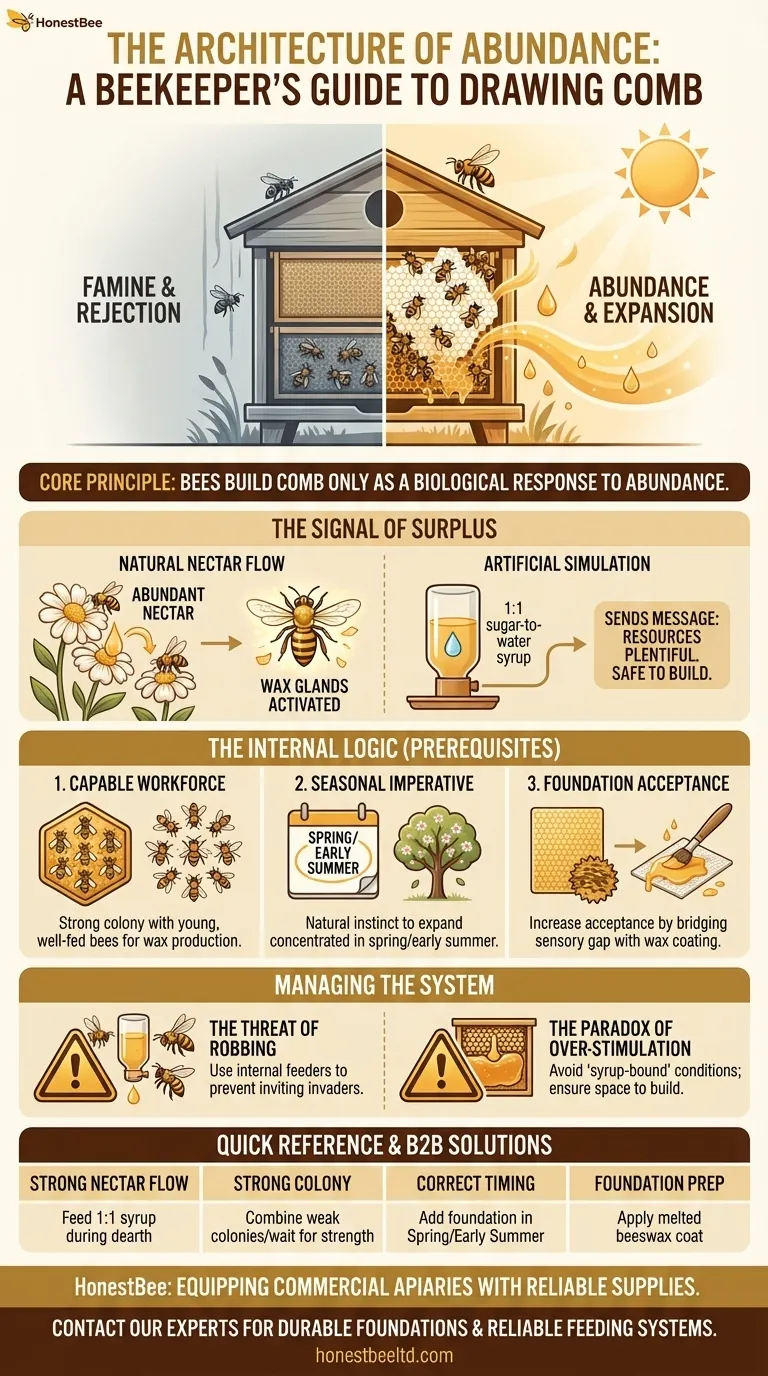
The single most important factor is understanding that bees do not build comb on command. They build comb as a biological response to abundance. Your primary job is to create or simulate an environment of resource surplus that triggers their natural instinct to expand.
The Signal of Surplus
Beeswax is one of the most energetically expensive materials in the natural world. For bees, producing it is like a nation deciding to fund a massive infrastructure project. Such a decision is never made during a famine. It is only made in times of overwhelming prosperity.
This prosperity is signaled by one thing: a strong and sustained nectar flow.
The Economics of Wax Production
When nectar is abundant, young worker bees gorge themselves. This surplus of carbohydrates activates four pairs of specialized glands on their abdomens, which begin to secrete delicate flakes of wax. Without this flood of resources, the glands remain dormant. The hive's economy is geared toward conservation by default. Expansion is the exception, triggered only by a clear signal of resource wealth.
Simulating the Signal
In the absence of a natural nectar flow—a period known as a dearth—a beekeeper's job is to become a convincing simulation. A continuous supply of 1:1 sugar-to-water syrup acts as an artificial nectar flow.
This isn't just "feeding." It's sending a specific, biological message: Resources are plentiful. The economy is booming. It is safe to build.
The Internal Logic of the Hive
A strong signal of abundance is necessary, but it is not sufficient. The hive’s internal state must also be primed for expansion. A successful beekeeper learns to read and align with this internal logic.
1. A Capable Workforce
A small, struggling colony is in survival mode. Its focus is on core tasks: raising brood, foraging for immediate needs, and defending the nest. It lacks the critical mass of young, well-fed bees required for large-scale wax production. Trying to force a weak colony to build is like asking a skeleton crew to construct a skyscraper. Only a strong, populous colony has the workforce to spare for major construction projects.
2. The Seasonal Imperative
Bees operate on a strict annual calendar. Their instinct to expand and build comb is overwhelmingly concentrated in the spring and early summer. This is the biological preparation for the peak season, a time of population growth and opportunity. As autumn approaches, their entire physiology and behavior shift toward conservation. They will not, and cannot, be convinced to build when their instincts are screaming that winter is coming.
3. The Psychology of Acceptance
Bees are creatures of scent and texture. A foreign object, like a new sheet of plastic foundation, can be met with suspicion. It doesn't smell or feel like home. You can dramatically increase acceptance by bridging this sensory gap. Rubbing the foundation with burr comb or painting on a micro-thin layer of melted beeswax translates the foreign object into a familiar language. It tells the bees, "This belongs here. This is part of us."
Managing the System, Not the Task
Thinking like the hive's architect means recognizing potential points of failure in the system you've created. Well-intentioned interventions can have unintended, negative consequences.
-
The Threat of Robbing: An open feeder or a slow leak in the hive can send your carefully crafted signal of abundance to neighboring hives. This can incite robbing—a violent takeover attempt by invaders that can decimate a colony. Internal feeders are a critical risk management tool.
-
The Paradox of Over-Stimulation: Pushing a colony that isn't ready can backfire. If the bees have no space to build, they may store the incoming syrup in the brood nest. This clogs the nursery, restricts the queen's ability to lay eggs, and can grind the colony's growth to a halt—a condition known as being "syrup-bound."
Patience is a prerequisite. A strong hive on a heavy flow might draw a frame in two days. A smaller one might take two weeks. The goal is not to force a specific timeline but to ensure the underlying conditions are consistently met.
A Quick Reference for Action
| Condition | The "Why" | The "How" |
|---|---|---|
| A Strong Nectar Flow | Provides the energy and biological trigger for wax. | Feed 1:1 sugar syrup continuously during a dearth. |
| A Strong Colony | Ensures a sufficient workforce of young wax-producing bees. | Combine weak colonies or wait for them to build strength. |
| Correct Timing | Aligns with the bees' natural instinct to expand. | Add new foundation in spring and early summer. |
| Foundation Prep | Overcomes the bees' hesitation to work on new material. | Apply a thin, even coat of melted beeswax to plastic. |
Building this architecture of abundance requires more than knowledge; it requires reliable tools. The right foundation provides the blueprint, and a dependable feeder delivers the signal. At HONESTBEE, we equip commercial apiaries and distributors with the high-quality supplies needed to create these optimal conditions, from durable foundations to reliable feeding systems.
To ensure your operation is built on a foundation of quality and reliability, Contact Our Experts.
Visual Guide
Related Products
- Heart-Shaped Comb Honey Frame and Honeycomb Cassette
- Heavy Duty Stainless Steel Honeycomb Cutter
- Manual Beeswax Comb Foundation Machine Wax Foundation Mill Embossing Machine
- Professional Bent Tine Honey Uncapping Fork with Ergonomic Grip
- Wooden Bee Brush with Double-Row Horsehair Bristles
Related Articles
- How Stored Honey Frames Accelerate Colony Recovery: A Beekeeper’s Guide
- Comb Honey: Why It Commands Premium Prices and How to Verify Purity
- How Honey Frames Naturally Manage Queen Bees Without Compromising Colony Health
- The Architecture of Purity: Deconstructing the Craft of Comb Honey
- Why Your Cut Comb Honey Quality Is Inconsistent—And the Simple Fix You're Overlooking