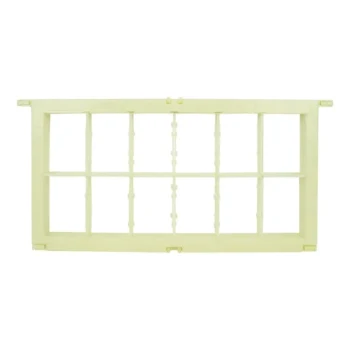
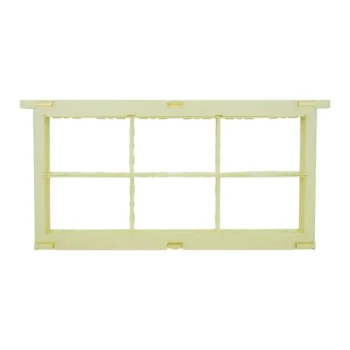
Standardized honeycomb frame weights act as a calibration tool to isolate the net weight of honey from the gross weight of the hive components. Specifically, light-colored new frames are assigned a standard deduction weight of 400 grams, while brown older frames are assigned a heavier standard of 600 grams. Beekeepers use these distinct values to account for the physical accumulation of material on older frames, ensuring that yield calculations reflect actual production rather than equipment variance.
Core Takeaway Accurate honey yield analysis relies on subtracting specific tare weights based on the frame's visual age. By distinguishing between new (400g) and old (600g) frames, beekeepers can eliminate measurement errors and objectively evaluate colony performance factors, such as the effectiveness of feed additives.
The Principles of Frame Standardization
The Impact of Frame Age on Weight
Honeycomb frames are not static environments; their physical properties change significantly over time.
New frames consist primarily of the wooden structure and fresh wax, resulting in a lighter overall mass.
Conversely, older frames accumulate weight through repeated brood cycles, which leave behind pupal cocoons, propolis, and additional layers of wax, causing them to darken and become heavier.
The Calibration Standards
To address this variability without weighing every empty frame individually, specific deduction standards are established based on visual inspection.
Light-colored new frames are assigned a baseline weight of 400 grams.
Brown older frames are assigned a baseline weight of 600 grams.
Application in Yield Analysis
Calculating Net Honey Weight
The process begins by weighing the full, honey-laden frame using precision scales to obtain a gross weight.
The beekeeper then subtracts the appropriate standardized weight (400g or 600g) based on the frame's color.
This simple calculation removes the weight of the infrastructure to reveal the net weight of the honey stored within.
Evaluating Colony Performance
This methodology is essential when measuring the impact of specific variables, such as feed additives.
If frame weight variances were ignored, a colony with lighter new frames might appear to produce more honey than one with heavier old frames, simply due to the tare weight difference.
Standardizing these deductions ensures that the data reflects the actual biological performance of the honeybee colony.
Understanding the Trade-offs
Efficiency vs. Absolute Precision
Using standardized weights is a heuristic approach—a practical approximation designed to balance accuracy with efficiency.
The primary trade-off is that not every "old" frame weighs exactly 600 grams; some may be slightly lighter or heavier depending on the exact level of buildup.
However, weighing every single empty frame before use is operationally impractical for large-scale management.
Therefore, accepting the minor variance of a standardized average is superior to ignoring the weight difference between old and new frames entirely.
Making the Right Choice for Your Goal
Applying these standards ensures your data reflects the bees' productivity, not the equipment's age.
- If your primary focus is assessing young colonies: Use the 400g deduction for fresh, light-colored wax builds to accurately track initial production without overestimating yield.
- If your primary focus is analyzing established hives: Apply the 600g deduction for darker combs to account for the biological debris and structural thickening accumulated over previous seasons.
Precision in standardizing your equipment weights is the critical foundation for scientific accuracy in apiary management.
Summary Table:
| Frame Type | Visual Characteristic | Standard Weight (Deduction) | Composition Factors |
|---|---|---|---|
| New Frame | Light-colored | 400 grams | Fresh wax and wooden structure |
| Old Frame | Dark brown | 600 grams | Accumulation of cocoons, propolis, and thick wax |
| Yield Impact | N/A | High precision | Eliminates equipment variance in performance data |
Maximize Your Honey Production Efficiency with HONESTBEE
Precision in measurement is the first step toward a high-performance apiary. HONESTBEE is dedicated to supporting commercial apiaries and distributors with professional-grade beekeeping tools, machinery, and essential consumables.
Whether you need precision scales for yield analysis, honey-filling machines for processing, or specialized hive-making equipment, our comprehensive wholesale offering provides the durability and accuracy your business demands. From technical hardware to honey-themed cultural merchandise, we help you scale your operations effectively.
Ready to upgrade your commercial beekeeping equipment? Contact us today to explore our full product portfolio and discover how our expertise can drive your success.
References
- D.A. Blagov, Irina Nukolaevna Kolchaeva. The use of protein and other biologically active substances in feeding honey bees. DOI: 10.28983/asj.y2022i12pp54-57
This article is also based on technical information from HonestBee Knowledge Base .
Related Products
- Professional Sectional Comb Honey Frame with 250g Cassette System for Beekeeping
- Professional 500g Sectional Comb Honey Frame System for Beekeeping
- Heart-Shaped Comb Honey Frame and Honeycomb Cassette
- Plastic Honey Comb Frames Cassette Box for Honey
- Heavy Duty Castellated Iron Frame Spacer for Honey Supers
People Also Ask
- How are honeybee combs utilized for non-destructive colony monitoring? Master Population Density Tracking
- What is the technical purpose of exchanging honeycomb frames? Master Apiary Equalization for Growth
- What frame to use for honeycomb? Choose the Right System for Pure, Edible Comb
- What is a honeycomb frame? The Key to Modern, Sustainable Beekeeping
- What are the recommended temperature and duration settings for freezing honey frames? Ensure Pest-Free Comb Storage