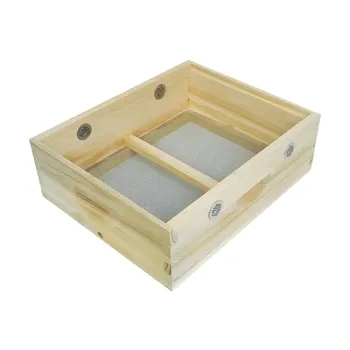
Add brood space before the colony experiences congestion. For highly prolific colonies, place a second full-sized brood box—or a ¾ box in a “brood-and-a-half” configuration—above the existing brood chamber, then position the queen excluder above the upper brood box. This gives the queen additional laying room, supports a larger worker population, and creates more production capacity for the honey flow.
The most effective configuration separates expansion from storage: use additional deep or brood boxes for colony growth, then add honey supers above the brood nest as nectar intake increases. Timing, inspection, and correct queen-excluder placement are as important as the number of boxes used.
Build the Configuration Around Colony Biology
Use deep boxes for brood expansion
The largest hive bodies, typically deep boxes, should form the brood chamber at the base of the stack. They provide sufficient volume for the queen to lay and for workers to raise developing bees.
When the existing brood chamber is becoming fully occupied, add another full-sized box above it. This is particularly useful for strong colonies with rapidly increasing populations during peak spring or summer growth.
Consider a brood-and-a-half setup
A second ¾ box can be used above the primary brood box when a full second deep is unnecessary or when the operation already uses that equipment format. This provides intermediate capacity while avoiding the additional weight and volume of a full deep.
The correct choice depends on colony strength, local nectar flows, frame compatibility, and the equipment standardized across the apiary.
Add honey supers above the brood nest
Once brood capacity is adequate, place medium or shallow honey supers above the brood chamber. These boxes provide nectar-storage space while remaining lighter and easier to lift during inspections and harvest.
A commercial configuration commonly uses two deep brood boxes at the base, followed by shallow or medium supers added as the colony fills available storage space.
Place the Queen Excluder Correctly
Keep the queen below the honey supers
In a brood-and-a-half setup, the queen excluder should be positioned above the upper brood box, not between the two brood boxes. This allows the queen to use both brood chambers while restricting access to the honey-storage supers.
With two deep brood boxes, the excluder is similarly placed above both brood boxes and below the first honey super.
Understand what the excluder does—and does not do
A queen excluder helps keep the queen from laying in the honey supers, simplifying inspection and extraction. However, it does not remove brood already present above the excluder, and it should not be treated as a standalone swarm-prevention method.
The colony still requires adequate brood space, ventilation, forage access, and timely management. A poorly timed excluder can also slow movement through the hive, especially in weaker colonies.
Expand Before Congestion Becomes Visible
Inspect the brood nest regularly
Examine brood frames for active egg laying, pearly-white larvae, and clean, slightly convex capped brood. These indicators help determine whether the queen is using the available comb effectively and whether the colony is expanding toward its available limits.
A productive queen may lay approximately 1,000 to 2,000 eggs per day, so empty comb can disappear quickly in a strong colony.
Add the next box when usable space is declining
Expansion should occur when existing frames are substantially drawn and occupied, but before the brood nest is completely restricted. If the queen has little empty comb available and the worker population is increasing rapidly, the colony may interpret the condition as congestion.
Adding a brood box at that point provides room for reproduction and helps absorb the growing workforce before swarm preparations become advanced.
Match expansion to colony strength
Do not add excessive volume to a weak colony. A large, underpopulated stack can be difficult for bees to regulate and defend.
Use the colony’s population, brood pattern, drawn comb, weather, and expected nectar flow to determine whether it is ready for another body or super.
Use Reversal as a Supporting Technique
Reposition brood boxes when appropriate
Brood-chamber reversal involves moving the upper brood box to the bottom and placing the box with more available space above it. This arrangement can encourage bees to move upward into empty comb and reduce the perception that the upper brood area is congested.
Reversal is a supporting management practice, not a substitute for adding capacity when the colony genuinely needs more room.
Avoid disrupting the brood nest unnecessarily
Before reversing boxes, confirm that the colony is strong enough and that local weather conditions are suitable. Excessive disturbance or poorly timed rearrangement can chill brood, separate the colony from food stores, or create unnecessary stress.
The objective is to improve access to usable space while preserving brood continuity.
Understanding the Trade-offs
More space does not guarantee swarm prevention
Additional hive bodies reduce one major swarm trigger—overcrowding—but swarming is influenced by colony genetics, queen age, weather, forage conditions, and the presence of swarm cells.
Strong colonies should continue to be inspected for queen cells and other swarm indicators even after additional boxes are added.
Full deeps increase production capacity but also handling weight
Deep brood boxes provide substantial brood capacity and fit well in standardized commercial systems. They are also heavy when filled with bees, brood, honey, and equipment.
Medium or shallow supers are easier to handle during harvest, making them attractive for operations prioritizing labor efficiency and faster processing.
Standardization improves operational efficiency
Using compatible box sizes, frames, covers, and queen excluders simplifies purchasing, stocking, field replacement, and staff training. For distributors and commercial apiaries, a coordinated product range is often more valuable than isolated box availability.
Reliable supply of brood bodies, supers, frames, excluders, and replacement components helps apiaries expand quickly when colony conditions change.
Making the Right Choice for Your Goal
Select the configuration according to colony strength, labor capacity, local conditions, and the equipment already standardized in the apiary.
- If your primary focus is preventing swarming: Add a second full-sized brood box or ¾ brood box before the existing brood chamber becomes congested, and inspect the colony frequently for swarm indicators.
- If your primary focus is maximizing honey yields: Build a strong, spacious brood nest first, then add shallow or medium honey supers promptly as nectar storage fills.
- If your primary focus is easier harvesting: Use deep boxes for brood and lighter medium or shallow supers for honey storage, with the queen excluder above the complete brood chamber.
- If your primary focus is commercial efficiency: Standardize compatible hive bodies, frames, supers, and excluders so replacement, expansion, fulfillment, and field servicing remain fast and predictable.
A well-timed, modular hive configuration gives the colony room to grow while giving the beekeeper greater control over swarm risk, honey storage, and harvest efficiency.
Summary Table:
| Configuration | Best For | Key Considerations |
|---|---|---|
| Single Deep + Brood-and-a-Half | Prolific colonies needing extra space without full second deep | Use 3/4 box above brood; place queen excluder above upper brood box |
| Two Full Deeps | Maximum brood capacity and honey production | Heavier lifting; excluder above both deeps; add supers as needed |
| Deep Brood + Medium/Shallow Supers | Easier harvesting and inspection | Lighter supers; excluder above brood chamber; add supers as nectar flow increases |
| Standardized Multi-Box Setup | Commercial efficiency and scalability | Compatible equipment; rapid expansion and servicing |
Ready to optimize your apiary's brood box configuration and prevent swarming while maximizing honey yields? At HONESTBEE, we cater to commercial apiaries and distributors with a comprehensive wholesale offering, providing the full spectrum of beekeeping tools, machinery, and equipment. Our portfolio includes hive-making and honey-filling machines, as well as specialty hardware and honey-themed merchandise. We emphasize one-stop sourcing, rapid response, and ultra-fast delivery to keep your operations running smoothly. For distributors and B2B resellers, we offer premium trading services, OEM/ODM support, and certified quality to ensure supply reliability and profitability. Contact us today to discuss your needs and boost your apiary's efficiency!
Related Products
- Australian Langstroth Beehive Boxes for Beekeeping Wholesales
- Langstroth Honey Bee Box Hive Boxes for Different Depths
- Portable Bee Mating Hive Boxes Mini Mating Nucs 8 Frames for Queen Rearing
- Professional Beekeeping Quilt Box with Multi Vent Moisture Control
- Twin Queen Styrofoam Honey Bee Nucs Mating and Breeding Box
People Also Ask
- What are the differences between the three standard depths of Langstroth boxes? Choose the Best Size for Your Apiary
- What are the primary advantages of using standardized Langstroth boxes? Scale Your Commercial Beekeeping Operation
- What role do standardized Langstroth boxes play in commercial apiary management and honey bee research? | HONESTBEE Guide
- How many beehive boxes are needed when starting a new hive? A Guide to Proper Hive Setup
- What are the disadvantages of using a combination of deep and medium boxes? Avoid Costly Incompatibility Issues