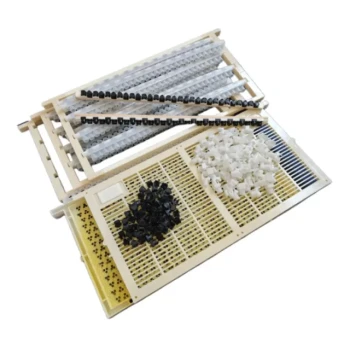
The coordination between grafting needles and collection devices functions as a sequential, high-precision cycle designed to maximize biological acceptance and minimize product degradation.
While grafting needles initiate the process by transferring larvae to induce secretion, their role re-emerges on the fourth day to precisely remove the larvae, clearing the path for collection devices to extract the pure royal jelly without mechanical damage.
Core Takeaway High-quality royal jelly production relies on a strict timeline where precision tools minimize physical trauma to both the biological catalyst (the larva) and the final product. The grafting needle ensures the colony accepts the cell to begin production, while the collection device extracts the resulting jelly only after the needle has safely removed the larva to prevent contamination.
The Role of Precision in the Initiation Phase
Simulating Natural Breeding
Production begins by inducing the colony to secrete jelly. This relies on the grafting needle simulating the natural queen-rearing environment.
The Importance of the Grafting Needle
The needle is the primary variable in determining yield. It is used to transfer delicate, 1-to-2-day-old larvae from worker cells into artificial queen cups.
Impact on Larval Survival
The flexibility and fine tip of the needle are critical. If the larva is damaged during transfer, the bees will reject the cell, and no royal jelly will be produced.
Wet Grafting Technique
To improve coordination between the tool and the biological subject, technicians often use "wet grafting." This involves placing larvae on diluted royal jelly to prevent dehydration and increase acceptance rates.
The Critical Hand-off: Day Four Extraction
The Fourth-Day Standard
According to standard production protocols, the harvest cycle culminates on the fourth day after grafting. This is the peak moment for harvesting before the larva consumes too much product.
Clearing the Cell
This is the moment of direct coordination. The grafting needle is used once again, not to insert, but to carefully remove the larva from the queen cell.
Preparing for Extraction
Removing the larva is a prerequisite for collection. This step must be performed with high precision to ensure no larval debris remains to contaminate the jelly.
specialized Collection Devices
Once the needle has cleared the cell, specialized collection equipment is employed. These devices extract the jelly rapidly to ensure efficiency.
Maintaining Commercial Value and Purity
Minimizing Mechanical Damage
The primary goal of the collection device is to extract the product without altering its composition. Rough handling or improper suction can degrade the jelly's structure.
Preserving Bio-Active Components
High-precision equipment is essential to maintain the pharmaceutical grade of the raw material. Any mechanical stress can impact the purity and commercial value of the final honey bee product.
The Necessity of Refrigeration
While not a collection tool, refrigeration is the immediate next step. Because royal jelly is heat-sensitive, it must be cooled immediately after the collection device finishes its work.
Understanding the Trade-offs
Speed vs. Precision
Beekeepers often face a trade-off between the speed of the transfer and the survival of the larvae. Rushing the grafting process with manual tools can lower acceptance rates, rendering the collection phase moot.
Mechanical vs. Manual Extraction
While mechanical collection devices increase scale, they require strict calibration. Poorly calibrated devices can introduce air bubbles or shear stress, potentially altering the physical consistency of the jelly.
Larval Age Sensitivity
Using larvae older than 2 days makes grafting easier but results in lower quality queens and potentially less vigorous jelly secretion. Adhering to the 1-day-old standard requires higher operator skill with the needle.
Making the Right Choice for Your Goal
To optimize your production line, assess your specific objectives:
- If your primary focus is Maximizing Yield: Prioritize high-precision grafting needles and the "wet grafting" method to ensure the highest possible larval acceptance rate.
- If your primary focus is Pharmaceutical Purity: Invest in specialized collection devices that minimize mechanical shear and ensure immediate transfer to refrigeration to protect bio-active compounds.
Success in royal jelly production is not just about the tools, but the timing of their interaction; the needle initiates and clears, while the collection device captures the value.
Summary Table:
| Production Stage | Primary Tool | Key Function | Impact on Quality |
|---|---|---|---|
| Initiation | Grafting Needle | Transferring 1-2 day old larvae | Determines larval acceptance and initial yield |
| Pre-Harvest | Grafting Needle | Precise removal of larvae | Prevents larval debris contamination in the jelly |
| Extraction | Collection Device | Rapid, low-shear extraction | Preserves bio-active compounds and physical structure |
| Preservation | Refrigeration Unit | Thermal stabilization | Maintains pharmaceutical grade and commercial value |
Elevate Your Royal Jelly Production with HONESTBEE
Maximize your apiary's efficiency and product purity with professional-grade tools designed for commercial success. HONESTBEE specializes in serving commercial apiaries and distributors with a robust wholesale catalog. From high-precision grafting needles that ensure maximum larval acceptance to advanced collection machinery and hive-making equipment, we provide everything needed for large-scale operations.
Why Partner with HONESTBEE?
- Comprehensive Wholesale Range: Full spectrum of beekeeping tools, consumables, and honey-filling machinery.
- Industry-Leading Quality: Our equipment is engineered to minimize mechanical stress on sensitive products like royal jelly.
- Global Distribution: Supporting distributors with reliable supply chains and diverse honey-themed cultural merchandise.
Ready to optimize your production line? Contact us today to explore our wholesale solutions!
References
- Abdallah Saad Soliman M. Kamel. Evaluation of Colony Parameters for Queen Rearing under Arid Ecosystem Conditions. DOI: 10.21608/japp.2021.234779
This article is also based on technical information from HonestBee Knowledge Base .
Related Products
- Plastic Chinese Queen Grafting Tool for Bee Queen Rearing
- No Grafting Queen Rearing Kit: System for Royal Jelly Production and Queen Rearing
- Black 2 Pack Beekeeper Queen Grafting Tool for Bee Queen Larva Transferring Needle
- Stainless Steel Beekeeping Queen Grafting Tool for Honey Bee Rearing
- Retractable Chinese Queen Rearing Grafting Tools Equipment
People Also Ask
- Why is it necessary for migratory beekeeping enterprises to utilize professional queen bee rearing tools? Boost Resilience
- What specialized tools and frame configurations are needed for larval grafting during queen rearing, and how are queen cells properly spaced? Master the essentials for efficient queen production
- What are the benefits of using a queen grafting tool for queen rearing? Master Precision for Superior Bee Genetics
- What is grafting in queen rearing? Take Control of Your Apiary's Genetics
- What are the steps involved in using a queen grafting tool? A Guide to Successful Queen Rearing