Mendelian sampling deviations are not independent in honey bees. Because a drone is haploid and produces genetically identical sperm, workers fathered by the same drone share the same paternal genetic contribution. Queen rearing and instrumental insemination therefore affect not only mating control, but also the covariance structure, relationship matrix, breeding-value estimates, and inbreeding risk of the breeding program.
Core takeaway: Standard diploid livestock formulas can underestimate full-sib covariance in honey bees because they assume independent paternal segregation. Breeders must model the shared paternal haplotype of drone-derived offspring and account for unequal drone or sire-family contributions when using single- or multi-drone insemination.
Why Honey Bee Pedigrees Require a Different Covariance Model
Drones transmit clonal paternal genomes
A drone develops from an unfertilized egg and is haploid. Its sperm therefore carry the same paternal genome, apart from effects such as mutation or biological irregularity that are normally negligible in quantitative-genetic models.
When the same drone inseminates a queen, its offspring do not receive independently sampled paternal alleles in the way offspring of a diploid sire generally do.
Full-sib offspring share more than a conventional paternal relationship
Two workers produced by the same queen and the same drone share:
- The same queen as their maternal parent
- Maternal genes sampled through different queen eggs
- The same drone-derived paternal genome
The maternal Mendelian sampling components can differ between offspring, but the paternal Mendelian sampling component is shared. Consequently, the covariance between these full siblings is higher than the value predicted by a standard diploid model that treats paternal gametes as independently sampled.
The additional covariance is model-dependent
In an additive genetic model, the shared paternal component is commonly represented as a separate covariance contribution. Under some scaling conventions, the paternal contribution may be expressed as a fraction of the drone’s breeding-value variance, but the exact coefficient depends on how breeding values, haploid genotypes, and worker or queen traits are coded.
The important principle is not a universal coefficient. It is that the paternal Mendelian sampling covariance must not be set to zero when the same drone fathers both offspring.
How the Relationship Structure Changes
Same queen and same drone
Offspring from the same queen and drone are true full siblings in the honey bee pedigree. Their covariance includes:
- Shared maternal ancestry
- Shared paternal ancestry
- A non-zero shared paternal Mendelian sampling term
- Any additional covariance caused by unequal reproductive contribution
This makes their effective genetic relatedness greater than that implied by an unmodified diploid full-sib relationship.
Same queen but different drones
Workers from the same queen but different drones are maternal half-sibs. They share the queen as a parent, but they do not share the same paternal haplotype.
Their covariance therefore lacks the same-drone paternal sampling term. However, if the drones are related—for example, because they came from the same drone-producing queen—their paternal lineages can still introduce additional covariance.
Drones from the same mother
A drone’s mother is its genetic parent. Drones produced by the same queen can therefore be related through their shared maternal origin.
This matters when a breeding program uses several drones from the same source colony. Treating them as unrelated males can understate relatedness among their offspring and make estimated inbreeding appear lower than it actually is.
Why Contribution Weights Matter
Unequal drone contributions
In multi-drone insemination, the nominal number of drones or the volume of semen collected does not necessarily equal the genetic contribution of each drone.
Contribution can differ because of:
- Sperm concentration
- Semen viability
- Collection efficiency
- Mixing or handling losses
- Sperm storage and usage within the queen’s spermatheca
These unequal contributions increase the probability that two offspring share the same drone-derived genome, even when semen from multiple drones was used.
Unequal sire-family contributions
The same issue applies at the level of drone-producing queens. If one source queen supplies most of the drones used in a breeding batch, that queen’s lineage contributes disproportionately to the next generation.
The covariance model should therefore incorporate both drone-level contributions and drone-producing-queen contributions, rather than assuming equal representation.
Contribution records are part of the genetic data
For accurate genetic evaluation, the breeding record should identify:
- Queen identity
- Drone identity, where possible
- Drone-producing queen
- Single- or multi-drone insemination status
- Semen source and pooling information
- Intended and, where available, observed contribution weights
- Queen-rearing batch and colony assignment
Equipment creates genetic control only when its use is documented well enough to reconstruct the pedigree.
How Queen Rearing and Insemination Equipment Affect the Calculation
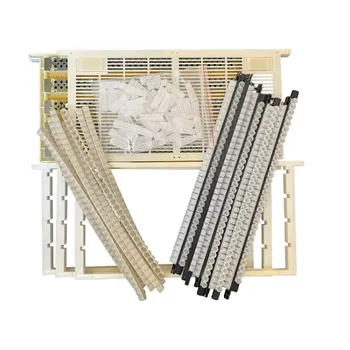
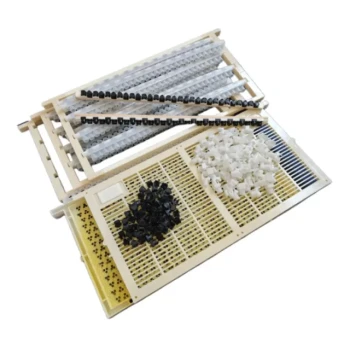
Queen rearing improves pedigree control
Controlled queen rearing and queen-cell management allow breeders to replace queens systematically and propagate selected maternal lines.
This helps establish known family structures for traits such as honey production, gentleness, colony survival, and Varroa-sensitive hygiene. The equipment itself does not change the genetic covariance formula, but it makes the family structure more intentional and therefore more important to model correctly.
Single-drone insemination creates maximum traceability
Single Drone Insemination, or SDI, gives the breeder a clearly defined paternal source. It is particularly useful for:
- Testing a specific drone genotype
- Establishing experimental colonies
- Studying inheritance of traits such as Varroa resistance or grooming behavior
- Estimating progeny performance from a known paternal line
Its statistical advantage is clarity. If the same drone fathers a group of workers, the shared paternal covariance can be assigned directly to that group.
Multi-drone insemination increases diversity but complicates attribution
Multi-Drone Insemination, or MDI, combines semen from several drones. This can provide a broader paternal base and may improve colony robustness for long-term or across-season evaluations.
However, pooled semen makes individual sire assignment difficult unless the source drones, proportions, and resulting patrilines can be tracked through genetic testing. Without that information, the breeder may know the expected paternal composition but not the realized contribution of each drone.
Precise semen volume is not equivalent to equal genetics
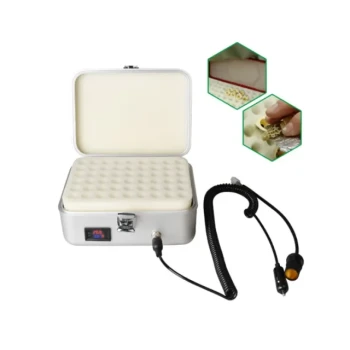
High-precision instruments may deliver tightly controlled semen volumes, such as approximately 8–10 μl in the referenced procedures. That improves procedural repeatability, but it does not by itself prove equal sperm numbers or equal reproductive success among drones.
For covariance calculations, genetic contribution is more important than delivery volume. Volume should be recorded as a management variable, while actual or expected paternal contribution should be represented separately in the model.
Understanding the Trade-offs
Genetic control versus genetic diversity
Artificial insemination reduces uncertainty from natural multi-drone mating and helps preserve selected breeding lines. It can also concentrate related individuals within the managed population if the same elite queens and drones are repeatedly used.
This creates a trade-off: precise selection can accelerate genetic progress, while excessive concentration can increase inbreeding and reduce population-level diversity.
SDI versus MDI
SDI offers strong attribution and a simple pedigree structure, but it narrows the paternal genetic base and can make colony performance more sensitive to one drone’s genotype.
MDI broadens paternal input and may support colony resilience, but it requires more complex covariance modeling and better contribution records.
Neither method is universally superior. The appropriate choice depends on whether the primary objective is genetic testing, commercial colony robustness, or balanced long-term selection.
Production efficiency versus statistical independence
Large-scale queen rearing can efficiently produce replacement queens and selected colonies. However, if many queens are derived from a small number of maternal lines or inseminated with related drones, observations that appear independent may actually be strongly correlated.
Ignoring this structure can produce overly confident breeding values and misleading estimates of selection response.
Equipment precision versus model quality
Advanced insemination and queen-rearing equipment improves mating control, repeatability, and operational consistency. It cannot compensate for incomplete pedigree records or an inappropriate diploid relationship matrix.
The best equipment and the best statistical model must be used together.
Common Modeling Errors to Avoid
Applying an unmodified livestock relationship matrix
A conventional diploid matrix may fail to represent the fact that one drone transmits the same haploid genome to all of its offspring.
The matrix should distinguish drone-derived relationships and include the appropriate shared paternal sampling contribution.
Treating pooled semen as a single unrelated sire
MDI semen should not automatically be recorded as if it came from one average, unrelated male. Doing so hides the number of paternal lineages and can distort both covariance and inbreeding estimates.
If individual assignment is unavailable, the model should at least retain the known mixture structure and its contribution assumptions.
Assuming equal contribution because insemination was controlled
Controlled insemination controls the mating event, not necessarily the realized number of offspring fathered by each drone.
Use documented contribution weights where available, and conduct sensitivity analyses when those weights are uncertain.
Ignoring colony-level common effects
Worker traits are also influenced by colony environment, queen effects, management, nutrition, and season. Genetic covariance should therefore be separated from common environmental covariance wherever the evaluation design permits.
Otherwise, shared colony conditions may be incorrectly attributed to shared paternal genetics.
How to Apply This to Your Breeding Program
The practical objective is to align mating records, equipment protocols, and the genetic evaluation model.
- If your primary focus is precise gene or trait testing: Use SDI with individually identified drones, controlled queen rearing, and a relationship matrix that includes the shared paternal Mendelian sampling term.
- If your primary focus is colony robustness and long-term survival: Use MDI to broaden paternal input, but record semen sources and contribution assumptions so the resulting covariance structure is not treated as ordinary diploid mating.
- If your primary focus is accurate breeding values: Separate queen, drone, drone-producing-queen, colony, and environmental effects, while modeling unequal paternal contributions.
- If your primary focus is preventing inbreeding: Track maternal and paternal lineage concentration across queen-rearing batches and avoid repeatedly using a small set of related elite lines.
- If your primary focus is operational reliability: Standardize insemination volume, semen handling, queen-cell management, and recordkeeping, while recognizing that procedural precision does not replace genetic verification.
When haploid paternal transmission and actual contribution patterns are represented correctly, queen rearing and artificial insemination become reliable tools for both genetic progress and responsible diversity management.
Summary Table:
| Factor | Effect on Covariance | Management Implication |
|---|---|---|
| Haploid drone paternal genome | Offspring share paternal haplotype, increasing full-sib covariance | Use models that include shared paternal sampling term |
| Unequal drone contributions | Greater chance of shared paternal genome | Record and model contribution weights |
| Single-drone insemination (SDI) | Clear paternal attribution | Ideal for genetic testing |
| Multi-drone insemination (MDI) | More diverse paternal base, complex attribution | Track sources or use genetic testing |
| Drone-producing queen contributions | Related drones increase covariance | Track lineage and balance use |
| Common colony environment | Confounds genetic covariance | Separate environmental effects |
Optimize your honey bee breeding program with precision queen rearing and artificial insemination equipment. At HONESTBEE, we provide a full spectrum of beekeeping tools, machinery, and equipment tailored for commercial apiaries and distributors. Our one-stop sourcing, rapid response, and dedicated support ensure you achieve genetic progress while maintaining diversity. For distributors and wholesalers, we offer competitive margins, OEM/ODM support, and certified quality. Ready to elevate your breeding? Contact us today for a customized solution!
Related Products
- Queen Bee Artificial Insemination Instrument Equipment for Instrumental Insemination
- HONESTBEE Improved No Grafting Queen Rearing Kit For Queen Rearing and Royal Jelly Production
- No Grafting Queen Rearing Kit: System for Royal Jelly Production and Queen Rearing
- Retractable Chinese Queen Rearing Grafting Tools Equipment
- Nicot Queen Rearing Kit for Beekeeping and Grafting in Nicot System
People Also Ask
- Why is maintaining sanitary conditions important during artificial insemination? Protect Your Queen from Fatal Infections
- Why are artificial insemination instruments critical in bee hybridization? Master Genetic Control & Pure Breeding
- What is the core value of bee artificial insemination instruments in breed improvement? Achieve Precise Genetic Control
- Why is professional bee artificial insemination equipment considered a core tool for genetic control in honeybee breeding? Ensure 100% Purity
- Why is high-purity CO2 used for queen bee artificial insemination? Unlock Precision Breeding & Faster Egg-Laying