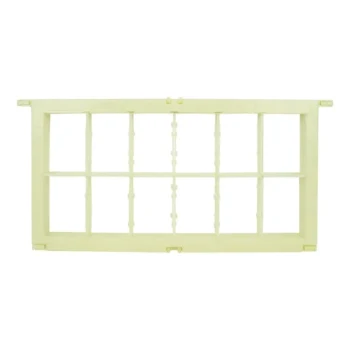
Standardized beehive frames serve as the modular backbone of modern apiary operations by ensuring the precise control of "bee space" and providing necessary structural support for the honeycomb. This technical uniformity allows beekeepers to extract, inspect, or replace individual combs independently, removing the need to disrupt the entire colony structure during routine maintenance.
The modular design of standardized frames transforms beekeeping from a chaotic gathering activity into a controlled, scientific process. By enabling independent manipulation of comb sections, these frames form the technical foundation for disease monitoring, artificial swarming, and scalable, mechanized production.
The Mechanics of Colony Control
Scientific Control of Bee Space
The primary function of a standardized frame is to maintain precise "bee space." By adhering to strict dimensional standards, these frames prevent bees from bridging combs together with excess wax or propolis.
This structural support ensures that the honeycomb remains distinct and manageable. It creates a controlled environment where the colony builds according to the beekeeper's management plan, rather than the random architecture found in wild hives.
Modular Inspection Capabilities
In daily operations, the frame acts as an independent module. A beekeeper can remove a single frame to check for the queen, assess brood health, or verify honey stores without dismantling the rest of the hive.
This modularity significantly reduces stress on the colony during inspections. It allows for targeted interventions, such as removing a specific diseased comb, without the collateral damage associated with traditional or non-standardized hives.
Operational Efficiency and Scalability
Interchangeability Through Precision
Industrial-grade manufacturing ensures that frames and dividers are produced with uniform specifications. This standardization creates total interchangeability of parts between different hives in an apiary.
This interchangeability is vital for rapid colony expansion and resource balancing. A frame of honey or brood from a strong colony can be instantly transferred to a weaker one to boost its population or stores.
Mechanized Management and Processing
Standardized frames are the prerequisite for mechanized beekeeping. Because every frame has identical dimensions, apiaries can utilize automated machinery for uncapping and honey extraction.
This significantly enhances production efficiency per colony. It also shortens the infrastructure deployment cycle, allowing operations to respond quickly to seasonal flowering windows across different vegetation zones.
Quantitative Population Assessment
Standardization transforms colony assessment from a guess into a calculation. For example, in a standard deep Langstroth hive, one side of a fully covered frame accommodates approximately 1,200 adult bees.
Beekeepers can quickly estimate the total adult population and brood amount using this coverage area method. This creates a physical basis for accurate health assessments and ensures biological comparability across different hives.
Advanced Management Techniques
Disease Monitoring and Prevention
The ability to isolate frames is the technical foundation for effective disease monitoring. Beekeepers can inspect brood patterns minutely for signs of illness.
Furthermore, standardized hive bases often work in tandem with frames to elevate the colony. This blocks ground moisture and soil-dwelling pests, improving internal humidity and extending the lifespan of the hardware.
Artificial Swarming and Breeding
Standardized hardware facilitates the splitting and merging of colonies. This is essential for artificial swarming, a technique used to manage colony population and prevent natural swarming (which results in the loss of bees).
It also enables graded honey harvesting. Beekeepers can selectively harvest frames that are fully capped and ripe, while leaving uncapped nectar to mature, ensuring higher quality produce.
Understanding the Trade-offs
Dependence on Manufacturing Precision
The effectiveness of this system relies entirely on precision. If frames deviate even slightly from standard specifications, the "bee space" is violated.
If the manufacturing quality fails, bees will bond frames together or build burr comb, negating the advantages of modularity. The system requires specialized woodworking machinery and assembly molds to maintain the strict tolerances necessary for interchangeability.
Biological Rigidity
While beneficial for management, standardized frames impose a uniform volume and environment on the bees. This eliminates environmental variables, which is excellent for scientific control groups but requires the beekeeper to actively manage space to prevent overcrowding.
Making the Right Choice for Your Goal
The adoption of standardized frames allows you to move from keeping bees to managing an agricultural asset.
- If your primary focus is Commercial Yield: Leverage the interchangeability of frames to mechanize extraction and rapidly balance resources between strong and weak colonies.
- If your primary focus is Colony Health: Utilize the modular design to perform frequent, low-impact inspections for disease monitoring and precise population estimates.
- If your primary focus is Scientific Research: Rely on the uniform hardware configuration to eliminate environmental variables, ensuring your metabolic and developmental studies are biologically comparable.
Standardized frames convert the complex biological variables of a bee colony into manageable, measurable, and scalable units of production.
Summary Table:
| Management Feature | Operational Impact | Strategic Benefit |
|---|---|---|
| Precise Bee Space | Prevents burr comb and bridging | Simplifies hive inspections and maintenance |
| Total Interchangeability | Frames move easily between any hive | Rapidly balance colony strength and resources |
| Modular Design | Individual comb manipulation | Targeted disease monitoring and queen checks |
| Uniform Dimensions | Compatibility with automated extractors | Significant increase in commercial honey yield |
| Quantitative Metrics | Accurate bee population estimates | Data-driven decision making for apiary growth |
Scale Your Apiary Operations with HONESTBEE Precision
Maximize your commercial yield and operational efficiency with HONESTBEE, the leading partner for professional beekeepers and global distributors. We specialize in the high-precision manufacturing of standardized beekeeping tools, machinery, and equipment designed to meet the rigorous demands of industrial-scale honey production.
Whether you need automated honey-filling machines, professional-grade hive-making hardware, or a consistent supply of essential industry consumables, we provide the modular infrastructure required to transform your apiary into a highly productive agricultural asset.
Ready to elevate your production standards?
Contact Us Today for Wholesale Solutions
References
- Ahmed Alghamdi, Yilma Tadesse. New approach for determination of an optimum honeybee colony’s carrying capacity based on productivity and nectar secretion potential of bee forage species. DOI: 10.1016/j.sjbs.2014.09.020
This article is also based on technical information from HonestBee Knowledge Base .
Related Products
- Wooden Bee Hive Frames for Beekeeping and Wholesale
- Professional Galvanized Steel Frame Rest for Beehives
- Assembled Wooden Bee Frames with Plastic Foundation for Durability and Convenience by HONESTBEE
- HONESTBEE Wired and Assembled Wooden Bee Frames Foundation for a Thriving Hive
- Plastic Bee Frame Beekeeping Hive Frames for Wholesale
People Also Ask
- How does balancing the number of frames impact hive productivity? Optimize Your Apiary's Biological Output
- How do wooden and plastic hive frames compare in terms of durability? Wood vs. Plastic Longevity & Repairability
- What are the main considerations when choosing between wooden and plastic bee hive frames? Optimize Your Apiary's Efficiency
- How should beehive frames be maintained to prolong their lifespan? 5 Pro Tips for Durable Beekeeping Equipment
- How are plastic frames different from traditional wooden frames? Choose the Right Frame for Your Apiary