Modern hive frames and foundation succeed by working with bee biology rather than against it. Worker bees naturally build strong, double-sided comb from precisely arranged hexagonal cells, but producing wax requires substantial energy and carbohydrate consumption. Standardized frames, embossed beeswax foundation, and accurate hive dimensions provide a ready-made structural guide, allowing colonies to devote more resources to brood rearing, honey storage, and colony development while producing comb suitable for inspection and mechanical extraction.
The central design principle is biological alignment: foundation supplies the cell pattern, frames provide stable support, and correct spacing preserves the bees’ natural “bee space.” Together, these features reduce irregular comb, simplify hive management, and protect the operational efficiency expected in commercial apiaries.
How Bee Behavior Shapes Comb Design
Worker bees build functional hexagonal cells
Worker bees construct comb as a double-sided structure composed of six-sided cells. These cells provide efficient use of space while supporting the colony’s two primary needs: brood rearing and the storage of honey and pollen.
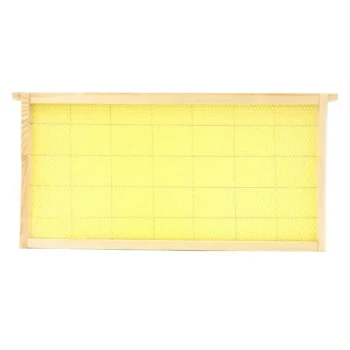
Hive foundation reflects this natural geometry by presenting embossed hexagonal patterns. The pattern encourages bees to extend the sheet into straight, parallel comb rather than beginning an irregular structure from an empty frame.
Wax production is biologically expensive
Worker bees secrete liquid wax through four pairs of wax glands on the underside of the abdomen. The wax hardens into translucent flakes, which bees manipulate with their mandibles and legs before attaching and shaping it into comb.
Wax production consumes significant colony resources and requires suitable internal hive temperatures. Providing pre-formed foundation reduces the amount of wax the colony must produce from scratch, helping redirect energy toward brood development and honey production.
Wax-building ability changes with worker age
Wax glands are most functional during a limited period of a worker’s life, primarily around the 12th to 18th day. After this period, the glands gradually degenerate, so comb construction depends on both colony population and seasonal conditions.
This behavior informs hive expansion and distribution planning. Foundation frames are most effective when supplied as colonies reach a strong population of appropriately aged workers and have sufficient nectar or carbohydrate resources to support construction.
How Foundation Guides Colony Development
Embossed foundation acts as a construction template
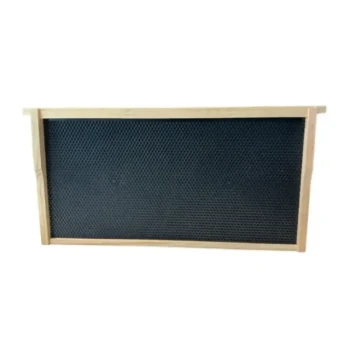
Beeswax foundation is not a finished comb; it is a pre-fabricated starting surface. Its cell impressions guide the location, orientation, and general dimensions of the comb that workers build.
This reduces the likelihood of cross-comb and uneven attachments. For beekeepers and commercial operators, the result is a more predictable frame that can be inspected, moved, rotated, and harvested efficiently.
Cell geometry supports brood organization
Uniform foundation helps maintain orderly brood areas by encouraging parallel comb construction and consistent cell placement. Workers can then use the comb for larval care, feeding, and the storage of pollen and honey around the brood nest.
The foundation does not eliminate all biological variation. Bees may adjust cell dimensions or reshape portions of the comb according to colony needs, but a precise starting pattern establishes useful structural discipline.
Wax quality and wall thickness affect construction
Worker bees use spoon-shaped mandibles to scrape, shape, and smooth wax. They are highly capable of manipulating wax, but they are not designed to cut and assemble thick, inconsistent materials efficiently.
For that reason, foundation manufacturing must control wax purity, cell accuracy, and wall thickness. Poorly formed or contaminated sheets can increase construction effort, reduce attachment quality, and produce comb that is less suitable for repeated handling.
How Frames Translate Natural Comb Into Equipment
Frames provide structural support
Natural comb is attached to the cavity walls and ceiling of a hive. Movable frames convert that fixed structure into a supported, removable unit that beekeepers can inspect and manage individually.
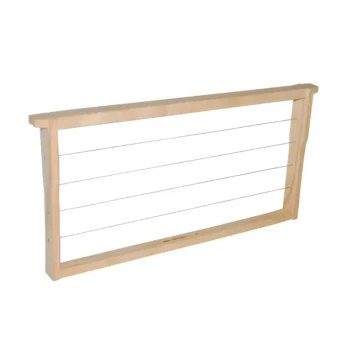
The frame must be strong enough to hold growing comb, brood, honey, and pollen during lifting and extraction. Foundation adds a central guide, while the surrounding wooden or engineered frame supplies the perimeter and load-bearing support.
Standard dimensions enable interoperability
Standardized frame dimensions allow equipment from different parts of a commercial operation to work together. Frames can be installed in compatible hive bodies, supers, storage systems, and honey extractors without requiring custom modification.
For distributors and resellers, this makes dimensional consistency a central product requirement. A broad portfolio is valuable only when its frames, foundation, boxes, and accessories maintain compatible specifications.
Extractable comb must remain stable
Mechanical extraction places considerable force on honey-filled comb. Straight, well-attached comb supported by a correctly assembled frame is more likely to withstand extraction and remain reusable.
This is one reason commercial designs favor standardized foundation and reinforced frame construction. The objective is not simply to make bees build comb; it is to produce repeatably usable comb across multiple handling and harvest cycles.
Why Bee Space Is a Critical Design Standard
Correct spacing prevents unwanted construction
Honey bees maintain a natural clearance known as bee space, commonly described as approximately 3/8 inch, or 9.5 mm. This spacing applies between combs and between combs and nearby hive components.
When the gap is too narrow, bees tend to fill it with propolis. When it is too wide, they often build additional comb, commonly called burr comb. Both outcomes interfere with orderly hive management.
Dimensional accuracy improves serviceability
Correct frame spacing keeps comb parallel and allows frames to be removed without excessive tearing or crushing. It also reduces the buildup of propolis that can glue frames, boxes, and covers together.
For high-volume apiaries, these details have direct operational consequences. Accurate equipment supports faster inspections, easier frame replacement, and more predictable extraction workflows.
Propolis influences component design
Propolis helps bees seal cracks, reinforce attachments, smooth surfaces, and maintain hive hygiene. Its natural antibacterial and antifungal properties benefit the colony, but its adhesive qualities can make hive components difficult to separate.
Frame rests, box joints, covers, and hive tools therefore need to accommodate routine propolization. Exact tolerances and durable construction reduce the risk that normal bee behavior will make equipment impractical to service.
Understanding the Trade-offs
Foundation reduces energy demand but adds sourcing requirements
Foundation lowers the wax-building burden, but it introduces dependence on manufactured components. Quality, purity, storage conditions, and compatibility with the selected frame system all become important purchasing considerations.
A low-cost sheet that cracks, warps, or has inaccurate embossing can create more labor than it saves. Commercial buyers should evaluate consistency across shipments rather than relying only on unit price.
Standardization improves efficiency but limits flexibility
Standard frames and foundation support interchangeable equipment and streamlined extraction. However, beekeepers using specialized hive formats, regional dimensions, or particular cell-size preferences may require more selective sourcing.
Distributors should clearly identify dimensions, compatibility, material specifications, and intended use. This prevents substitution errors that can lead to poor bee space, damaged comb, or equipment downtime.
Bees remain active participants in the design
Foundation guides construction but does not fully control it. Colonies can modify cell structure, add propolis, reinforce attachments, or build unwanted comb when spacing, colony conditions, or equipment placement are unsuitable.
Equipment should therefore be viewed as a biological interface, not a rigid mold. Good design creates conditions in which natural behavior produces a commercially useful result.
Frame strength must balance cost and handling
Heavier or reinforced frames may tolerate repeated inspections and extraction more effectively, but they can increase shipping weight, storage requirements, and purchase cost. Lighter components may be appropriate for some operations but can be less forgiving under load.
The correct specification depends on the handling intensity, frame size, extraction method, and expected service life of the apiary.
Making the Right Choice for Your Goal
Select frame and foundation products by evaluating both bee behavior and the practical workflow of the operation.
- If your primary focus is rapid comb establishment: Supply accurately embossed, high-quality foundation during periods when colonies have sufficient young wax-producing workers and adequate carbohydrate resources.
- If your primary focus is commercial honey extraction: Prioritize straight, well-supported frames with reliable foundation attachment and dimensions compatible with the intended extractor.
- If your primary focus is easier hive inspection: Maintain precise bee space across frames, supers, and hive bodies to limit burr comb and excessive propolis bonding.
- If your primary focus is dependable distribution: Build a compatible product portfolio with clearly controlled dimensions, consistent materials, responsive fulfillment, and technical support for equipment selection.
- If your primary focus is long-term operating value: Compare foundation quality, frame durability, reusability, and replacement availability rather than evaluating purchase price alone.
The most effective hive equipment turns the worker bee’s natural capacity for precise construction into consistent, serviceable, and scalable apiary performance.
Summary Table:
| Design Feature | How It Works | Benefits |
|---|---|---|
| Hexagonal foundation | Embossed patterns guide bees to build straight comb | Reduces irregular comb, saves energy |
| Movable frames | Provide structural support and remove comb | Enables inspection, harvesting, and extraction |
| Bee space (9.5 mm) | Maintains correct gap between combs and components | Prevents burr comb and excessive propolis |
| Standard dimensions | Ensures compatibility across equipment | Simplifies management and extraction |
| Wax quality and thickness | Controlled purity for easy manipulation | Reduces construction effort, improves durability |
Ready to align your hive equipment with bee biology for better yields? At HONESTBEE, we supply a comprehensive range of hive frames, foundation, and beekeeping machinery designed for commercial apiaries and distributors. Our full-spectrum portfolio supports one-stop sourcing, rapid fulfillment, and dedicated service. Optimize your operation with products that respect natural bee behavior. Contact us today to discuss your needs and discover how our expertise can enhance your profitability and supply reliability. Request a quote now!
Related Products
- HONESTBEE Wired and Assembled Wooden Bee Frames Foundation for a Thriving Hive
- Plastic Bee Frame Beekeeping Hive Frames for Wholesale
- Assembled Wooden Bee Frames with Plastic Foundation for Durability and Convenience by HONESTBEE
- Wooden Bee Hive Frames for Beekeeping and Wholesale
- Professional Galvanized Steel Frame Rest for Beehives
People Also Ask
- What role does replacing foundation and frames play in controlling American Foulbrood (AFB)? A Key to Hive Sanitation
- What is the difference between frames and foundation in a bee hive? A Guide to Hive Structure and Comb Building
- What is the role of frames and foundation in a bee hive? Build a Stable and Productive Apiary with Modern Design
- What is the purpose of frames and foundations in a beehive? Achieve a Healthy, Manageable Hive
- How do wooden and plastic hive frames compare in terms of durability? Wood vs. Plastic Longevity & Repairability