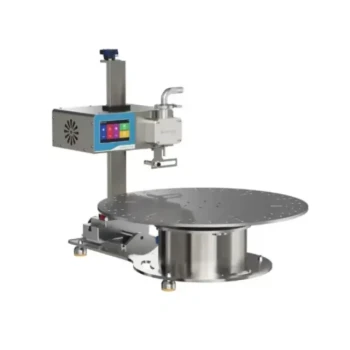
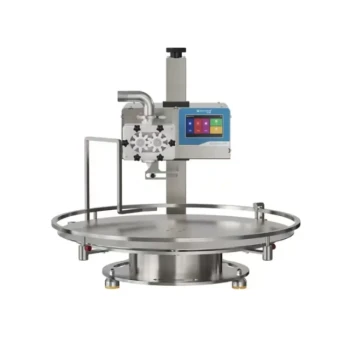
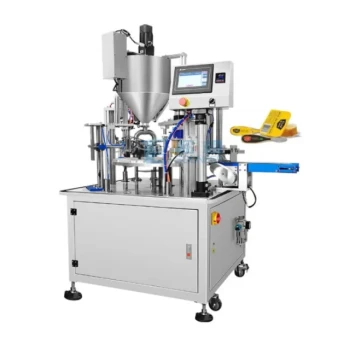
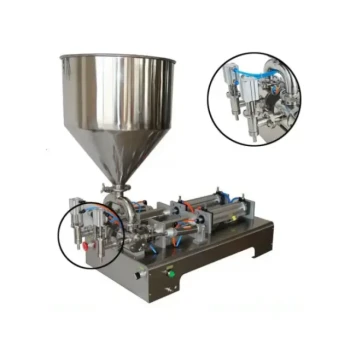
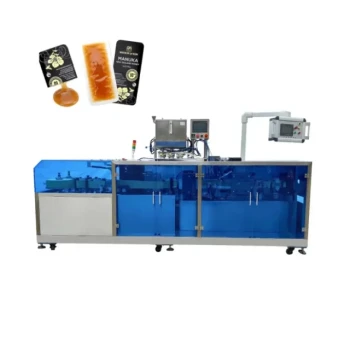
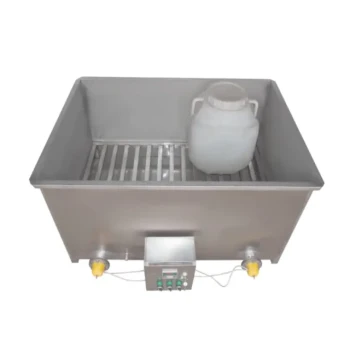
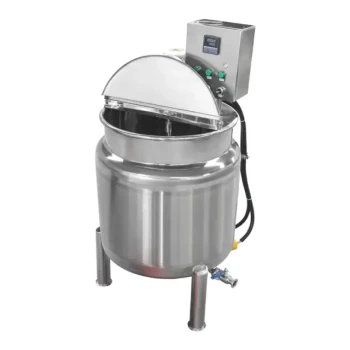
Dwarf honeybee honey requires a gentler, more adaptable filling system than a standard high-volume honey line. Its high levulose content gives it a low tendency to crystallize, reducing the need for aggressive heating and de-crystallization. However, dextrin levels up to four times higher than in conventional honey can create variable viscosity, making adjustable positive-displacement pumping and precise anti-drip filling essential.
The main equipment priority is not heavy crystal removal—it is accurate control of viscosity, temperature, shear, and fill volume. A suitable machine should combine adjustable positive-displacement pumps, volumetric anti-drip nozzles, food-grade corrosion-resistant contact parts, and precise thermal management.
Why Dwarf Honeybee Honey Behaves Differently
High levulose reduces crystallization risk
Dwarf honeybee honey contains a high proportion of levulose, also known as fructose. This composition gives the honey a low tendency to granulate, allowing it to remain fluid for longer during storage and filling.
For processors, this can reduce dependence on heavy-duty de-crystallization tanks, aggressive agitators, and repeated pre-heating cycles before bottling.
High dextrin content affects viscosity
Dextrin levels may reach up to four times those found in standard honeybee honey. Dextrin can contribute to a thicker or less predictable flow profile, particularly when temperature, storage time, and batch composition change.
The machinery therefore needs to accommodate viscosity variation rather than assuming that every batch will flow like conventional liquid honey.
Small yields increase the value of dosing precision
Dwarf honeybee colonies generally produce limited quantities, with standard nests producing approximately 500 grams to 1 kilogram, and forage-rich areas producing up to about 4 kilograms.
This makes the product relatively high value per unit volume. Even small filling inaccuracies can create measurable product loss, so equipment should be suitable for small containers, low batch volumes, and highly accurate dosing.
Equipment Specifications That Matter Most
Use adjustable positive-displacement pumps
A positive-displacement pump delivers a controlled volume instead of relying primarily on free-flow behavior. This is important when dextrin-driven viscosity changes affect how quickly honey moves through the system.
The pump should offer adjustable speed or output settings so operators can tune the system for different batches, container sizes, and operating temperatures.
Specify anti-drip volumetric nozzles
Anti-drip nozzles help prevent stringing, trailing, and product accumulation around the bottle neck. These problems become more significant when filling a viscous honey that does not break cleanly from the nozzle.
A volumetric filling arrangement also supports consistent dosing, which is especially important for premium dwarf honeybee honey packed in smaller containers.
Select gentle, low-shear product handling
Honey contains sensitive compounds, including enzymes, proteins, phenolics, flavonoids, and other bioactive constituents. Pumps and transfer systems should therefore minimize unnecessary shear, turbulence, and air incorporation.
Gentle handling helps preserve the product’s original sensory and functional qualities while reducing foaming and oxidation exposure during processing.
Include precise temperature control
Low crystallization does not mean that temperature control is unnecessary. Moderate, controlled warming may still be needed to manage viscosity during transfer and filling, but excessive heat can damage heat-sensitive enzymes and other bioactive components.
The preferred system uses controlled, uniform heating, rather than aggressive thermal treatment or repeated high-temperature cycles.
Use food-grade, corrosion-resistant contact materials
Honey is naturally acidic, with an average pH of approximately 3.9, and contains chemically active enzymes. Product-contact components should therefore use food-grade, corrosion-resistant materials, such as high-grade stainless steel, with 316L stainless steel being an appropriate specification for demanding contact surfaces.
This reduces contamination and corrosion risks during repeated commercial operation.
How the Chemistry Changes the Processing Line
De-crystallization capacity can be lighter
Because dwarf honeybee honey has a low tendency to granulate, the line may not need the same large heating and crystal-dissolving capacity used for honeys that crystallize readily.
This can simplify the equipment package and reduce energy use, provided that the system still offers sufficient temperature control for viscosity adjustment.
Pump and nozzle flexibility become more important
The equipment emphasis shifts from crystal removal to flow control. A processor should prioritize pump adjustability, nozzle shutoff performance, and fill-volume calibration over oversized de-crystallization hardware.
For distributors and resellers, this means specifying a machine according to the honey’s rheology and package format—not simply according to the nominal filling speed.
Smaller formats require finer calibration
Premium dwarf honeybee honey may be sold in small bottles or specialty containers. The filler should support low-volume dosing with accurate calibration and minimal residual product in the pipework and nozzle assembly.
A machine designed only for large containers or high-throughput commodity honey may create excessive giveaway when used for this product.
Understanding the Trade-offs
Reduced crystallization does not eliminate heating requirements
The honey may remain fluid for longer, but dextrin-related viscosity can still make transfer and filling difficult. The correct solution is controlled temperature adjustment, not assuming that the product can always be filled cold.
Higher precision may reduce maximum throughput
Small-container filling, low-shear pumping, and frequent calibration can reduce headline production speed compared with a commodity honey line. For a limited-yield, higher-value product, however, dosing accuracy and product retention are often more valuable than maximum speed.
Heavy-duty equipment may be unnecessary—but under-specification is risky
A processor may avoid investing in large de-crystallization systems, but an overly simple gravity filler can struggle with viscosity variation and nozzle dripping. The line still needs a positive-displacement pump and controlled filling architecture.
Heat-sensitive constituents constrain process intensity
Excessive heating, prolonged residence time, and aggressive mechanical handling can reduce the quality of honey’s natural enzymes and other bioactive constituents. Equipment should be selected for thermal stability and gentle transfer, not merely for mechanical output.
What Distributors and Processors Should Specify
Define the viscosity operating range
Ask the equipment supplier to confirm the pump, valve, and nozzle performance across the expected viscosity range. The specification should account for batch variation and the intended filling temperature.
Match the filler to the package size
Request calibration data for the actual bottle or container sizes used. Small-volume accuracy, nozzle shutoff, and low residual volume should be explicit requirements rather than assumed features.
Confirm material and temperature controls
Verify food-grade contact materials, corrosion resistance, and the available temperature-control range. The machine should allow operators to maintain flow without exposing the honey to unnecessarily high temperatures.
Prioritize service and configuration support
Because dwarf honeybee honey may be processed in small, premium batches, rapid technical response and easy adjustment are operational advantages. Distributors should provide a complete sourcing package covering the filler, pump, nozzles, temperature controls, and application support.
Choosing the Right Machinery for the Product
A suitable system should be selected around the honey’s chemical behavior, batch size, container format, and preservation requirements.
- If your primary focus is filling accuracy: Choose an adjustable positive-displacement volumetric filler with anti-drip nozzles and calibration for small containers.
- If your primary focus is product preservation: Choose gentle low-shear handling, precise temperature control, and food-grade corrosion-resistant contact surfaces.
- If your primary focus is lower equipment cost: Avoid oversized de-crystallization systems, but retain adaptable pumping and controlled warming capabilities.
- If your primary focus is premium commercial distribution: Source a complete, configurable line with rapid technical support and reliable fulfillment for pumps, nozzles, controls, and replacement parts.
The best dwarf honeybee honey filling system is one that uses less aggressive de-crystallization equipment while providing more precise control over viscosity, temperature, and dosage.
Summary Table:
| Property | Impact on Machinery | Required Spec |
|---|---|---|
| High levulose | Low crystallization | Lighter de-crystallization |
| High dextrin | Variable viscosity | Adjustable positive-displacement pumps |
| Low yield | High value per unit | Precise dosing, anti-drip nozzles |
| Heat-sensitive enzymes | Thermal degradation | Precise temperature control |
| Acidic pH | Corrosion | Food-grade 316L stainless steel |
Optimize your honey processing line for dwarf honeybee honey. At HONESTBEE, we supply specialized filling and processing machinery tailored to premium honey, with a full spectrum of beekeeping equipment and consumables. Our rapid response, expert support, and ultra-fast delivery ensure you get the right solution fast. Contact us today to discuss your requirements and boost your production efficiency.
Related Products
- Fully Automatic Honey Filling Packaging Machine for Processing Line
- Precision Durable Efficient HONESTBEE Rotary Honey Filling Machine
- Automatic Honey Filling and Filtering Machine for Beekeeping Bottle Filling
- Economy Small Honey Filling Machine Honey Bottle Filler Packaging Machine
- Double Nozzle Small Honey Filling Machine Honey Sachet Packing Packaging Equipment
People Also Ask
- Why are fully automatic honey filling and packaging lines essential? Boost Your Honey's Market Value and Quality
- What is a fully-automatic honey filler? Streamline Your Production with High-Precision Automation
- How do automated honey filling and packaging machines affect profitability? Boost Margins with HONESTBEE Technology
- How do automated honey filling and packaging machines contribute to the market value of honey products? Maximize Your ROI
- How do industrial-grade automated honey filling and packaging machines mitigate the risk of physical contamination?