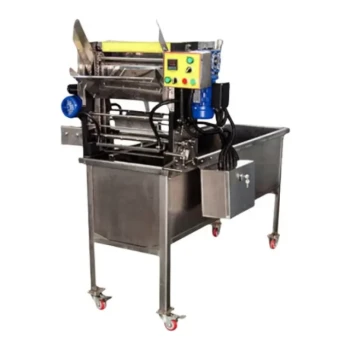
Transitioning to commercial honey production requires a shift from manual, small-scale methods to industrial-grade automated systems that guarantee volume, hygiene, and consistency. These technologies facilitate the move to a commercial scale by replacing labor-intensive tasks with high-precision volumetric control and advanced sealing, turning raw honey into a standardized product ready for global distribution.
Core Takeaway: Industrial-grade equipment is the essential foundation for scaling honey production, as it ensures the high-volume consistency and hygiene standards required to meet the demands of international export and modern retail markets.
Scaling Through Precision and Efficiency
Transitioning from Workshops to High-Volume Delivery
Manual filling and extraction are the primary bottlenecks in traditional honey production. Industrial-grade machinery eliminates these constraints by utilizing automated centrifugal extraction and high-speed filling lines to process large volumes of honey in a fraction of the time. This transition allows producers to shift from local sales to meeting the rigorous supply demands of B2B wholesalers and distributors.
Maintaining Nutritional Stability and Shelf Life
Automated systems use closed-loop filling processes that significantly reduce the honey's exposure to air and environmental impurities. For high-value products like stingless bee honey, this technology is vital for maintaining nutritional integrity and preventing premature fermentation. By strictly controlling moisture through dehydration and ensuring airtight seals, these machines extend the product shelf life necessary for long-distance shipping and storage.
Professional Appearance and Market Competitiveness
Commercial viability depends on a product's ability to compete on a retail shelf. Automated equipment ensures a standardized, professional appearance through precise weighing and uniform sealing. This level of consistency is critical for building brand trust in modern retail environments and high-end domestic markets.
Strengthening the Global Supply Chain
Meeting International Quality Standards
For distributors targeting international export, meeting global hygiene standards is non-negotiable. Industrial processing equipment includes deep filtration and temperature control to remove impurities and ensure the honey meets strict purity benchmarks. This "export-ready" processing allows trading partners to facilitate ultra-fast delivery without the risk of regulatory rejection at customs.
Optimizing Backend Recovery and Output
Even when bee colonies face environmental pressure or disease, industrial equipment helps maximize backend recovery. High-efficiency filtration and refining processes ensure that every drop of harvested honey is utilized, minimizing economic losses. This reliability is a key selling point for one-stop sourcing partners who require a stable and predictable product supply.
Compensating for Raw Material Shortages
In regions with lower raw honey output, automation allows for higher resource utilization. By increasing the diversity and efficiency of processing equipment, producers can extract more value from less raw material. This efficiency enhances market competitiveness by maintaining high output levels even during lean harvest seasons.
Understanding the Trade-offs
The Cost of Initial Investment
The primary barrier to adopting industrial-grade equipment is the significant upfront capital expenditure. While these systems provide long-term ROI through labor savings and increased volume, the initial cost may require specialized financing or high-volume commitments from B2B buyers to justify the expense.
Complexity and Maintenance Requirements
Automated lines are significantly more complex than manual tools, requiring specialized technical expertise for operation and maintenance. Any mechanical failure can lead to production downtime, making it essential to partner with suppliers who offer comprehensive customer service and rapid response times for spare parts.
Balancing Industrial Scale with "Pure" Branding
While automation improves hygiene, excessive processing or overheating can sometimes be perceived as a move away from "artisanal" or "raw" honey qualities. Producers must carefully calibrate their temperature control and filtration settings to maintain the honey's natural physicochemical properties while still achieving commercial standardization.
Making the Right Choice for Your Goal
To successfully transition to commercial honey production, your choice of equipment must align with your specific market objectives.
- If your primary focus is international export: Prioritize equipment with advanced dehydration and deep filtration capabilities to meet strict global moisture and purity standards.
- If your primary focus is rapid market expansion: Invest in high-speed automated filling lines and integrated sealing systems to ensure ultra-fast order fulfillment and high turnover.
- If your primary focus is high-end retail packaging: Choose machinery with high-precision volumetric control to ensure identical fill levels and premium aesthetic consistency across all units.
By integrating industrial-grade automation, honey producers can transform raw resources into a high-value, standardized commodity that meets the rigorous demands of the global B2B trade.
Summary Table:
| Key Benefit | Industrial Solution | Impact on Commercial Growth |
|---|---|---|
| Scalability | Automated filling & extraction lines | Enables high-volume B2B supply and rapid order fulfillment. |
| Quality Control | Closed-loop processing & dehydration | Extends shelf life and ensures compliance with export standards. |
| Consistency | Precision volumetric & weight control | Guarantees a professional retail appearance and brand trust. |
| Efficiency | Deep filtration & refining machinery | Maximizes backend recovery and resource utilization from raw honey. |
Scale Your Honey Business with HONESTBEE
Ready to transition from workshop to industrial-scale production? HONESTBEE specializes in supporting commercial apiaries and B2B distributors with one-stop sourcing for high-precision honey filling machines, hive-making equipment, and essential industry consumables.
We provide our partners with:
- Premium Trading Services: High profit margins and OEM/ODM support for wholesalers.
- Unmatched Reliability: Comprehensive full-spectrum product portfolio with ultra-fast delivery.
- Expert Support: Deep industry expertise and rapid response times to keep your lines running.
Contact us today to optimize your supply chain!
References
- Aleksandar Joksimović, Stefan Ko�evic. Smart Apiculture Business Model. DOI: 10.62036/isd.2025.155
This article is also based on technical information from HonestBee Knowledge Base .
Related Products
- Fully Automatic Honey Filling Packaging Machine for Processing Line
- Automatic Honey Filling and Filtering Machine for Beekeeping Bottle Filling
- Precision Automated Packaging Turntable Honey Spoon Filling Sealing Packing Machine
- Semi Automatic Small Honey Bottle Filling Machine Honey Filler
- Precision Durable Efficient HONESTBEE Rotary Honey Filling Machine
People Also Ask
- Why are fully automatic honey filling and packaging lines essential? Boost Your Honey's Market Value and Quality
- What is a fully-automatic honey filler? Streamline Your Production with High-Precision Automation
- How do automated honey filling and packaging machines affect profitability? Boost Margins with HONESTBEE Technology
- How do automated honey filling and packaging machines contribute to the market value of honey products? Maximize Your ROI
- How do industrial-grade automated honey filling and packaging machines mitigate the risk of physical contamination?