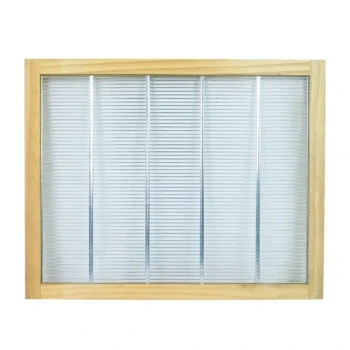
Installing a metal queen excluder helps commercial beekeepers keep honey supers brood-free. Placed between the brood chamber and upper honey supers, its precision-spaced grid allows worker bees to pass while restricting the larger queen. This prevents eggs and larvae from entering honey-storage frames, making those frames cleaner and faster to process during extraction.
A metal queen excluder separates brood production from honey storage. The result is cleaner frames, simpler handling, reduced labor, and a more consistent commercial extraction workflow.
How a Metal Queen Excluder Supports Commercial Extraction
It keeps the queen in the brood chamber
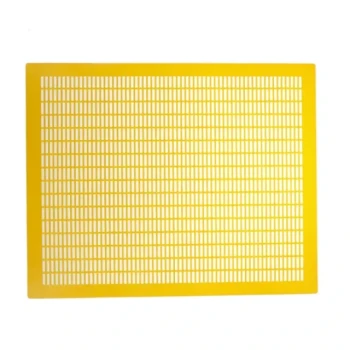
The excluder creates a physical barrier between the lower brood area and the upper honey supers. Worker bees can move through the openings to store nectar, while the queen remains confined to the brood chamber.
Because the queen cannot reach the honey supers, she cannot lay eggs in the frames intended for harvest.
It keeps honey frames free from brood
Without an excluder, brood may appear in honey supers if the queen moves upward. Eggs, larvae, and pupae create additional sorting and inspection requirements during harvesting.
A properly installed excluder helps ensure that extraction frames contain honey rather than mixed brood material.
It improves extraction-line efficiency
Brood-free supers can move more directly from hive removal to uncapping and extraction. Commercial operators spend less time identifying, separating, or managing frames that are unsuitable for immediate processing.
This is particularly valuable when many supers must be harvested within a limited operating window.
Why Cleaner Frames Matter Commercially
It reduces handling and labor
Frames containing brood require extra attention before extraction. They may need to be returned to the hive, separated from the harvest batch, or handled differently during processing.
Keeping brood in the lower chamber reduces these interruptions and supports a more predictable labor process.
It simplifies filtration and processing
Honey extracted from brood-free frames is less likely to contain brood-related material. This simplifies the subsequent filtration and settling stages.
The excluder does not replace filtration, but it helps prevent avoidable contamination at the source.
It supports consistent product quality
Commercial honey buyers and processors depend on uniform raw material. Honey harvested from clean, brood-free frames is better suited to maintaining consistent purity, appearance, and processing quality.
That consistency supports more reliable order fulfillment and quality control across larger shipments.
Why Choose a Metal Excluder for Commercial Use
It provides a rigid, precision-spaced barrier
A metal excluder maintains a fixed grid structure between hive boxes. Its effectiveness depends on openings that are consistently sized to permit worker movement while restricting the queen.
This dimensional consistency is important when equipment is used repeatedly across multiple colonies and harvest cycles.
It suits repeated commercial handling
Commercial extraction involves frequent installation, removal, cleaning, and transport of hive equipment. A rigid metal construction is well suited to this repeated handling when properly maintained.
Product quality still depends on accurate manufacturing, a suitable frame design, and compatibility with the hive system.
It supports standardized operations
Using consistent excluder specifications across an apiary makes hive setup and harvesting procedures easier to standardize. Distributors and wholesalers can therefore support customers with repeatable equipment configurations rather than improvised solutions.
Understanding the Trade-offs
Worker traffic may be affected
Although worker bees can pass through the grid, an excluder is still a restriction between the brood chamber and supers. Colonies may respond differently depending on population strength, nectar flow, hive configuration, and management practices.
The excluder should therefore be used as part of an appropriate colony-management plan, not as a substitute for inspection.
Installation must be accurate
The excluder should be installed directly between the brood chamber and the honey supers, with no unintended gaps that could allow the queen to bypass the barrier.
It should also sit securely and remain aligned with the hive boxes during routine handling.
It does not remove every extraction problem
A queen excluder prevents the queen from entering the supers, but it does not guarantee that every frame is ready for harvest. Operators must still assess honey maturity, frame condition, capping, and general colony health.
The device improves separation and workflow; it does not replace experienced harvesting decisions.
Equipment quality matters
Poorly manufactured grids, damaged edges, inaccurate spacing, or incompatible dimensions can reduce performance and create handling problems. For commercial supply, buyers should verify material quality, opening consistency, hive compatibility, and availability of replacement units.
Reliable sourcing is important because a missing or unsuitable excluder can disrupt an entire harvesting schedule.
How to Apply This to Your Operation
A metal queen excluder is most valuable when the objective is to make honey handling cleaner, faster, and more repeatable.
- If your primary focus is extraction efficiency: Install the excluder between the brood chamber and honey supers to reduce brood-related sorting and accelerate frame movement into the extraction line.
- If your primary focus is honey purity and presentation: Use a precision-spaced excluder to keep eggs, larvae, and pupae out of honey-storage frames.
- If your primary focus is commercial standardization: Source consistent metal excluders with verified dimensions and hive compatibility across your apiary or customer network.
- If your primary focus is supply reliability: Work with a supplier able to provide the required specifications, responsive service, and dependable fulfillment for repeat orders.
Used correctly, a metal queen excluder turns brood separation into a practical control point for more efficient and consistent commercial honey extraction.
Summary Table:
| Benefit | Impact on Extraction |
|---|---|
| Brood-free honey supers | Cleaner frames, less sorting, easier processing |
| Reduced labor | Less handling of mixed brood and honey frames |
| Consistent product quality | Uniform raw honey for reliable processing |
| Standardized operations | Repeatable setup across hives |
| Worker traffic restriction | May require adaptive colony management |
| Installation accuracy required | Proper placement critical to effectiveness |
Ready to streamline your honey extraction? At HONESTBEE, we supply precision-engineered metal queen excluders and a full range of beekeeping equipment for commercial apiaries and distributors. Our wholesale solutions ensure rapid delivery, certified quality, and dedicated support to keep your operation running smoothly. Contact us today to discuss your requirements and elevate your extraction workflow. Get in touch now.
Related Products
- Metal Queen Bee Excluder for Beekeeping
- Premium Wood Framed Metal Wire Queen Bee Excluder
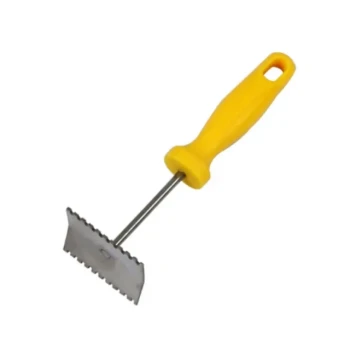
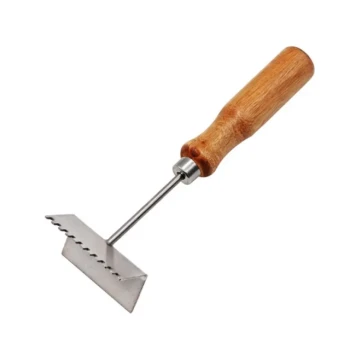
- Stainless Steel Scraper for Metal Queen Bee Excluders
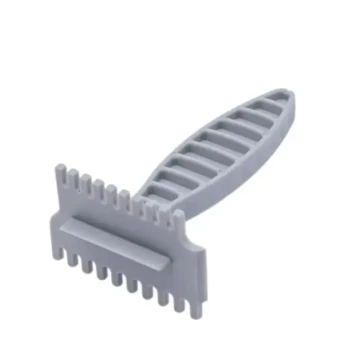
- Lightweight Durable Plastic Queen Excluder Scraper for Beekeeping
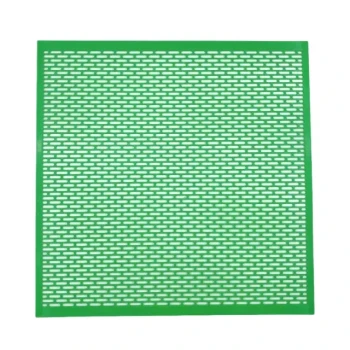
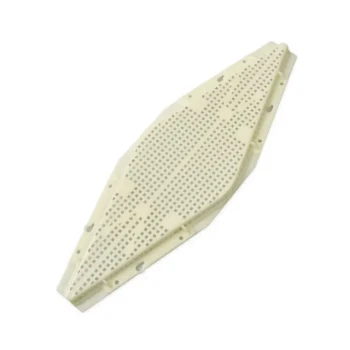
- High Performance Plastic Queen Excluder for Beekeeping and Apiary Management
People Also Ask
- Why are standardized hive frames and queen excluders essential for maintaining honey purity and quality? Scale Your Purity
- What types of queen excluders are available for beekeepers? Choose the Right Tool for Your Hive
- How does a queen-bee excluder function as a defense against Small Hive Beetles? Protect Your Honey with Resource Denial
- What is the primary function of a queen excluder within a commercial beehive? Ensure Purity in Honey Production
- Can a queen excluder be used as a propolis trap? Understand Bee Space for Better Hive Management