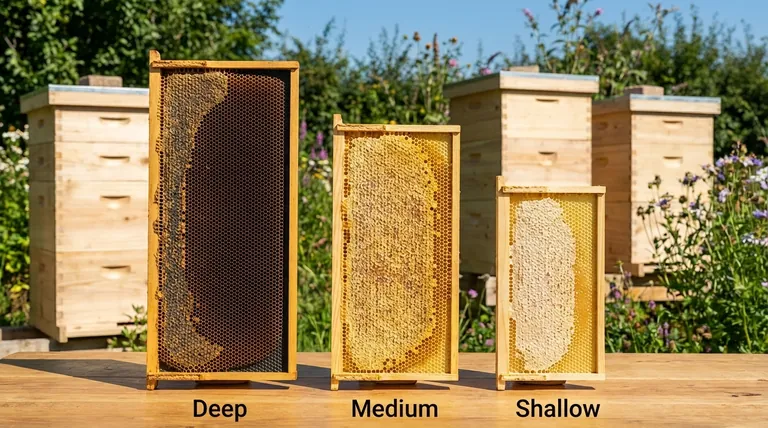
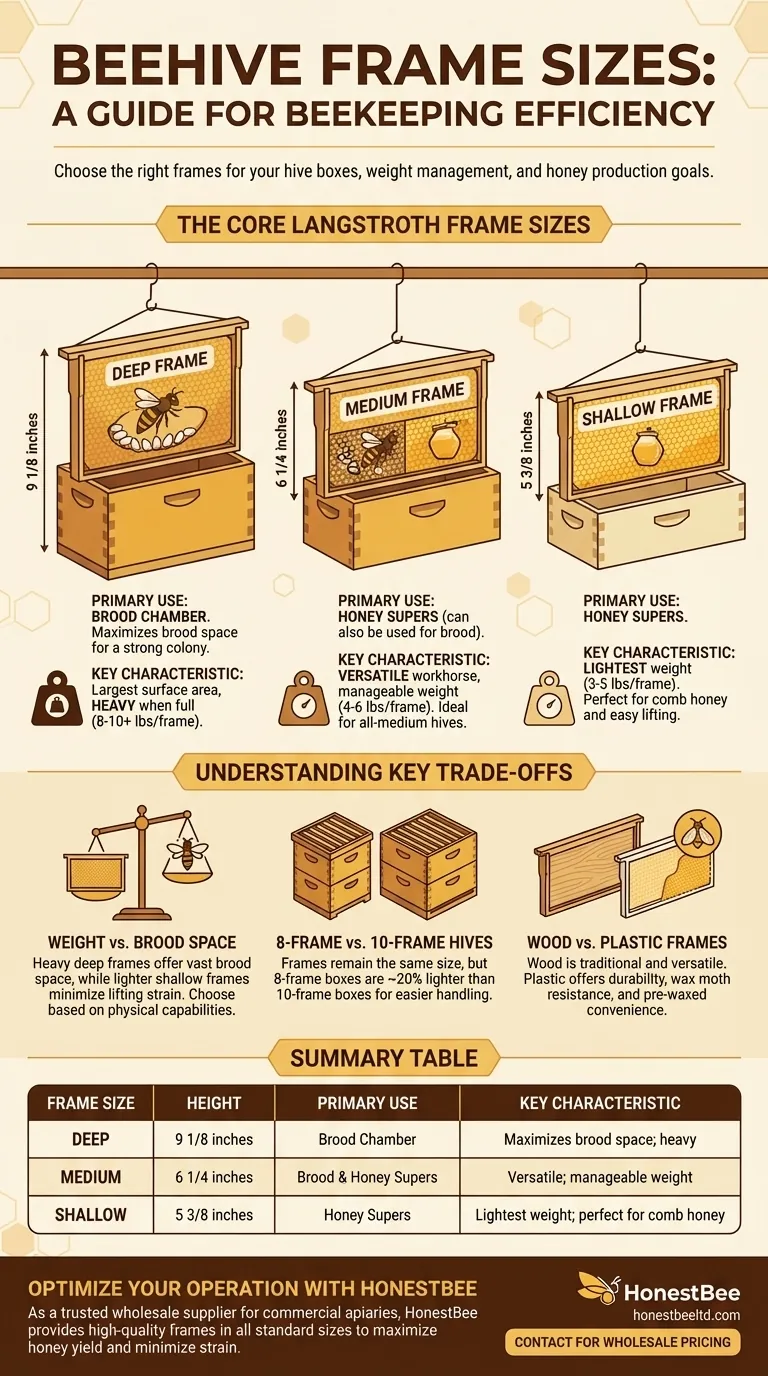
At the core of modern beekeeping, there are three standard Langstroth frame sizes determined by their height. The largest, a Deep frame, measures 9 1/8 inches tall. The most versatile, a Medium frame, is 6 1/4 inches tall. The smallest, a Shallow frame, measures 5 3/8 inches tall. These frames are designed to fit perfectly within hive boxes (or "supers") of corresponding depths.
The choice of beehive frame size is not an isolated decision. It directly dictates the weight of your hive boxes and the function of each section of the hive, fundamentally shaping your entire beekeeping management strategy.
The Role of a Frame in the Hive
A beehive frame is a simple yet brilliant invention. It is a rectangular structure, typically made of wood or plastic, that hangs vertically inside a hive box.
A Foundation for the Colony
Frames provide a removable foundation on which bees build their wax comb. This comb is used for two primary purposes: raising brood (young bees) and storing food (honey and pollen).
Enabling Inspection and Management
The ability to remove frames is the cornerstone of modern beekeeping. It allows the beekeeper to inspect the queen's laying pattern, check for pests and diseases, and harvest honey without destroying the colony's comb structure.
The Three Standard Frame Sizes Explained
Frame size corresponds directly to the depth of the hive box it's designed for. The width is standardized to fit within Langstroth hives, but the height is the key differentiator.
Deep Frames (9 1/8 inches)
Deep frames are almost exclusively used in the lowest boxes of the hive, known as the brood chamber. Their large surface area provides the queen with an expansive, uninterrupted space to lay her eggs, which promotes a strong and healthy colony population.
Medium Frames (6 1/4 inches)
Medium frames are the versatile workhorses of the hive. They are most commonly used for honey supers—the boxes stacked on top of the brood chamber for honey storage. Some beekeepers also use all-medium boxes for their entire hive to standardize equipment.
Shallow Frames (5 3/8 inches)
Shallow frames are used strictly for honey supers. Their smaller size means they are the lightest to lift when full of honey, making them a popular choice for beekeepers who want to minimize physical strain. They are also ideal for producing specialty comb honey.
Understanding the Key Trade-offs
Choosing a frame size involves balancing the needs of the bees with the physical capabilities and goals of the beekeeper.
Weight vs. Brood Space
The primary trade-off is weight. A full deep frame of honey can weigh 8-10 pounds, meaning a 10-frame deep box can exceed 80 pounds. A full medium box is a more manageable 40-50 pounds, while a shallow box is even lighter. This is a critical consideration for any beekeeper's long-term health and enjoyment.
8-Frame vs. 10-Frame Hives
While the frame dimensions remain the same, you can choose between hives that hold 8 or 10 frames side-by-side. An 8-frame hive is narrower and its boxes are about 20% lighter than their 10-frame counterparts, making it a popular alternative for those concerned about lifting heavy boxes.
Wood vs. Plastic Frames
Wooden frames are traditional, natural, and allow for versatility in choosing between wax or plastic foundation inserts. Plastic frames offer durability, resistance to wax moths, and often come pre-coated with wax, reducing assembly time. The choice often comes down to beekeeper preference and management style.
Making the Right Choice for Your Goal
Your choice of frame will define your beekeeping experience. Base your decision on your physical ability and what you want to achieve with your hives.
- If your primary focus is a traditional setup: Use deep frames for your brood boxes and medium or shallow frames for your honey supers.
- If your primary focus is minimizing heavy lifting: Use medium frames for your entire hive, including the brood boxes, to standardize equipment and keep all boxes at a manageable weight.
- If your primary focus is ease of harvest or comb honey: Use shallow frames for your honey supers, as they are the lightest to handle and perfect for comb production.
Understanding how each frame size functions empowers you to build a hive that works for both you and your bees.
Summary Table:
| Frame Size | Height | Primary Use | Key Characteristic |
|---|---|---|---|
| Deep | 9 1/8 inches | Brood Chamber | Maximizes brood space; heavy when full of honey |
| Medium | 6 1/4 inches | Brood & Honey Supers | Versatile; manageable weight; ideal for all-medium hives |
| Shallow | 5 3/8 inches | Honey Supers | Lightest weight; perfect for comb honey and easy harvest |
Ready to optimize your beekeeping operation with the right frames?
As a trusted wholesale supplier for commercial apiaries and equipment distributors, HONESTBEE provides durable, high-quality beehive frames in all standard sizes. We help you build efficient, productive hives that maximize honey yield and minimize physical strain.
Contact our expert team today to discuss your frame requirements and wholesale pricing.
Visual Guide
Related Products
- JZBZ Langstroth Queen Rearing Frame for Beekeeping
- Stainless Steel 9 Frame Hive Spacer Durable Precise for Commercial Beekeeping
- Wooden Bee Hive Frames for Beekeeping and Wholesale
- Durable Plastic Frame Spacer
- High-Performance Langstroth Bee Hives for Global Professional Beekeeping
People Also Ask
- Why use finishing colonies for queen cell capping? Secrets to Superior Queen Quality and Performance
- How do queen rearing frames and grafting needles function together? Master the Doolittle Method for High-Quality Queens
- What is the purpose of queen rearing frames? Master Controlled Queen Production for Your Apiary
- What are the functions of queen rearing frames and artificial queen cells? Master Bee Genetic Improvement
- What roles do professional queen rearing frames and artificial queen cells play? Scaling Your Queen Bee Production