Diversifying into beeswax and pollen allows a commercial apiary to transform from a single-product operation into a robust, multi-revenue business. By harvesting these secondary products alongside honey, apiaries can maximize resource utilization, access industrial markets, and significantly increase overall profitability.
Core Strategic Insight
Moving beyond a "honey-only" model does more than generate extra cash; it fundamentally de-risks the business. By establishing multiple revenue streams through beeswax and pollen, an apiary creates a financial buffer against honey price volatility and maximizes the comprehensive output value of every hive.
The Strategy of Revenue Diversification
Mitigating Honey Price Volatility
The honey market is subject to fluctuation due to weather, floral sources, and global supply. Relying solely on honey exposes the apiary to significant financial risk.
By harvesting diverse products, you create a buffer against these market shifts. If honey yield or prices drop, revenue from wax and pollen helps stabilize the operation's cash flow.
Maximizing Output Value Per Unit
A hive produces more than just honey; it is a source of multiple raw materials. Focusing exclusively on honey leaves value on the table.
Integrating specialized collection processes allows an apiary to capture this lost value. This approach increases the "comprehensive output value per unit," meaning each hive generates more total revenue without necessarily adding more colonies.
Transitioning to a Multi-Component Model
High-efficiency apiaries view themselves as producers of various biological assets, not just food.
Using specialized separation devices enables the extraction of high-purity pollen, beeswax, and even propolis. This shifts the business model from simple agriculture to high-value component production.
Industrial and Nutritional Market Opportunities
Tapping into Industrial Supply Chains
Beeswax is a critical raw material for sectors outside the food industry.
It is in high demand for industrial manufacturing and cosmetic production. By harvesting wax, an apiary enters a supply chain with different economic drivers than the food market, further diversifying risk.
Capturing the Nutritional Supplement Market
Bee pollen is widely recognized as a valuable nutritional supplement.
Harvesting pollen allows the apiary to enter the health and wellness market. This sector often commands higher price points per ounce compared to bulk sweetener markets.
Understanding the Operational Trade-offs
Requirement for Specialized Equipment
Diversification requires capital investment beyond standard woodenware.
To extract high-purity pollen and wax efficiently, you must integrate specialized separation devices and collection tools like pollen traps. This increases the upfront fixed costs of the operation.
Increased Management Complexity
Managing multiple product streams adds layers to your operational workflow.
You are no longer just monitoring honey supers; you are managing pollen traps and wax processing. This requires more precise labor allocation and potentially more complex processing machinery to maintain efficiency.
Making the Right Choice for Your Goal
To effectively implement this strategy, align your harvesting choices with your specific business objectives:
- If your primary focus is Financial Stability: Prioritize beeswax and pollen harvesting to create a revenue buffer that insulates you from fluctuations in honey prices.
- If your primary focus is Profit Maximization: Invest in high-efficiency separation devices to extract high-purity, high-value components like propolis and venom to increase the total value per hive.
- If your primary focus is Operational Scale: Use the increased revenue from diverse products to justify investments in automated processing machinery, reducing your average cost per unit.
True commercial resilience comes not just from producing more, but from utilizing every resource the colony offers.
Summary Table:
| Product Category | Primary Economic Driver | Target Markets | Strategic Benefit |
|---|---|---|---|
| Beeswax | Industrial Demand | Cosmetics, Manufacturing, Pharmaceuticals | Stabilizes cash flow; non-perishable asset |
| Bee Pollen | Health & Wellness Trends | Nutritional Supplements, Superfoods | High price-per-ounce; enters premium markets |
| Propolis | Pharmaceutical Utility | Natural Medicine, Skin Care | High-purity value; high-margin component |
| Honey | Food Industry Supply | Wholesale, Retail, Industrial Food | Core revenue source; high-volume output |
Maximize Your Apiary’s Revenue with HONESTBEE
Don't leave value on the table by focusing solely on honey. HONESTBEE empowers commercial apiaries and distributors to transition into high-efficiency, multi-product powerhouses.
We provide a comprehensive wholesale range of:
- Advanced Machinery: From hive-making to honey-filling and specialized separation devices.
- Professional Equipment: High-performance pollen traps and wax processing tools to ensure purity and value.
- Industrial Consumables: Every essential tool needed for large-scale, diversified beekeeping.
Ready to de-risk your business and capture the full value of every hive? Contact our expert team today to discover how our specialized hardware and merchandise can scale your operation.
References
- Osoe Bouli Freddy Patrick Ngah, liman Hamidou. Socio technical characteristics of beekeeping and honey production in Cameroon. DOI: 10.31248/jasvm2023.401
This article is also based on technical information from HonestBee Knowledge Base .
Related Products
- Removable Plastic Pollen Trap With Ventilated Tray for Bees Pollen Collector
- 30 cm Plastic Entrance Hole Bee Pollen Trap and Collector
- Beeswax Foundation Sheets Beehive Foundation for Wholesale
- Plastic Bee Pollen Trap Strips Comb Catcher Collector
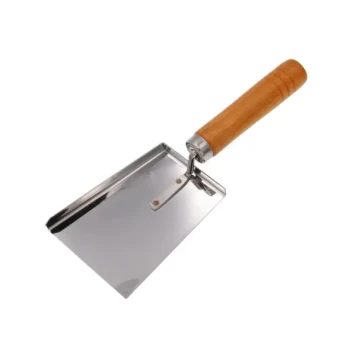
- Stainless Steel Pollen Shovel with Wooden Handle
People Also Ask
- What are the design principles and advantages of pollen traps in the collection of bee pollen? Boost Your Apiary Yield
- What is the function of professional pollen traps in evaluating honey plants? Quantifying Pollination and Crop Potential
- What functions do pollen traps serve for bee bread production? Optimize Your Raw Material Collection
- What maintenance and pest prevention measures should be taken for pollen traps? Protect Your Hive and Harvest Quality
- How does the use of pollen traps in honeybee hives enhance crop fertilization? Boost Your Yield Through Induced Activity