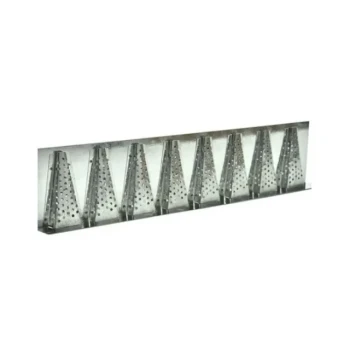
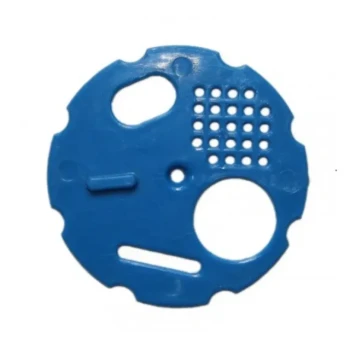
An entrance reducer provides three distinct configurations for managing hive access in standard 8 or 10-frame Langstroth hives. Specifically, it offers a very small opening, a medium opening, or the option to remove the reducer entirely to utilize the full width of the hive entrance.
By adjusting the physical size of the entrance, you effectively regulate the colony's ability to defend itself and control internal temperature. The reducer is not just a barrier; it is a throttle for hive traffic and ventilation.
Detailed Breakdown of Entrance Options
The entrance reducer is a simple but critical component of the modular Langstroth hive design. It typically fits between the bottom board and the first brood box.
The Very Small Opening
This setting creates the most restricted access point for the colony. It is generally a notch cut into the wood stick that allows only a few bees to pass at a time.
This configuration is primarily used when the colony is at its most vulnerable. It minimizes the area that guard bees must defend against robbers or pests.
The Medium Opening
By rotating the reducer, you can expose a wider notch. This creates a medium-sized entrance that allows for increased traffic flow while still maintaining a defensible perimeter.
This option serves as a transition stage. It is ideal for a growing colony that has expanded beyond the need for maximum restriction but is not yet strong enough to defend a wide-open front.
The Full-Sized Entrance (Reducer Removal)
The third option is achieved by removing the reducer entirely. This opens the entrance to the full width of the bottom board.
This configuration provides maximum ventilation and unimpeded access. It is reserved for strong, established colonies with high foraging activity that require the ability to move large numbers of foragers in and out without congestion.
Understanding the Trade-offs
While the reducer is a simple tool, using the wrong setting for the current hive conditions can have negative consequences.
Congestion vs. Ventilation
A common pitfall is leaving the reducer on the smallest setting during a heavy nectar flow. This causes traffic jams at the entrance, slowing down foraging efficiency and potentially causing the hive to overheat.
Conversely, removing the reducer too early can expose the hive to excessive drafts. In cooler climates or seasons, a wide-open entrance makes it difficult for the cluster to maintain the necessary brood temperature.
Defense vs. Accessibility
A full entrance maximizes accessibility but weakens defense. If a colony is weak or there is a dearth of nectar in the area, a wide-open entrance invites robbing from other hives or wasps.
The very small opening offers maximum security but limits the colony's ability to dry nectar and cure honey efficiently due to reduced airflow.
Making the Right Choice for Your Colony
Selecting the correct entrance size depends on the immediate strength of your colony and the environmental conditions.
- If your primary focus is establishing a new package or nucleus colony: Use the very small opening to help the small population defend their new home.
- If your primary focus is winterizing the hive: Use the very small opening (or a dedicated mouse guard) to exclude pests and reduce cold drafts.
- If your primary focus is maximizing production during a honey flow: Remove the reducer entirely to eliminate traffic congestion and aid in ventilation for honey curing.
Properly managing these three states ensures your colony balances defense with productivity.
Summary Table:
| Entrance Option | Opening Size | Primary Use Case | Key Benefit |
|---|---|---|---|
| Small Notch | Minimum (Very Small) | New packages, nucs, or wintering | Maximum defense and heat retention |
| Medium Notch | Intermediate (Medium) | Growing colonies in transition | Balances traffic flow with security |
| No Reducer | Full Width | Strong colonies during honey flow | Maximum ventilation and foraging efficiency |
Scaling Your Apiary Operations with HONESTBEE
Managing hive health starts with the right equipment. At HONESTBEE, we specialize in supporting commercial apiaries and distributors with high-quality, wholesale beekeeping solutions. Whether you need precision-cut entrance reducers, durable Langstroth hive components, or advanced honey-filling machinery, our comprehensive portfolio is designed to enhance your productivity.
Why partner with HONESTBEE?
- Wholesale Excellence: Full spectrum of beekeeping tools and industry consumables.
- Specialized Hardware: From hive-making machines to honey-themed cultural merchandise.
- Targeted Support: Tailored offerings specifically for large-scale operations and retail distributors.
Ready to elevate your beekeeping business? Contact us today to explore our wholesale catalog and discover how we can streamline your supply chain!
Related Products
- Beehive Entrance Reducer Guardian Metal Hive Entrance for Bees
- Steel Round Disc Entrance Reducer for Flexzion Bee Hive Nuc Box Gate
- Ergonomic Two Person Foldable Hive Lifter
- Langstroth Screen Bottom Board for Beekeeping Wholesale
- White Plastic 0.5L Beekeeping Entrance Feeder for Bees
People Also Ask
- Why are entrance reducers used to counter hornet infestations? Protect Your Hive with Strategic Choke Points
- What is the purpose of an entrance reducer for a beehive? Strengthen Colony Defense and Prevent Robbery
- What are the proper guidelines for using hive entrance reducers? Master Temperature Control & Colony Defense
- Why is it critical to maintain a smaller entrance for a newly established bee hive? Boost Colony Growth and Security
- What is the physical mechanism behind the use of hive entrance reducers? Protect Your Bees from Vespa velutina