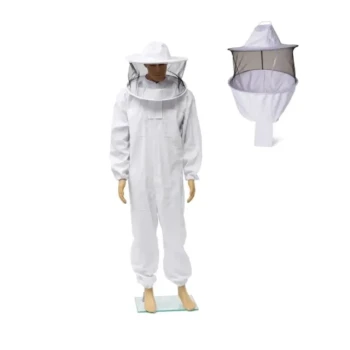
Ensuring a complete seal is the absolute priority when donning an observation veil. Whether your equipment uses a zipper attachment or a hooded design, you must verify that the connection between the veil and your clothing is unbroken to prevent bee ingress.
Even high-quality protective gear is compromised if gaps exist. The primary safety objective is to eliminate any opening that would allow a bee to slip inside the veil and sting vulnerable areas like the face or neck.
The Mechanics of Veil Safety
The Critical Inspection Point
The most common point of failure in beekeeping PPE is not the mesh itself, but the attachment zone.
You must inspect the interface where the veil meets the suit or hat. This is often a zipper, but it can also be an elastic band or drawstring depending on the model.
Why Small Gaps Matter
Bees are adept at crawling into tight spaces.
If there is a misalignment in the zipper or a fold in the fabric that creates a tunnel, a bee can enter the interior of the veil. Once inside, the risk of a sting to the face or neck increases dramatically.
Common Pitfalls to Avoid
The False Sense of Security
Do not assume that simply zipping up the veil guarantees safety.
Zippers can separate slightly at the ends, or Velcro flaps may not overlap completely. A visual and tactile check is required every time you suit up.
Rushing the Process
The trade-off for speed is often safety.
Rushing to put on gear frequently leads to overlooked gaps. It is better to spend an extra thirty seconds verifying your seal than to manage a bee inside your headgear during an inspection.
Making the Right Choice for Your Safety
Consistent safety relies on habit, not just equipment.
- If your primary focus is absolute protection: Run your finger along the entire length of the zipper or seal to ensure it is fully engaged with no fabric folds.
- If your primary focus is workflow efficiency: Incorporate a "buddy check" or use a mirror to quickly verify the seal behind your head before approaching the hive.
Treat the veil attachment as your primary line of defense against stings.
Summary Table:
| Safety Checkpoint | Key Action Required | Why It Matters |
|---|---|---|
| Attachment Zone | Inspect zippers, Velcro, or elastic bands for gaps | Most common failure point for bee ingress |
| Fabric Integrity | Check for folds or tunnels near the seal | Small openings allow bees to crawl inside |
| Mechanical Check | Run a finger along the entire length of the seal | Ensures the zipper is fully engaged and secure |
| Visual Verification | Perform a buddy check or use a mirror | Confirms areas you cannot see are fully protected |
Secure Your Apiary Success with HONESTBEE
Protecting your team starts with professional-grade gear. At HONESTBEE, we specialize in supporting commercial apiaries and distributors with a comprehensive wholesale selection of high-quality beekeeping tools and machinery. From secure protective veils to advanced honey-filling machines and hive-making equipment, our portfolio is designed to enhance your efficiency and safety.
Why partner with HONESTBEE?
- Full Spectrum Supply: Everything from hardware and consumables to honey-themed cultural merchandise.
- Built for Professionals: Our equipment is engineered to withstand the demands of large-scale operations.
- Global Distribution: Reliable wholesale solutions tailored to your business needs.
Ready to upgrade your equipment or restock your inventory? Contact us today to discuss your wholesale needs!
Related Products
- Premium Cowboy Beekeeper Hat with Visibility Veil Outdoor Professional Beekeeping Protective Gear
- Professional Square Folding Wire Mesh Beekeeping Veil
- Acrylic Lid Beekeeping Honey Extractor for Beekeepers
- Professional Beekeeper Suit with Square Folding Cotton Veil
- Professional Cotton Beekeeper Suit with Round Veil Design for Commercial Apiaries
People Also Ask
- What design features contribute to the stability and fit of the beekeeper hat? Key Features for Maximum Hive Safety
- How is the beekeeper hat designed for comfort and practicality? Explore Key Features for Enhanced Apiary Safety
- What is the general protective gear recommendation for new beekeepers? Your Essential Beginner's Safety Guide
- How does beekeeping protective gear facilitate the queen bee selection process? Enhancing Precision in Queen Breeding
- What should beekeepers consider when choosing protective gear? A Guide for Maximum Safety & Comfort