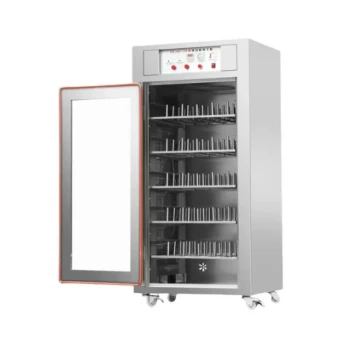
The critical role of a vacuum freeze dryer in the production of drone larvae powder (Apilarnil) is to stabilize the product by removing moisture in a controlled, low-temperature vacuum environment. This specific mechanism is the only effective way to convert the biologically active larval homogenate into a powder without destroying its delicate nutritional profile.
Core Takeaway: The vacuum freeze dryer serves as the essential preservation step that locks in the bioactivity released during processing. It solves the stabilization paradox: removing water to prevent spoilage while maintaining low temperatures to save enzymes and hormones that would be destroyed by heat.
Preserving Bioactive Integrity
Protecting Heat-Sensitive Components
The primary value of the vacuum freeze dryer is its ability to operate without high heat. Drone larvae are rich in heat-sensitive bioactive components, including proteins, vitamins, enzymes, and hormones.
Conventional drying methods utilize heat which causes rapid denaturation of these components. Vacuum freeze drying preserves the biological activity of these nutrients, ensuring the final powder retains the therapeutic properties of the raw larvae.
Stabilizing the Homogenate
Before drying, larvae are processed through high-energy grinding and homogenization to create a viscous liquid. This physical process disrupts tissue structures to release internal nutrients like amino acids.
The vacuum freeze dryer acts immediately on this exposed, vulnerable state. It stabilizes the "released" nutrients found in the uniform consistency of the liquid, preventing them from degrading due to oxidation or environmental exposure.
Extending Shelf Life and Safety
Inhibiting Microbial Growth
Raw drone larvae are highly susceptible to spoilage. The vacuum freeze drying process removes the moisture content required for biological activity.
By eliminating this moisture, the equipment significantly inhibits the growth of microorganisms and fungi. This creates a shelf-stable product that does not require chemical preservatives to remain safe for consumption.
Ensuring Physicochemical Stability
Beyond simple preservation, the process maintains the product's physicochemical properties. It ensures that the powder's composition remains consistent over time.
This stability is vital for standardization, allowing the final product to deliver a reliable nutrient profile comparable to the fresh larval state.
Common Pitfalls in Stabilization
The Cost of Conventional Drying
It is a common error to attempt stabilization using standard thermal drying techniques to save time or resources.
The primary reference explicitly notes that compared to vacuum freeze drying, conventional methods lead to nutrient degradation. While the product may appear dry, the heat will have rendered the enzymes and hormones inactive, defeating the purpose of the supplement.
Making the Right Choice for Your Goal
To maximize the quality of your Apilarnil product, align your processing method with your specific preservation targets:
- If your primary focus is Bioactivity: Prioritize vacuum freeze drying to protect heat-sensitive hormones and enzymes released during the homogenization phase.
- If your primary focus is Safety: Utilize the vacuum environment to inhibit fungal and microbial growth without resorting to chemical additives.
- If your primary focus is Consistency: Rely on this method to lock in the physicochemical properties of the viscous liquid, ensuring every batch has a uniform composition.
By utilizing a vacuum freeze dryer, you transform a perishable biological material into a potent, stable, and distinctively high-quality nutritional ingredient.
Summary Table:
| Feature | Vacuum Freeze Drying | Conventional Heat Drying |
|---|---|---|
| Temperature | Low-temperature vacuum | High heat exposure |
| Bioactivity | Preserves hormones & enzymes | Denatures proteins & nutrients |
| Consistency | Stable physicochemical properties | Likely nutrient degradation |
| Shelf Life | Long-term microbial inhibition | High risk of spoilage |
| Product Quality | High-potency Apilarnil powder | Low-grade byproduct |
Elevate Your Beekeeping Production with HONESTBEE
Are you looking to scale your production of high-quality Apilarnil? HONESTBEE specializes in supporting commercial apiaries and distributors with premium wholesale solutions. From high-precision vacuum freeze dryers and honey-filling machines to advanced beekeeping tools and hardware, we provide the industrial machinery and consumables you need to succeed.
Why partner with us?
- Comprehensive Inventory: Access a full spectrum of specialized apiculture equipment.
- Scalable Solutions: We cater to the unique demands of global distributors and large-scale honey producers.
- Quality Guarantee: Our tools are designed to maximize the bioactivity and market value of your products.
Ready to enhance your efficiency and product quality? Contact HONESTBEE today to discuss how our specialized machinery can transform your commercial beekeeping operations.
References
- Sibel Sılıcı. Drone Larvae Homogenate (Apilarnil) as Natural Remedy: Scientific Review. DOI: 10.15832/ankutbd.1293015
This article is also based on technical information from HonestBee Knowledge Base .
Related Products
- 0.5T Capacity Honey Dehumidifier Dryer with Vacuum Heating and Thickening Filtering Machine
- HONESTBEE Professional Cabinet Bottle Dryer
People Also Ask
- What is the primary function of professional dehumidification equipment in honey processing? Stability & Quality
- How to dry up honey? The Safe Guide to Stabilizing Honey and Preventing Fermentation
- What is the process for using a dehumidifier to lower honey's moisture content? Expert Drying Techniques
- How to decrease moisture in honey? Prevent Fermentation and Ensure Long-Term Quality
- How to remove humidity from honey? Protect Your Harvest from Fermentation