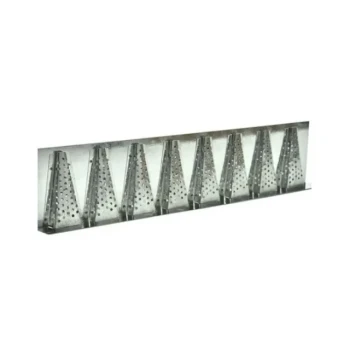
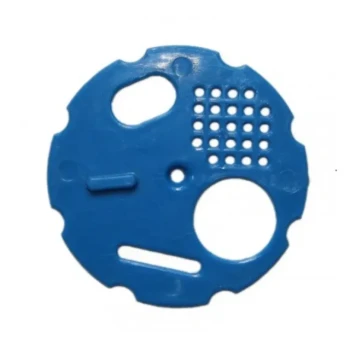
The governing design principle of this entrance reducer is biomimicry rooted in biological research. The dimensions are not arbitrary; they are engineered to strictly replicate the entrance size preferred by wild honey bee colonies in nature. This approach aims to align hive hardware with the bees' innate instincts rather than forcing the colony to adapt to artificial constraints.
By adopting the precise dimensions found in natural wild nests, this reducer allows beekeepers to leverage the bees' evolutionary history, creating a management system that works in harmony with the colony’s natural defensive and thermoregulatory behaviors.
The Science of Natural Entrances
Research-Based Dimensions
Standard beekeeping equipment often utilizes entrance sizes based on wood cuts or manufacturing convenience.
In contrast, this specific reducer is designed using empirical research into the nesting habits of wild bees. It prioritizes biological data over manufacturing tradition to determine the optimal opening.
Supporting Natural Instincts
Honey bees have evolved over millions of years to select nest sites with specific characteristics that maximize their survival.
By matching the entrance size to these natural preferences, the equipment supports the colony's instinctive behaviors regarding defense and traffic flow. This reduces the friction between the bees' biological needs and the man-made environment of the apiary.
Understanding the Trade-offs
Specificity vs. Adaptability
While a biologically accurate entrance is beneficial for the majority of the season, it is a fixed dimension.
In scenarios requiring extreme ventilation or massive traffic flow (such as during an exceptionally heavy nectar flow), a fixed natural size may offer less flexibility than fully adjustable or removable reducers.
Standardization Limits
Research on "wild bees" often yields an average or an optimal range, but individual colonies or subspecies may vary slightly in their preference.
Relying on a single "perfect" size assumes a level of uniformity in bee behavior that may not account for local environmental variances or specific genetic ecotypes.
Making the Right Choice for Your Goal
To determine if this research-based design aligns with your management style, consider your primary objectives:
- If your primary focus is Natural Beekeeping: This reducer is the ideal choice as it minimizes artificial interference and respects the colony's evolutionary adaptations.
- If your primary focus is High-Production Management: You should monitor the entrance during peak flows to ensure the natural size does not become a bottleneck for heavy foraging traffic.
Aligning your equipment with bee biology transforms hive management from a struggle for control into a partnership with your colony.
Summary Table:
| Design Feature | Biomimetic Approach | Traditional Approach |
|---|---|---|
| Sourcing | Empirical research on wild bee nests | Manufacturing & wood-cut convenience |
| Primary Goal | Alignment with evolutionary instincts | Human ease of use and adaptability |
| Behaviors Supported | Natural defense & thermoregulation | Maximum airflow & high-traffic foraging |
| Best Use Case | Natural beekeeping & colony health | High-production commercial management |
Elevate Your Apiary with Research-Driven Equipment
At HONESTBEE, we understand that commercial success in beekeeping starts with respecting bee biology. Whether you are managing a large-scale commercial apiary or supplying the next generation of beekeepers as a distributor, our products bridge the gap between innovation and instinct.
From our biomimetic metal entrance reducers to advanced honey-filling machines and specialized hive-making hardware, we offer a comprehensive wholesale portfolio designed for durability and performance. Partner with us to provide your customers with the high-quality tools, machinery, and industry consumables they need to thrive.
Contact HONESTBEE today to discuss our wholesale offerings and equipment solutions!
Related Products
- Beehive Entrance Reducer Guardian Metal Hive Entrance for Bees
- Steel Round Disc Entrance Reducer for Flexzion Bee Hive Nuc Box Gate
- 8-Cone Galvanized Steel Bee Robber Guard
- Professional Hive Front Entrance Bee Feeder
- Multi-Functional Rotary Hive Entrance Disc for Beekeeping
People Also Ask
- Why are entrance reducers used to counter hornet infestations? Protect Your Hive with Strategic Choke Points
- What is the purpose of an entrance reducer for a beehive? Strengthen Colony Defense and Prevent Robbery
- What are the proper guidelines for using hive entrance reducers? Master Temperature Control & Colony Defense
- Why is it critical to maintain a smaller entrance for a newly established bee hive? Boost Colony Growth and Security
- What is the physical mechanism behind the use of hive entrance reducers? Protect Your Bees from Vespa velutina