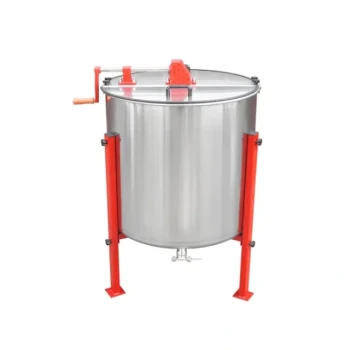
The primary function of a manual honey presser is to mechanically separate liquid honey from solid wax residue through physical compression. Specifically designed for the unique challenges of traditional beehives, this tool performs the essential initial separation of the harvest, isolating the honey while preserving the byproduct known as "Sefef" (wax residue) for further processing.
The manual presser acts as the bridge between raw harvest and usable products. By compressing the mixture, it efficiently extracts crude honey while consolidating wax residue, serving as the foundational step for both honey clarity and commercial wax production.
The Mechanics of Separation
Applying Physical Compression
Unlike modern extraction methods that spin honey out of frames, traditional hives often require the entire honeycomb to be crushed. The manual presser applies direct force to this mixture. This pressure breaks down the structural integrity of the comb, forcing the liquid honey out while retaining the solid matter.
Handling Traditional Hive Harvests
Harvests from traditional hives are typically a mash of honey, wax, and pollen. The presser allows for the processing of these small, irregular quantities of comb at one time. It transforms a complex mixture into two distinct raw materials: crude honey and crude wax.
The Role in Wax Production
Isolating "Sefef" (Wax Residue)
The solid material left behind after pressing is not waste; it is a valuable raw material often referred to as Sefef. The presser ensures this residue is separated from the liquid honey, creating a concentrated mass of wax.
Preparation for Industrial Application
Once the honey is removed, the remaining wax residue is ready for secondary processing. Because the presser removes the bulk of the liquid, the Sefef can be easily cleaned, heated, and molded into blocks. This crude wax serves as the input for various industrial and commercial applications.
Enhancing Honey Clarity
Removing Macro Impurities
The pressing process acts as a preliminary filter. It holds back significant solid impurities such as wax debris, large bee fragments, and other physical residues found in traditional hives.
Establishing a Quality Baseline
By removing the bulk of the solids, the presser ensures the collected raw honey achieves high physical clarity. This establishes a "clean baseline," making subsequent steps—such as fine laboratory-grade filtration or physicochemical analysis—significantly more effective.
Understanding the Trade-offs
Manual Effort and Scale
As implied by the name, this equipment relies on manual operation. While it is easy to operate and effective for small quantities, it is labor-intensive compared to automated systems. It is best suited for targeted, high-quality extraction rather than mass industrial throughput.
Preliminary vs. Final Filtration
While the presser removes bulk solids, it is not a substitute for fine filtration. It creates crude honey and wax. For pharmaceutical or high-grade commercial standards, both the honey and the wax will require further purification steps after leaving the press.
Making the Right Choice for Your Goal
To maximize the utility of a manual honey presser, align its use with your specific processing objectives:
- If your primary focus is Wax Production: Prioritize the compression strength of the press to extract every drop of honey, leaving the driest possible Sefef for efficient molding.
- If your primary focus is Honey Quality: Use the press to remove bulk debris quickly, ensuring you move the semi-clean honey to fine filtration screens immediately to prevent oxidation.
Ultimately, the manual presser is the critical "first pass" tool that transforms a raw, traditional harvest into manageable, separate resources.
Summary Table:
| Feature | Function & Impact |
|---|---|
| Primary Mechanism | Physical compression to break combs and release liquid honey |
| Output Materials | Crude liquid honey and solid wax residue (Sefef) |
| Wax Processing | Consolidates wax for easier cleaning, heating, and molding |
| Honey Quality | Removes macro impurities like wax debris and bee fragments |
| Ideal Use Case | Small-scale traditional hive harvests and high-quality wax production |
Elevate Your Apiary Production with HONESTBEE Solutions
Are you looking to maximize the value of your honey and wax harvests? HONESTBEE specializes in supporting commercial apiaries and distributors with high-performance beekeeping tools and machinery.
Whether you need robust manual honey pressers, advanced honey-filling machines, or specialized hive-making equipment, we provide the full spectrum of hardware and essential consumables to scale your operations. From raw harvest processing to honey-themed cultural merchandise, our comprehensive wholesale offerings are designed to enhance your efficiency and product quality.
Ready to optimize your beekeeping business? Contact HONESTBEE Today to Discuss Your Wholesale Needs
References
- Tesfu Shegaw, Desalegne Begna. Assessment on Beeswax Production, Processing and Marketing in Selected Districts of Kafa Zone, Southern Nations Nationalities and Peoples Region (SNNPR), Ethiopia. DOI: 10.7176/fsqm/119-03
This article is also based on technical information from HonestBee Knowledge Base .
Related Products
- Stainless Steel Manual Honey Press with Guard for Pressing Honey and Wax
- Easy Use Manual Stainless Steel Honey Press for Honey Comb
- Manual Honey Filling Machine Bottling Machine for Honey
- HONESTBEE 3-Frame Manual Acrylic Honey Extractor
- Stainless Steel 3 Frame Manual Honey Extractor Spinner for Bee Honey Extraction
People Also Ask
- What other functions can a honey press serve besides honey extraction? Discover Versatile Multi-Purpose Uses
- How does the honey press preserve the quality of honey during extraction? Maintain Pure Enzymes and Flavor
- What materials are used to construct the honey press? Choose Durable, Food-Grade Solutions for Your Apiary
- What are the fundamental differences between manual honey presses and centrifugal honey extractors? A Guide for Pros
- What are some general features of a honey press? Maximize Your Yield with Durable Extraction Tools